Punyavachanam & Namakaranam
A Baby's First Blessings and the Name That Becomes a Lifetime
FROM CRADLE TO KASHI • 02/36
The Lifetime Journey of an Iyer Mama & Mami
A few days ago, everyone simply called the newest member of the family “the baby.”
“Has the baby slept?”
“Did the baby drink milk?”
“Who is holding the baby?”
“Don't wake the baby!”
But very soon, those three words will be replaced by something that may stay with this little person for an entire lifetime.
A name.
Before we reach that beautiful moment, however, the Iyer household begins preparing for another important family observance.
Punyavachanam.
The home that has spent the last few days adjusting to feeding times, sleepless nights, visiting relatives and whispered conversations around a sleeping newborn now begins preparing for prayer, purification and blessings.
Another small step in the child's journey is about to begin.
The House Feels Different Today
Morning arrives earlier than usual.
Someone has already cleaned the entrance.
A fresh kolam appears outside the home.
The pooja area is prepared.
Flowers have arrived.
Banana leaves, fruits, coconuts and other items required according to the family's practice are being arranged.
The Vadhyar is expected.
Thatha has already asked twice whether everything is ready.
Patti says it is.
Then checks everything again anyway.
Inside another room, the baby's Amma is getting ready slowly.
Life has changed enormously in just a few days.
Until recently, everybody was looking after her because she was expecting a child.
Now there is a tiny person beside her whom everyone wants to hold.
What Is Punyavachanam?
In many traditional Hindu households, Punyavachanam is associated with ritual purification and auspiciousness and is performed on important family occasions.
Following childbirth, Iyer families may observe Punyavachanam according to their particular family custom and the guidance of their Vadhyar.
Sacred water is prepared and sanctified through mantras and ritual procedures, and the ceremony marks an important transition for the household after the birth.
The exact procedure and timing should not be assumed to be identical in every family.
Customs may differ according to family tradition, Veda shakha, region and circumstances.
And this is something we will repeat throughout our journey:
Tradition has a framework, but families also carry their own inherited ways of observing it.
Patti Knows Where Everything Is
There is often one person at a family ceremony who seems to know where absolutely everything should go.
Today, that person is Patti.
Someone asks for turmeric.
Patti knows where it is.
Someone wants an extra plate.
Ask Patti.
Where are the flowers?
Patti already arranged them.
Where is the baby's new dress?
She knows that too.
Years ago, Patti may have stood in another house watching her mother or mother-in-law organise similar ceremonies.
At the time, perhaps she simply followed instructions.
Now everyone is asking her.
This is how knowledge moves through a family.
Not always through books.
Often through observation.
Madisar Is More Than Festive Clothing
For an important traditional family occasion, the sight of women in Madisar sarees immediately changes the atmosphere.
The nine-yard drape doesn't merely make the occasion look traditional.
For many families, it belongs naturally within the visual memory of such gatherings, where appropriate to their custom.
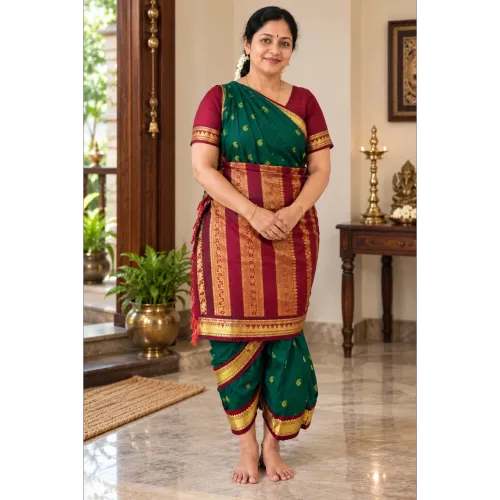
Perhaps Patti chooses a deep maroon Madisar with a traditional gold border.
Perhaps another Mami arrives in green with a contrasting pallu.
Jasmine is tucked into neatly tied hair.
Kumkum appears on foreheads.
Gold bangles make their familiar sound as women move between the kitchen, pooja area and baby's room.
The child understands none of this.
But photographs are being created that the child may look at decades later.
And What About Mama and Panchakacham?
For ceremonies where the family's practice calls for it, the men may wear traditional veshti or Panchakacham.
There is a visual dignity to seeing generations dressed for a family ritual.
Thatha in traditional attire.
The baby's father participating in the ceremony.
Other Mamas helping with arrangements.
A young boy watching all of them.
That boy may not realise it yet, but years later he may stand in exactly the same position his father occupies today.
Again, tradition teaches through observation.
Then Comes the Question Everyone Has Been Discussing
What are we going to name the baby?
The discussion may have started months before the child was born.
Amma has her favourites.
Appa has his.
Patti has suggestions.
Thatha has suggestions.
The other grandparents have suggestions too.
Then come suggestions from Mamas, Mamis, Chithis, Chithappas, Athais and practically anyone who has access to the family WhatsApp group.
One name sounds beautiful but is apparently too long.
Another is traditional but Amma isn't convinced.
A third is modern, but Thatha asks:
“What does it mean?”
Suddenly choosing a name feels like negotiating an international agreement.
Namakaranam — More Than Choosing Something That Sounds Nice
Namakaranam is the traditional naming ceremony of the child.
A name can carry several layers of meaning.
Some families look toward the child's Nakshatra and the traditionally associated starting sounds.
Some remember grandparents or ancestors.
Some choose names connected with their Kula Deivam or another deity deeply important to the family.
Some choose names from Sanskrit or Tamil traditions.
And today's parents may also think about something earlier generations rarely needed to consider:
Will people pronounce this name correctly if the child grows up abroad?
That single question says something fascinating about modern Iyer families.
Tradition hasn't necessarily disappeared.
It has travelled.
A Name Can Carry a Family Story
Imagine Thatha suggesting a particular name.
Everyone assumes he simply likes it.
Then he explains.
It belonged to his grandfather.
Suddenly the conversation changes.
The child being named today may never have met that ancestor.
There may only be one faded black-and-white photograph left.
But a name can cross that distance.
This doesn't mean every child must be named after an ancestor.
It simply shows how naming can connect generations in ways we don't immediately notice.
The Moment the Name Is Spoken
Eventually, after all the discussions, lists and opinions, the family arrives at a name.
During Namakaranam, the name is ceremonially given according to the family's traditional procedure.
And then something surprisingly emotional happens.
Until that morning, everyone had been saying:
“the baby.”
Now Patti looks into the cradle and uses the child's name.
For the first time.
Appa says it.
Amma says it.
Thatha repeats it with approval.
Relatives begin using it.
Within hours, it sounds as though the child had always been called that.
The Cradle Is Waiting
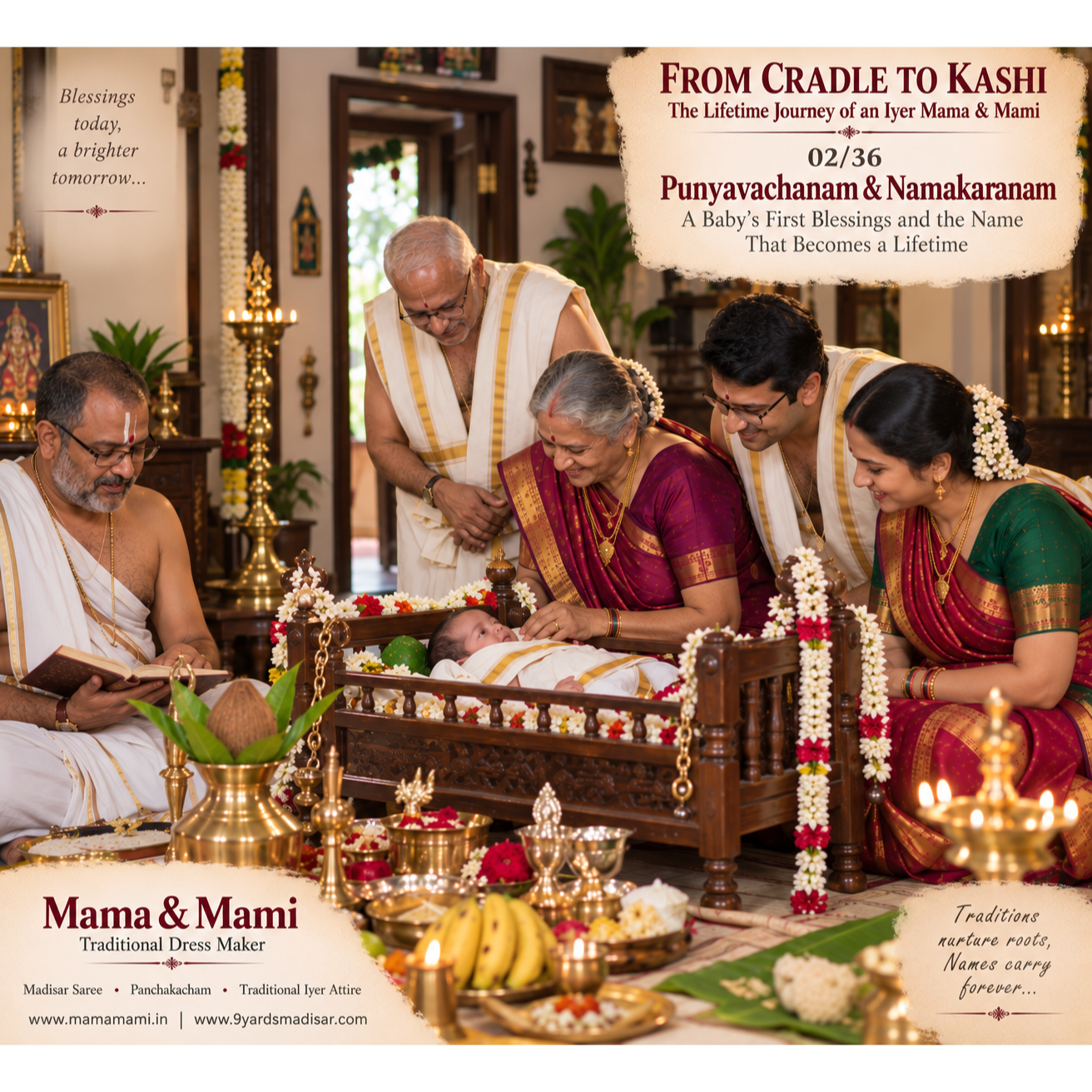
Nearby, the cradle is ready.
Perhaps it is a beautiful traditional wooden cradle that has already held other children in the family.
Perhaps it is new.
Perhaps grandparents had it made especially for this baby.
Flowers decorate it.
Someone adjusts the bedding.
Someone else says the baby is sleeping and should not be disturbed.
Patti ignores this because she has been waiting to hold the child all morning.
The atmosphere is no longer merely ceremonial.
It is joyful.
And this takes us naturally toward the next chapter of our journey:
Thottil Vizha.
Look Carefully at the Family Photograph
Before everyone leaves, someone calls the family together.
“Photo! Photo!”
Immediately, half the people disappear to adjust their hair.
Eventually everyone gathers.
At the centre is the baby.
Amma and Appa beside the child.
Patti in her Madisar.
Thatha in traditional attire.
Mamas and Mamis surrounding them.
Perhaps brothers, sisters and cousins are trying to squeeze into the frame.
Someone is looking in the wrong direction.
Someone's eyes are closed.
The baby may start crying exactly when the photograph is taken.
At that moment, it feels like an imperfect family photograph.
Twenty-five years later, it may be priceless.
Because the Clothes Will Change
The baby's tiny clothes will disappear into a cupboard.
The young parents will grow older.
Patti's Madisar may eventually be folded and passed to her daughter.
Thatha's Panchakacham may become part of the grandchildren's memories of him.
The house itself may change.
People may move to different cities and countries.
But the photograph remains.
And so does the name spoken for the first time that day.
One More Step on a Much Longer Journey
Our child now has a name.
The family has prayed.
The elders have blessed the newest generation.
But childhood has only just begun.
Soon there will be a cradle ceremony.
Then the first food.
The first birthday and Ayushya Homam.
Mottai.
Kaathu Kuthal.
Kula Deivam Darisanam.
Aksharabhyasam.
School.
Festivals.
Patti's stories.
Thatha's lessons.
And eventually, the little person lying peacefully in the cradle today will begin asking:
“Why do we do this?”
That may be the most important question of this entire 36-part journey.
Because traditions don't survive simply because somebody tells the next generation to follow them.
They survive when someone takes the time to explain why they mattered to the generations before us.
Today, however, nobody is asking complicated questions.
Everyone is looking at the cradle.
And calling the baby by a name.
For the very first time.
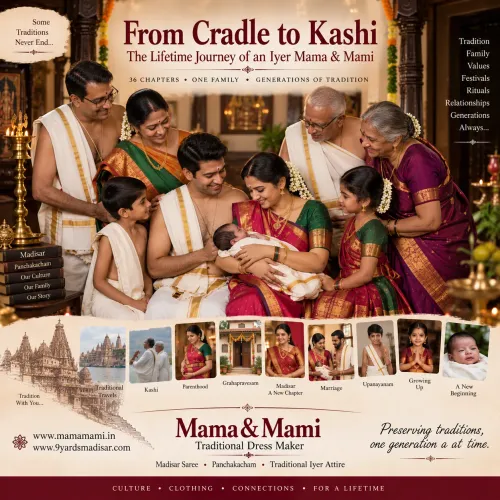
FROM CRADLE TO KASHI • 02/36
The Lifetime Journey of an Iyer Mama & Mami
Previous — 01/36:
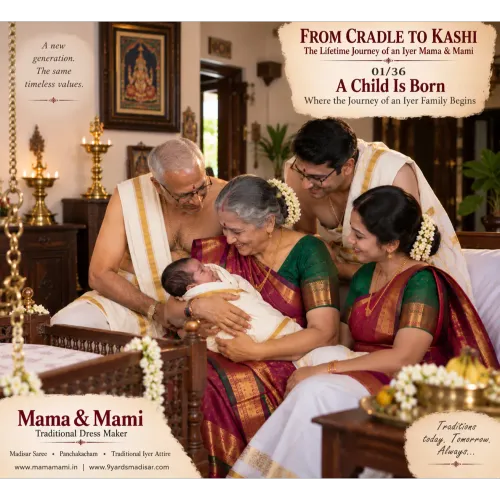
A Child Is Born: Where the Journey of an Iyer Family Begins
Next — 03/36:
Thottil Vizha: The Cradle, the Lullabies and a Home Filled With Happiness
Mama & Mami – Traditional Dress Maker
Preserving traditions, one generation at a time.
Madisar Saree • Panchakacham • Traditional Iyer Attire