FROM CRADLE TO KASHI — 16/36
The Newly Married Couple's First Steps
Grihapravesam, Welcoming the New Mami & Beginning Married Life
The Lifetime Journey of an Iyer Mama & Mami
The wedding is over.
The sacred Muhurtham has been completed.
The Mangalyam has been tied.
The seven steps of Saptapadi have been taken.
The blessings of Patti, Thatha, Appa, Amma and all the elders have been received.
The Nadaswaram has gradually become silent.
The wedding guests are returning home.
The beautiful flower decorations are being removed from the marriage hall.
And somewhere, a tired bridegroom is finally sitting down after two days of ceremonies.
But the bride?
She is experiencing a mixture of emotions.
Happiness.
Excitement.
Nervousness.
And perhaps a few tears.
Because today, she is leaving the familiar surroundings of her childhood home to begin a new chapter of married life.
Yesterday, she was a bride. Today, she begins her journey as a new Mami.
And the groom, who was once the little boy of our earlier chapters, is now taking his first steps as a husband.
Welcome to Chapter 16 of our journey.
1. The Morning After the Wedding
The marriage hall feels different today.
Yesterday, everyone was rushing.
“Where is the groom?”
“Has the bride changed her saree?”
“Is the Vadhyar ready?”
“Where is the Mangalyam?”
“Has the photographer arrived?”
Today, the atmosphere is quieter.
Some relatives have already departed.
Others are packing their belongings.
Patti is carefully folding her Madisar.
Thatha is searching for his spectacles.
Appa is checking whether anything has been left behind.
Amma is making sure her daughter has packed everything.
And the newly married couple?
They are discovering that marriage begins with a very practical question.
“Where are we keeping all these bags?”
The laughter continues.
But underneath it, a meaningful change has taken place.
Two people who once lived separate lives are beginning to make decisions together.
2. Leaving the Bride's Home — An Emotional Moment
In families where the bride moves to the groom's household after marriage, leaving her parental home can be deeply emotional.
Amma has prepared everything.
Clothes.
Jewellery.
Personal belongings.
Traditional items.
Perhaps a few favourite homemade snacks.
Patti has added something extra.
“Take this also. You may need it.”
The bride smiles.
“Patti, I already have enough!”
But Patti insists.
Because grandmothers have a special talent for believing that one more item will always be useful.
Then comes the moment of departure.
The bride hugs Amma.
Appa stands nearby.
Her siblings smile, trying to keep the atmosphere cheerful.
And suddenly, the house that witnessed her childhood seems filled with memories.
The small girl who once ran through these rooms is now married.
But there is something important to remember.
Marriage does not mean a daughter stops belonging to her parents' family.
Her relationships with Amma, Appa, Patti and Thatha continue with the same affection.
She is not losing one family.
She is building another important relationship while remaining connected to the people who raised her.
3. Grihapravesam — Entering the Groom's Home
One of the cherished post-wedding customs in many Iyer families is the ceremonial welcome of the newly married couple into the groom's home.
This is commonly called Grihapravesam, or entering the house.
Here, we are discussing the newlyweds' welcome into their marital home.
The separate Grihapravesam ceremony associated with buying or moving into a new house will appear in a later chapter of our series.
The groom's home has been prepared.
A beautiful kolam decorates the entrance.
Mango leaves hang above the doorway.
Flowers have been arranged.
A brass kuthuvilakku is placed in an appropriate location.
The pooja room has been cleaned.
And the groom's mother is waiting to welcome the couple.
For her, this is a special day.
Her son has returned home.
But this time, he is not returning alone.
He is bringing his wife into the family.
4. The Mother-in-Law Welcomes the New Mami
The groom's mother stands near the entrance.
She is wearing a beautiful traditional Madisar.
Perhaps a bottle-green saree with a maroon zari pallu.
Her hair is decorated with jasmine.
A small kumkum pottu adorns her forehead.
She smiles as the couple approaches.
Depending on the family's customs, the welcome may include aarathi, auspicious offerings, prayers or other prescribed gestures.
The precise sequence varies between households.
The new Mami stands beside her husband.
Her mother-in-law welcomes her warmly.
“Vaa ma, ulle vaa.”
Come, dear. Come inside.
It is a simple sentence.
But those words can make a tremendous difference.
A young woman entering an unfamiliar household should feel respected and comfortable.
The most beautiful welcome is not the decoration at the entrance. It is the kindness shown to the person entering.
5. The First Step Across the Threshold
The couple stands at the doorway.
The new Mami looks at her husband.
He smiles reassuringly.
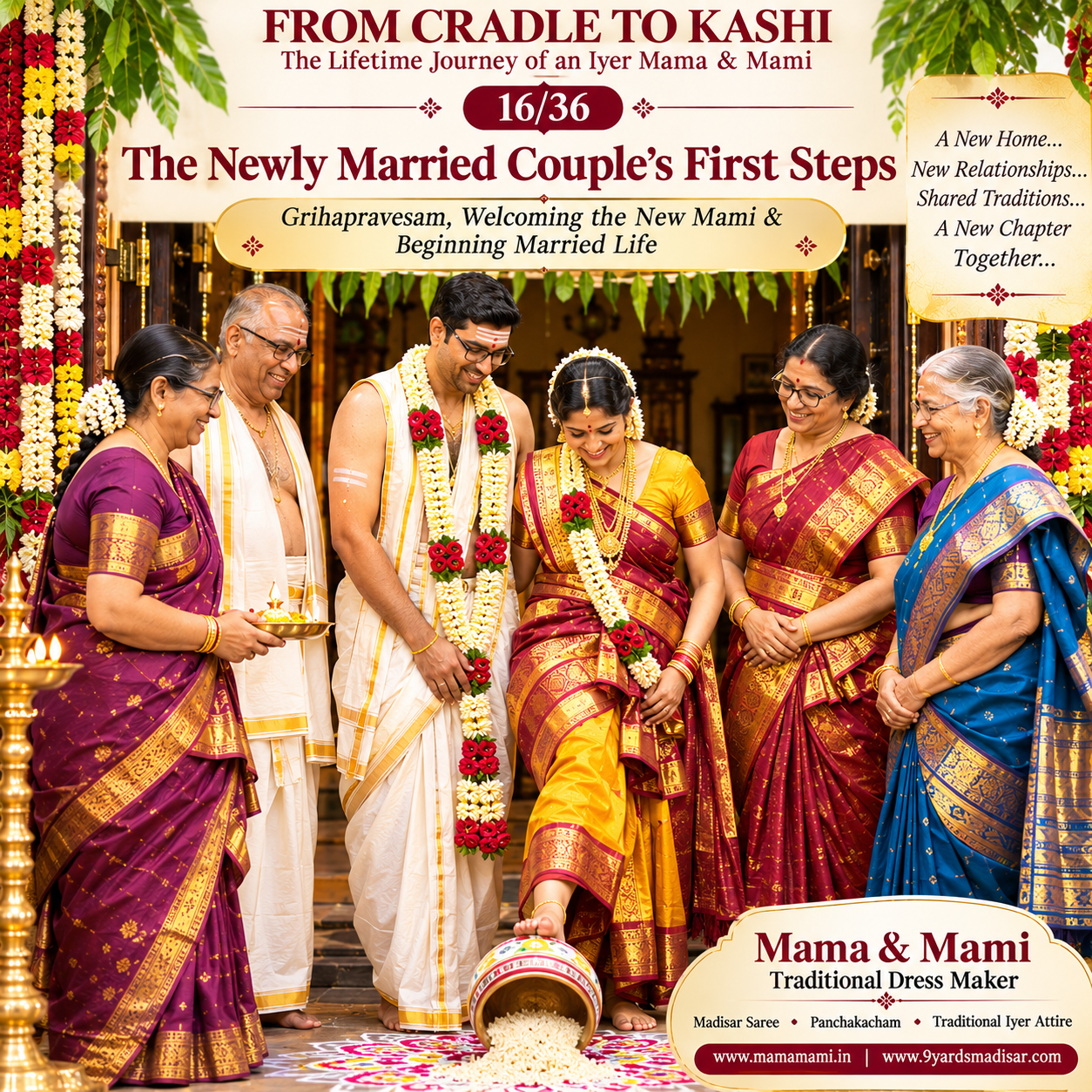
In some family traditions, the bride is guided to enter with her right foot first.
Other households observe different auspicious customs, including particular offerings or symbolic gestures.
The family's elders guide the procedure.
The new couple enters the house.
The relatives smile.
Someone takes a photograph.
Patti offers her blessings.
And the groom's mother looks at her daughter-in-law with happiness.
A new relationship has begun.
6. The Rice Pot — A Symbol of Prosperity
In some South Indian wedding customs, a vessel containing rice is associated with the ceremonial entry of the bride.
Where this custom is followed, the bride may gently move or tip the vessel as instructed by the elders.
Rice is traditionally associated with food, abundance and household well-being.
However, this is not a universal requirement of every Iyer Grihapravesam.
Some families follow it.
Others do not.
The particular procedure should always follow the family's own sampradayam.
What matters is the intention behind the welcome.
The family wishes the newly married couple a life filled with peace, nourishment, prosperity and happiness.
7. The First Visit to the Pooja Room
After entering the home, the couple may be guided to the family pooja room.
A small brass lamp is glowing.
The family deities are beautifully decorated.
Fresh flowers have been offered.
The fragrance of sandalwood and incense fills the room.
The groom's mother explains the family's customary worship.
The couple offers prayers according to tradition.
For the new Mami, this is an opportunity to learn about the spiritual practices of her husband's family.
Perhaps the family worships particular forms of Vishnu, Shiva, Ambal or other deities.
Perhaps they observe special Friday poojas.
Perhaps they have a long-established practice of visiting their Kula Deivam.
The new Mami listens with interest.
But it is equally important that her own family's traditions are respected.
Marriage should bring two sets of family customs into conversation, not require one person's heritage to disappear.
8. The First Meal in the New Home
After the welcome, everyone gathers for a meal.
The newly married couple is invited to sit.
The groom's mother has arranged their favourite dishes.
Perhaps there is paruppu, sambar, rasam, poriyal, appalam and payasam.
A relative asks the bride:
“Do you like this sambar?”
She smiles.
“Yes, Mami.”
The mother-in-law laughs.
“You can call me Amma if you are comfortable.”
The bride smiles again.
The groom looks relieved.
Because the first meal is going very well.
Then Patti asks the groom:
“Have you eaten properly?”
He has been married for barely a day.
But Patti's concern remains unchanged.
Some things never change!
9. The First Night in a New Home
When the celebrations end and the relatives settle down, the couple finally gets some quiet time.
For the bride, everything may feel unfamiliar.
The room.
The household routine.
The sounds of the neighbourhood.
The arrangements of the kitchen.
Even the place where drinking water is kept.
The groom notices.
“Are you comfortable?”
She smiles.
“A little nervous.”
He replies:
“Don't worry. We will figure everything out together.”
It may sound like an ordinary conversation.
But it contains one of the most important foundations of marriage.
A new home should become a shared space where both people feel safe, heard and respected.
10. The New Mami and Her First Madisar
Now comes a beautiful part of our traditional Iyer family journey.
The Madisar.
During important religious observances, many married Iyer women wear the traditional nine-yard saree according to their family custom.
The new Mami may already know how to wear it.
Perhaps Amma taught her before the wedding.
Perhaps she learned from Patti.
Or perhaps she is still learning.
One morning, the family is preparing for a pooja.
The new Mami takes out her beautiful nine-yard saree.
A rich arakku-red Madisar with traditional gold zari.
Her mother-in-law offers to help.
The saree is carefully arranged.
The cloth passes over the right shoulder.
The grand zari-rich section is displayed prominently across the front, moving from the left towards the right-hand side.
The waist is wrapped securely.
The lower portion is formed into the characteristic kacham.
The traditional construction is important.
It should not resemble an ordinary six-yard saree.
Finally, the new Mami looks in the mirror.
Her mother-in-law smiles.
“Romba nanna irukku.”
It looks very beautiful.
And for a moment, the young woman feels connected to generations of women who have worn the same traditional garment.
11. Madisar Is Not Just Wedding Clothing
The Madisar has a distinctive place in the clothing traditions of many Tamil Brahmin households.
Depending on family custom, it may be worn during important occasions such as weddings, Sumangali Prarthanai, religious poojas and other ceremonial observances.
Its nine-yard construction allows the characteristic traditional drape.
The fabric may be silk or cotton, depending on the occasion and preference.
Some women prefer rich zari Madisars for weddings.
Others prefer comfortable cotton Madisars for regular religious observances.
The colours vary beautifully.
Mango yellow and maroon.
Bottle green and arakku.
Royal blue and gold.
Traditional red.
Purple and mustard.
Every Madisar carries its own beauty.
But the most important thing is understanding how the garment is traditionally worn.
A beautifully woven Madisar deserves an equally authentic drape.
12. The Groom's Panchakacham
The groom also begins taking part in the religious and family observances of married life.
For appropriate ceremonies, he may wear traditional Panchakacham.
Appa may help him arrange it.
Thatha may explain a particular family practice.
The groom listens.
Perhaps he remembers wearing Panchakacham during his wedding.
Now it is becoming part of his life beyond the marriage hall.
Traditional attire is not simply for photographs.
It continues to have a place in the rituals and observances of the household.
And just as the new Mami learns about Madisar, the new Mama continues learning the responsibilities associated with family life.
13. Learning the Family's Customs
Every household has its own rhythm.
In one family, the morning begins with Suprabhatam.
In another, someone recites Vishnu Sahasranamam.
Some families observe particular fasting days.
Some perform special poojas during Navaratri.
Some maintain regular temple visits.
Others have customs associated with their Kula Deivam.
The new Mami may be unfamiliar with some of these practices.
And that is perfectly natural.
She has grown up in another household with its own traditions.
The groom's mother can explain the customs patiently.
The new Mami can share practices from her own family.
Together, they can decide how to observe meaningful traditions in their married life.
Tradition grows stronger through understanding, not fear of making mistakes.
14. The First Phone Call to Amma
The next morning, the bride calls her mother.
“Amma!”
“Enna ma? Everything okay?”
“Yes, Amma.”
“Did you eat?”
“Yes.”
“Did you sleep properly?”
“Yes.”
“Are they taking good care of you?”
“Yes, Amma!”
Then there is a small silence.
Amma asks:
“Are you happy?”
The daughter smiles.
“Yes, Amma. I am happy.”
For a mother, those words mean more than any expensive wedding gift.
15. The Mother-in-Law and Daughter-in-Law Relationship
Indian family stories often portray the mother-in-law and daughter-in-law relationship as a source of conflict.
But it can also become one of the most supportive relationships in a household.
The mother-in-law has years of experience.
The daughter-in-law brings her own knowledge, education and perspectives.
Both have something valuable to contribute.
The mother-in-law can help the younger woman understand family customs.
The daughter-in-law may introduce new ideas and practical improvements.
Neither needs to prove superiority.
Neither should be expected to sacrifice personal dignity.
Mutual respect is the foundation.
A home becomes happier when generations learn from one another rather than compete with one another.
16. The First Visit to the Bride's Parents
After the wedding, the couple may visit the bride's parental home according to family arrangements and customary observances.
Amma is delighted.
Appa has been waiting.
Patti has already asked what time they will arrive.
The door opens.
The daughter enters.
But this time, her husband is beside her.
Amma welcomes both of them.
The groom is offered coffee.
Patti asks whether he is eating properly.
Appa discusses their travel plans.
The daughter looks around the familiar house.
Nothing has changed.
Her childhood photographs are still on the wall.
Her favourite chair is still near the window.
And her room still feels like her room.
Marriage has changed her life, but her childhood home remains part of her story.
17. Two Families, One Extended Circle
Before the wedding, the bride's family and groom's family may have known very little about each other.
Now they are connected.
Festivals may bring them together.
Birthdays may be celebrated together.
Family functions create opportunities to meet.
Grandparents exchange stories.
Parents discuss their children's future.
The cousins become friends.
And slowly, two separate family histories begin to overlap.
This is one of the beautiful possibilities of marriage.
Not simply two individuals forming a relationship.
But two families developing new bonds of affection.
18. The First Visit to the Kula Deivam
For many Tamil families, visiting the Kula Deivam, or family deity, after marriage is an important tradition.
The newly married couple may travel with their parents or elders to the family's traditional temple.
The exact timing and procedures depend on the family's custom.
Some families make the visit soon after the wedding.
Others arrange it when the appropriate date and circumstances permit.
The couple offers prayers and seeks blessings for married life.
The elders explain the family's connection with the deity.
Perhaps the temple is located in an ancestral village.
Perhaps several generations have worshipped there.
Perhaps Patti remembers visiting the same temple as a young bride.
The couple listens to these stories.
And their understanding of the family's history becomes deeper.
We will explore Kula Deivam Darisanam in greater detail in a dedicated chapter.
19. The First Festival as Husband and Wife
Soon, the couple will celebrate their first major festival together.
Perhaps Deepavali.
Perhaps Pongal.
Perhaps Navaratri.
Perhaps another festival important to their families.
The first celebration after marriage can be particularly memorable.
There may be new clothes.
Special poojas.
Visits to relatives.
Traditional food.
And opportunities to learn one another's family customs.
The bride may wear a beautiful silk saree or Madisar according to the occasion.
The groom may wear veshti or Panchakacham.
Patti may share stories about how festivals were celebrated decades ago.
And the couple begins creating its own memories.
20. The First Deepavali — Thalai Deepavali
In many Tamil families, the first Deepavali after marriage is known as Thalai Deepavali.
It is often celebrated with particular affection.
Depending on family tradition, the newly married couple may visit the bride's parental home.
Special clothes and gifts may be arranged.
Relatives gather.
Traditional sweets and savouries are prepared.
The celebrations can be joyful and memorable.
But the details vary between families.
We will explore Thalai Deepavali and other first festivals in Chapter 17.
For now, our young couple has something wonderful to look forward to.
Their first festival as husband and wife.
21. Learning to Manage a Household Together
The wedding celebrations may have been elaborate.
But everyday married life is much simpler.
Someone must buy groceries.
Someone must pay the electricity bill.
The kitchen needs cleaning.
Clothes need washing.
Meals need preparing.
Appointments must be remembered.
Expenses must be managed.
Both partners may have demanding careers.
The responsibilities of a home should therefore be shared fairly.
The new Mami should not automatically be expected to manage everything.
The new Mama should not assume that earning money is his only responsibility.
A good partnership involves discussing responsibilities and finding arrangements that work for both people.
A happy home is built by cooperation, not by assigning every burden to one person.
22. The First Disagreement
Let us be practical.
Every married couple will eventually disagree about something.
Perhaps it is a small matter.
Where to keep the keys.
Which restaurant to visit.
How much money to save.
Whether to visit one family this weekend or the other.
Or perhaps it is a more serious decision.
Where to live.
Career opportunities.
Financial commitments.
The important thing is not to avoid every disagreement.
It is to handle disagreements respectfully.
Listen before responding.
Avoid unnecessary comparisons.
Do not involve relatives in every small argument.
And remember that winning an argument is not always the same as solving a problem.
Marriage requires two people to learn how to disagree without losing respect for one another.
23. The Wisdom of Patti and Thatha
One evening, the newly married couple sits with Patti and Thatha.
The conversation turns towards married life.
The groom asks:
“Thatha, what is the secret of a long marriage?”
Thatha smiles.
He looks towards Patti.
Then he says:
“Patience.”
Patti immediately replies:
“And listening!”
Everyone laughs.
But there is wisdom in the exchange.
Decades of marriage teach lessons that cannot be learned from a wedding ceremony alone.
There will be difficult days.
There will be misunderstandings.
There will be sacrifices.
But there can also be affection, companionship and shared happiness.
The couple listens.
Perhaps one day they will pass the same advice to their own grandchildren.
24. Creating Their Own Traditions
The newly married couple has inherited traditions from both families.
But they also have an opportunity to create their own.
Perhaps they decide to visit a temple together every month.
Perhaps they celebrate their anniversary with a family meal.
Perhaps they prepare traditional festival dishes together.
Perhaps they maintain a small pooja room.
Perhaps they make time to visit both sets of parents regularly.
These habits may seem ordinary.
But repeated over many years, they become family traditions.
One day, their children may remember them with affection.
Today's small habits can become tomorrow's cherished memories.
25. Planning for the Future
As the first weeks of marriage pass, the couple begins discussing the future.
Where should they live?
Should they rent a house?
Should they save to buy their own home?
How will they manage their finances?
What are their career goals?
How will they support their parents as they grow older?
Do they wish to have children?
When might they be ready?
These decisions should be made together.
Some plans will change.
Others may take years to achieve.
But discussing them openly helps the couple build trust.
And perhaps one day, they will stand before a house they have purchased together.
A new chapter will begin.
Grahapravesam into their own home.
We will follow that milestone later in our journey.
26. A New Relationship With Both Sets of Parents
Marriage does not remove the couple's responsibilities towards their parents.
Instead, it creates opportunities to build respectful relationships with both families.
The groom should value his wife's relationship with her parents.
The bride should respect her husband's relationship with his parents.
Both should have the freedom to maintain meaningful family connections.
As the years pass, their parents may need increasing support.
Medical appointments.
Emotional companionship.
Financial assistance.
Help with everyday responsibilities.
These matters are easier to manage when the couple approaches them together.
Respecting elders is meaningful when it is expressed through care, patience and practical support.
27. The New Mami's First Pooja
Imagine a Friday morning.
The house is peaceful.
The new Mami has prepared the pooja room.
Fresh flowers are arranged.
The lamp is ready.
Her mother-in-law stands nearby.
Today, they are performing a simple family pooja together.
The new Mami wears a traditional Madisar.
Her mother-in-law explains the customary procedure.
The groom joins them.
The prayers begin.
Patti watches happily.
For her, the moment is deeply meaningful.
A younger generation is learning the family's traditions.
Not merely by reading about them.
But by participating.
Asking questions.
Understanding the significance.
And gradually becoming confident.
Traditions survive when knowledge is shared with affection.
28. A Photograph of the New Family
One afternoon, someone suggests taking a family photograph.
The newly married couple stands in the centre.
The groom's parents stand beside them.
Patti and Thatha join.
The bride's parents are also present.
Everyone smiles.
The new Mami wears a beautiful Madisar.
The groom wears traditional veshti.
The elders look proud.
Click.
A new photograph enters the family album.
Years later, children may look at it and ask:
“Was this taken just after your wedding?”
The couple will smile.
“Yes. That was when our married life had just begun.”
And another family story will unfold.
29. From Wedding Mandapam to Everyday Life
Think about the difference between yesterday and today.
Yesterday, the couple sat beneath a beautifully decorated wedding mandapam.
Hundreds of relatives watched.
The Nadaswaram played.
Sacred mantras were recited.
Today, the couple may be sitting together at the breakfast table.
Discussing the day's plans.
Making tea.
Checking messages.
Deciding what to cook.
It may seem less exciting than the wedding.
But this is where marriage truly develops.
In ordinary conversations.
Small acts of kindness.
Shared responsibilities.
And the gradual building of trust.
A wedding creates a memorable day. Married life creates the years that follow.
30. The Beginning of Another Generation's Story
Our journey began with a child in a cradle.
We followed that child through childhood.
Education.
Religious traditions.
Growing up.
Marriage discussions.
Nichayathartham.
The wedding celebrations.
Kasi Yatra.
Oonjal.
Kanyadanam.
Mangalya Dharanam.
Saptapadi.
And now, the newly married couple has entered its first home together.
Soon, there will be festivals.
Temple visits.
Family poojas.
Perhaps a new house.
Perhaps children.
And eventually, the couple may become Appa and Amma themselves.
One day, a baby may be placed in a cradle.
Patti will sing.
Thatha will smile.
And the beautiful cycle of family life will continue.
But before that happens, our young Mama and Mami have many experiences waiting for them.
31. Preserving Tradition While Building a Modern Life
The world has changed considerably.
Many couples work in different cities.
Some live abroad.
Some establish independent households.
Others live with extended families.
Traditional practices may need to be adapted to different circumstances.
But the meaning behind those practices can remain.
Respect for elders.
Affection between generations.
Religious observances.
Family celebrations.
The sharing of traditional knowledge.
And the beauty of cultural attire.
Madisar and Panchakacham continue to hold an important place in many Iyer family ceremonies.
Learning to wear them correctly is one way of preserving that heritage.
At the same time, traditions should be shared with understanding and respect for individual choice.
The future of tradition lies not only in repeating what earlier generations did, but in helping younger generations understand why those practices mattered.
32. The Journey Continues
The newly married couple stands at the entrance of their home.
A beautiful kolam decorates the floor.
The brass lamp glows softly.
The jasmine flowers are still fresh.
The new Mami looks towards her husband.
He smiles.
Behind them stand their parents and grandparents.
The family offers its blessings.
The wedding is now a memory.
Married life has begun.
And somewhere in the future, another important celebration is waiting.
Their first Deepavali together.
New clothes.
Traditional sweets.
Family visits.
Festive poojas.
And another opportunity to wear beautiful Madisar and Panchakacham.
Our journey continues.
FROM CRADLE TO KASHI • 16/36
The Newly Married Couple's First Steps
Grihapravesam, Welcoming the New Mami & Beginning Married Life
The Lifetime Journey of an Iyer Mama & Mami
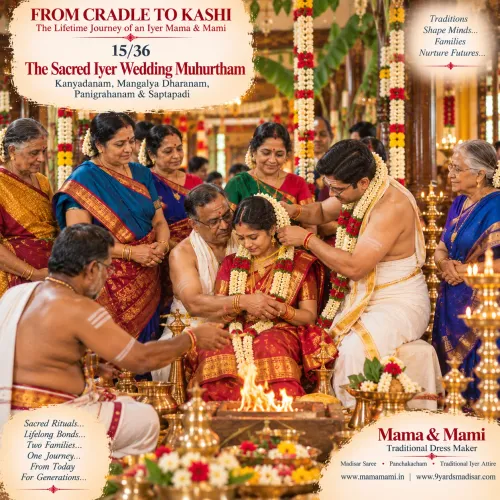
Previous — 15/36: The Sacred Iyer Wedding Muhurtham — Kanyadanam, Mangalya Dharanam, Panigrahanam & Saptapadi
Next — 17/36: The First Festivals Together — Thalai Deepavali, Pongal & Building Family Traditions
Mama & Mami — Traditional Dress Maker
Preserving traditions, one generation at a time.
Madisar Saree • Panchakacham • Traditional Iyer Attire