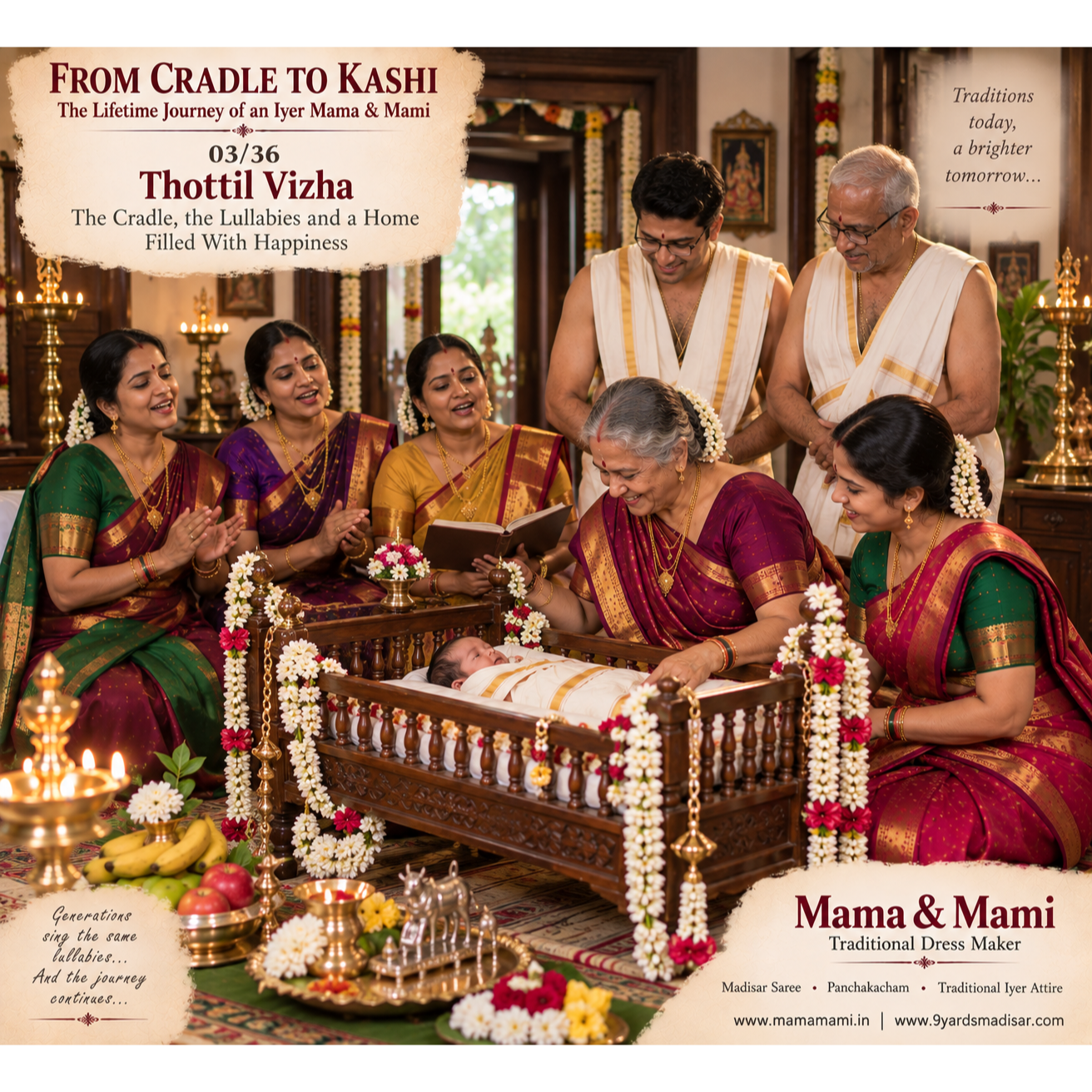
Thottil Vizha
The Cradle, the Lullabies and a Home Filled With Happiness
FROM CRADLE TO KASHI • 03/36
The Lifetime Journey of an Iyer Mama & Mami
There is a cradle in the middle of the house today.
Yesterday, it was simply a beautiful wooden cradle decorated with flowers.
Today, everyone seems to be standing around it.
Patti has already checked the bedding several times.
Thatha has inspected whether the cradle is secure.
Amma is holding the baby.
Appa is welcoming relatives.
Mamas, Mamis, Chithis, Athais, cousins and grandparents have begun filling the house.
Someone is arranging flowers.
Someone else has gone to bring more chairs.
The kitchen is busy.
Children are running between rooms despite being repeatedly told not to.
And somewhere among all this activity, one tiny baby has absolutely no idea that an entire celebration is happening because of them.
Welcome to the Thottil Vizha.
A Cradle Is Never Just a Cradle
For a newborn, a cradle is simply a place to sleep.
For a family, it can become something much more.
In many South Indian homes, the cradle ceremony is one of the early celebrations following the arrival of a child. The exact timing, rituals and customs can vary from family to family.
But the emotion surrounding it is remarkably similar.
The baby is no longer only being welcomed by Amma and Appa.
The larger family is welcoming the child.
And that makes the day special.
Preparing the Thottil
Preparation often begins long before the guests arrive.
The cradle is cleaned and decorated.
Fresh flowers may be tied around it.
Jasmine and colourful flowers bring fragrance into the room.
Traditional decorations may be added according to family custom.
A soft cloth is carefully placed inside.
Then someone adjusts it.
Patti adjusts it again.
Amma checks it.
Patti checks it once more.
Because apparently no cradle is officially ready until Patti has approved it.
The Women Begin to Arrive
The atmosphere changes as relatives enter the home.
A Mami arrives carrying fruits.
Another brings something for the baby.
An Athai walks straight past everyone because she wants to see the child first.
Someone asks:
“Is the baby sleeping?”
The answer is yes.
Naturally, everyone then goes to look at the sleeping baby.
The women gather around Amma.
Some may be dressed in beautiful traditional sarees, and where customary for the occasion, elder women may wear their Madisar sarees.
Deep maroon.
Traditional green.
Mango yellow with a contrasting border.
Purple with gold zari.
Every saree seems to bring another colour into the room.
Jasmine flowers, kumkum, bangles and gold jewellery complete a scene that generations of South Indian families would immediately recognise.
Patti's Madisar Has Seen Celebrations Before
Perhaps Patti has chosen one particular Madisar for today's function.
It may not be her newest saree.
It may not even be her most expensive.
But she likes wearing it for family occasions.
Maybe she wore it for a daughter's Seemantham.
Perhaps for an Ayushya Homam.
Maybe during a Navaratri several years ago.
Traditional clothes have an interesting way of collecting memories.
The saree begins its life as silk or cotton.
Then occasions attach themselves to it.
Eventually, when Patti opens her cupboard, she doesn't merely see colours.
She sees events.
People.
Photographs.
Years.
Today, another memory is being added.
Her grandchild's Thottil Vizha.
Thatha Pretends He Is Not Emotional
Meanwhile, Thatha is busy.
At least, that is what he tells everyone.
He is checking whether guests have eaten.
He wants to know whether Appa remembered something.
He is making sure everything is running properly.
Depending on the family's custom and the nature of the ceremony, the men may be dressed in traditional veshti or Panchakacham.
But watch Thatha when the baby is finally placed in the cradle.
The busy man becomes very quiet.
For a moment, he isn't thinking about arrangements.
He is looking at his grandchild.
And perhaps remembering another cradle.
Decades earlier.
The Baby Is Placed in the Cradle
Eventually comes the moment everyone has been waiting for.
Amma carries the baby carefully.
Conversations become quieter.
Relatives move closer.
The newborn is gently placed in the decorated cradle according to the family's custom.
Someone immediately says:
“Careful!”
As though anybody holding a newborn has ever forgotten that instruction.
The baby settles.
Everyone looks.
And then comes one of the most beautiful parts of a traditional cradle ceremony.
The Songs Begin
Long before playlists and Bluetooth speakers entered our homes, families had songs for occasions.
Women sang.
Grandmothers remembered verses.
Mothers learned from their mothers.
Some songs were devotional.
Some were lullabies.
Some belonged specifically to family celebrations.
Not every voice was perfectly trained.
That was never the point.
These weren't performances.
They were memories being passed orally from one generation to another.
Perhaps Patti begins a familiar lullaby.
Another Mami joins.
Then another.
The younger women may know only part of it.
Someone forgets a line.
Someone else remembers.
Everyone laughs.
And the song continues.
What Happens When Nobody Knows the Song Anymore?
This is a question worth asking.
Many families today live far apart.
A young couple may be in Bengaluru while their parents are in Chennai.
Another family may be in Singapore.
Another in London.
Another in California.
Grandparents may join ceremonies through video calls when travelling isn't possible.
Traditional songs that were once heard repeatedly in joint families may now be known by only one elderly person.
This is why recording them matters.
Ask Patti to sing.
Record Amma explaining the words.
Write down the lyrics your family uses.
Ask what the song means.
A recording that seems ordinary today may become priceless thirty years from now.
Then Comes the Family Tradition Everyone Remembers Differently
Ask five relatives how the cradle ceremony was performed when they were children and you may receive six answers.
One says:
“We always did it this way.”
Another immediately says:
“No, no. In our house we did it differently.”
Both may be correct.
Iyer family customs can differ according to lineage, region and inherited household practice.
That variation should be respected.
Our purpose in this journey is not to declare that every family must perform a ceremony identically.
It is to understand why these moments mattered—and why families continue remembering them.
Gifts Begin Appearing
Babies have a remarkable ability to acquire possessions without asking for anything.
Tiny clothes.
Silver items.
Traditional jewellery.
Toys the baby cannot use yet.
Money tucked into envelopes.
Something from Patti.
Something from Thatha.
Something from the maternal grandparents.
Something carefully preserved from an earlier generation.
Some gifts will be used immediately.
Others will be stored away.
Years later, Amma may open a small box and say:
“Patti gave you this for your Thottil.”
The grown child may have no memory of receiving it.
Yet suddenly the object has a story.
Food Brings Everyone Together
No traditional family gathering feels complete until someone asks:
“Saaptiya?”
Have you eaten?
The kitchen has been working quietly behind the celebration.
The exact menu will depend on the family's customs and circumstances, but the meal itself becomes another important part of the gathering.
Relatives sit together.
Someone asks for more sambar.
Someone says they have eaten enough.
The person serving ignores this and gives them more anyway.
A child wants only the sweet.
Another child has disappeared.
Someone is sent to find them.
The baby's celebration becomes a family reunion.
Amma Watches Everything Differently Now
Only a short while ago, she was somebody's daughter.
She still is.
But today she is watching Patti hold her child.
That changes something.
The advice that once sounded repetitive begins to make a little more sense.
The traditions she watched as a girl suddenly have another meaning.
She isn't simply participating anymore.
She is becoming responsible for remembering.
One day, perhaps, she will be the Mami explaining these customs to someone younger.
Much later, she may become the Patti checking whether the cradle bedding has been arranged properly.
She doesn't know that yet.
But our 36-chapter journey does.
Appa Is Changing Too
Appa has spent much of the day welcoming guests, checking arrangements and making sure Amma and the baby are comfortable.
Perhaps he sees his father standing nearby in traditional attire.
For most of his life, he has known him simply as Appa.
Today he sees something else.
Thatha.
One day, this young father may wear Panchakacham for his own son's Upanayanam.
He may stand beside his child at a wedding.
He may perform Grahapravesam in a home he has not yet purchased.
He may perform Tarpanam remembering the very elders smiling in today's photographs.
Life rarely tells us which ordinary moment will become important later.
Take the Photograph
Before everyone leaves, someone gathers the family.
Patti sits near the cradle in her Madisar.
Thatha stands beside her.
Amma and Appa come closer.
Mamas and Mamis gather around.
Someone holds the baby.
The photographer asks everyone to look forward.
One person doesn't.
Someone blinks.
The baby yawns.
Click.
Nobody knows it yet, but this photograph may survive longer than almost everything else from the day.
Thirty years later, the child may zoom into it and ask:
“Who is standing beside Patti?”
And another family story will begin.
The Cradle Will Soon Become Too Small
That is the strange thing about childhood.
While you're living through it, it seems endless.
Then suddenly the cradle is too small.
The baby begins sitting.
Then crawling.
Then walking.
Then talking.
Soon the family will celebrate the child's first food.
The first birthday.
Ayushya Homam.
Mottai.
Kaathu Kuthal.
Kula Deivam Darisanam.
Aksharabhyasam.
And eventually school.
But today there is no hurry.
Today the baby fits perfectly inside the cradle.
Patti is singing.
Thatha is watching.
Amma is smiling.
Appa is standing nearby.
And the house is full.
Years later, perhaps nobody will remember what food was served.
They may forget who brought which gift.
They may even disagree about exactly which rituals took place.
But they will remember something simpler.
Everyone was there.
And perhaps that is what a family celebration is really trying to preserve.
Not simply a ceremony.
Belonging.
FROM CRADLE TO KASHI • 03/36
The Lifetime Journey of an Iyer Mama & Mami
Previous — 02/36:
Punyavachanam & Namakaranam: A Baby's First Blessings and the Name That Becomes a Lifetime
Next — 04/36:
From First Food to First Birthday: Annaprasanam, Ayushya Homam, Mottai & Kaathu Kuthal
Mama & Mami – Traditional Dress Maker
Preserving traditions, one generation at a time.
Madisar Saree • Panchakacham • Traditional Iyer Attire