FROM CRADLE TO KASHI — 17/36
Thalai Deepavali — The First Deepavali After Marriage
The First Festivals Together: Deepavali, Pongal & the Beautiful Beginning of Family Traditions
The Lifetime Journey of an Iyer Mama & Mami
The wedding is over.
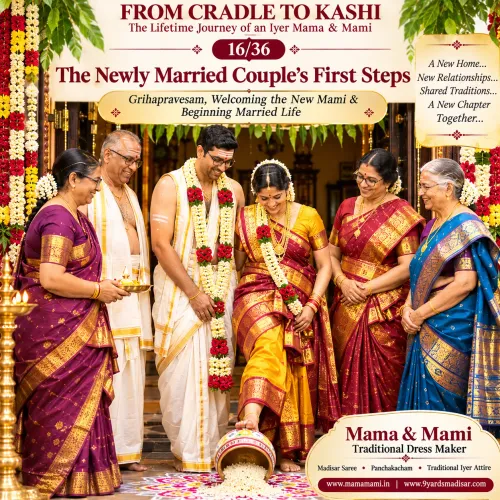
The newly married couple has completed their Grihapravesam.
The new Mami is slowly becoming familiar with her married life.
The new Mama is learning that marriage involves much more than wearing Panchakacham for the wedding!
Both families are getting to know one another better.
The first few months pass quickly.
And suddenly, Amma calls her daughter.
“Indha Deepavali-ku neengal rendu perum inga thaan varanum!”
This Deepavali, both of you must come here!
The daughter smiles.
Because this is not just another Deepavali.
It is her Thalai Deepavali — the first Deepavali after marriage.
A celebration filled with affection, new clothes, traditional food, family blessings and beautiful memories.
For the newly married couple, it is their first opportunity to celebrate one of Tamil Nadu's most beloved festivals as husband and wife.
And for Amma and Appa?
It is another opportunity to welcome their daughter and son-in-law home.
Welcome to Chapter 17 of our journey from cradle to Kashi.
1. What Is Thalai Deepavali?
In Tamil tradition, Thalai Deepavali refers to the first Deepavali celebrated after marriage.
It holds a special place in many Tamil families, including Iyer households.
Traditionally, in many families, the newly married couple is invited to the bride's parental home to celebrate the occasion.
The bride's parents may arrange new clothes, a festive meal, sweets, savouries and gifts according to their family customs and circumstances.
The celebrations vary between families.
Some observe elaborate customs.
Others celebrate simply with prayers, a family meal and time together.
But the underlying sentiment remains beautiful.
The couple is welcomed and celebrated as they begin their first year of married life.
2. Amma Starts Planning Weeks in Advance
Deepavali is still several weeks away.
But Amma has already started preparing.
She calls her daughter.
“What saree do you want this year?”
“Amma, I already have so many sarees from the wedding!”
“That is different. This is your Thalai Deepavali!”
The daughter laughs.
Appa hears the conversation.
He asks:
“Have you asked Mappillai what he wants?”
Amma replies:
“Of course! We must buy something for him also.”
Soon, the family begins discussing clothes, travel arrangements, sweets and the festive menu.
Patti joins the conversation.
“In our days, Thalai Deepavali was celebrated with so much excitement!”
And another collection of family stories begins.
3. The Invitation to the Newly Married Couple
In many Tamil families, the bride's parents personally invite the newly married couple for Thalai Deepavali.
Today, the invitation may arrive through a phone call or video call.
But the affection remains the same.
Appa speaks to his son-in-law.
“Mappillai, take leave for Deepavali. Both of you should come.”
The groom smiles.
“Definitely, Mama.”
Amma immediately asks:
“How many days will you stay?”
The daughter replies:
“Three days, Amma.”
“Only three days?”
Everyone laughs.
Because for parents, no visit from their children ever seems long enough.
4. Shopping for the First Deepavali
Now comes one of the most enjoyable parts.
Deepavali shopping!
The family visits a traditional textile shop.
Rows of colourful silk sarees fill the shelves.
Rich maroon.
Mango yellow.
Emerald green.
Royal blue.
Deep purple.
Arakku red.
Beautiful zari borders shine under the lights.
Amma asks her daughter to choose a saree.
The daughter selects a beautiful silk saree.
Then Patti notices a traditional nine-yard Madisar.
“Idhu romba nanna irukku!”
This is very beautiful!
For religious observances where the family follows the custom of wearing Madisar, a new nine-yard saree may be a meaningful addition to the young Mami's wardrobe.
The groom may choose a traditional veshti, Panchakacham and angavastram for ceremonial use, along with other new clothes.
The new clothes are not merely purchases. They become part of the memories of the couple's first festival.
5. The New Mami's Beautiful Madisar
Imagine the new Mami choosing a traditional Madisar for the Deepavali pooja.
She selects a rich mango-yellow saree with a maroon zari pallu.
Amma helps her arrange it.
Patti watches carefully.
The nine-yard saree is draped in the family's traditional Iyer style.
The cloth passes over the right shoulder.
The grand zari-rich pallu is displayed across the front, extending from the left towards the right-hand side.
The waist is wrapped securely.
The lower kacham is properly formed.
The traditional folds are neatly arranged.
It is unmistakably a Madisar, not an ordinary six-yard saree.
The young Mami looks into the mirror.
Amma smiles.
Patti adjusts one final fold.
“Perfect!”
The daughter remembers watching Amma and Patti wear Madisar during family functions when she was a child.
Today, she is learning the same tradition.
A garment once associated with her elders has become part of her own family journey.
6. The New Mama's Panchakacham
Meanwhile, the groom is preparing his traditional clothes.
He has selected a beautiful white veshti with a gold border.
For the family's religious observances, he may wear Panchakacham according to custom.
Appa offers to help.
The groom smiles.
“I know how to wear it!”
Five minutes later...
“Mama, can you check this fold?”
Appa laughs.
Thatha joins them.
Soon, three generations of men are discussing how to arrange the Panchakacham correctly.
And the photographer has already found another wonderful moment to capture.
7. The Journey to Amma and Appa's House
A day or two before Deepavali, the newly married couple begins their journey.
Their bags are packed.
The new clothes are ready.
Gifts have been purchased.
The bride is excited.
Because she is returning to her childhood home for her first major festival after marriage.
On the way, she tells her husband:
“When I was small, Appa used to wake us up very early on Deepavali.”
The groom smiles.
“In our house also!”
She continues:
“Amma would prepare all the sweets. Patti would supervise everything.”
He laughs.
“Then this Deepavali is going to be interesting!”
They arrive.
Amma is waiting near the entrance.
Appa comes outside to help with the bags.
Patti is sitting in the hall.
And the moment the daughter enters, the familiar questions begin.
“Have you eaten?”
“Was the journey comfortable?”
“Are you tired?”
Some traditions never change.
8. Deepavali Eve — The House Comes Alive
The evening before Deepavali is filled with excitement.
The house has been cleaned.
A beautiful kolam decorates the entrance.
New clothes have been arranged.
Traditional sweets and savouries are stored in large containers.
The fragrance of freshly prepared food fills the kitchen.
Amma is busy making final arrangements.
Patti is checking whether everything is ready.
The daughter joins them.
For a moment, it feels like childhood again.
Except this time, her husband is sitting in the hall with Appa and Thatha.
The family has grown.
And Deepavali has become even more special.
9. The Traditional Deepavali Marundhu
In many Tamil households, Deepavali preparations include a traditional herbal preparation called Deepavali Marundhu or Deepavali Legiyam.
It is commonly prepared using selected spices and other ingredients according to family recipes.
The preparation has a longstanding place in festive food traditions.
Some families make it at home.
Others purchase it.
The ingredients and methods differ.
Although traditionally associated with digestion after festive meals, it should be regarded as a customary food preparation rather than a proven treatment for medical conditions.
Patti may have her own recipe.
Amma may follow a slightly different method.
The new Mami watches and learns.
Perhaps one day, she will prepare it for her own family.
10. Deepavali Morning — Before Sunrise
The house wakes up early.
Very early.
Amma is already awake.
Patti has finished her morning preparations.
Appa is arranging the traditional oil-bath items.
The groom is still sleepy.
The bride whispers:
“Wake up! It's Deepavali!”
He looks at the clock.
“Already?”
She laughs.
“In our house, Deepavali starts before sunrise!”
The traditional Ganga Snanam preparations begin.
11. Ganga Snanam — The Sacred Deepavali Oil Bath
In many Tamil families, the Deepavali morning oil bath is an important custom.
It is often referred to as Ganga Snanam.
According to family tradition, oil may be ceremonially applied before bathing.
The prescribed timing and procedure vary.
The expression “Ganga Snanam Aacha?” is a familiar Deepavali greeting in many Tamil households.
The custom connects personal cleansing with the auspicious beginning of the festival.
For the newly married couple, the first Deepavali oil bath becomes a memorable family occasion.
Amma guides the daughter.
Appa helps with the traditional arrangements.
The groom participates according to the family's custom.
Patti watches happily.
Another generation is observing the festival.
12. Wearing New Clothes
After the morning bath, everyone changes into fresh clothes.
The bride wears her new festive saree.
The groom wears his new traditional attire.
Amma wears a beautiful silk saree or Madisar according to the family's practice.
Patti is dressed in her favourite traditional Madisar.
Appa and Thatha wear their veshtis.
The younger children are excited about their new dresses.
Someone asks:
“Where is the camera?”
And the family gathers for the first Deepavali photograph.
13. The First Deepavali Pooja
The pooja room has been decorated with flowers.
Brass lamps glow softly.
The family deities are adorned.
The newly married couple joins the elders for prayers.
Depending on the family's sampradayam, particular prayers and offerings may be performed.
The new Mami stands beside Amma and Patti.
The groom joins Appa and Thatha.
For a moment, the family is united in prayer.
The bride remembers earlier Deepavalis.
As a child, she stood beside Amma.
Now she stands beside her husband.
The festival is familiar, but her place within the family story has changed.
14. Deepavali Sweets — The Taste of Childhood
After the morning observances, the festive food begins.
The dining table is filled with traditional preparations.
Adhirasam.
Mysore Pak.
Laddu.
Murukku.
Thenkuzhal.
Mixture.
Payasam.
And other family favourites.
The groom tastes Amma's homemade Mysore Pak.
“This is excellent!”
Amma smiles proudly.
Patti immediately says:
“You should try my Adhirasam also!”
The groom realises that he must praise everything equally.
Marriage teaches many important lessons.
And some begin at the dining table!
15. The First Deepavali Feast
The family gathers for a traditional festive meal.
Banana leaves may be arranged.
The menu depends on the household.
There may be paruppu, sambar, rasam, vegetables, appalam, vadai, payasam and other festive preparations.
The new Mama sits beside his wife.
Appa serves him another helping.
The groom says:
“Enough, Mama!”
Appa replies:
“Just a little more.”
Patti watches.
“He is eating too little!”
Everyone laughs.
For the bride, the meal brings back childhood memories.
The same dining room.
The same family voices.
The same familiar dishes.
But now, her husband is part of the celebration.
16. The Importance of Thalai Deepavali Gifts
In many Tamil families, Thalai Deepavali is associated with gifts and new clothes for the newly married couple.
The bride's parents may present traditional garments, sweets or other items according to their means and customs.
Some families have particular gift-giving practices.
Others keep the celebration simple.
There is no need for expensive gifts to make the occasion meaningful.
A beautiful saree.
A traditional veshti.
A homemade sweet.
A family photograph.
Or simply spending time together.
The value of Thalai Deepavali lies in affection, not expenditure.
17. The First Deepavali Photograph
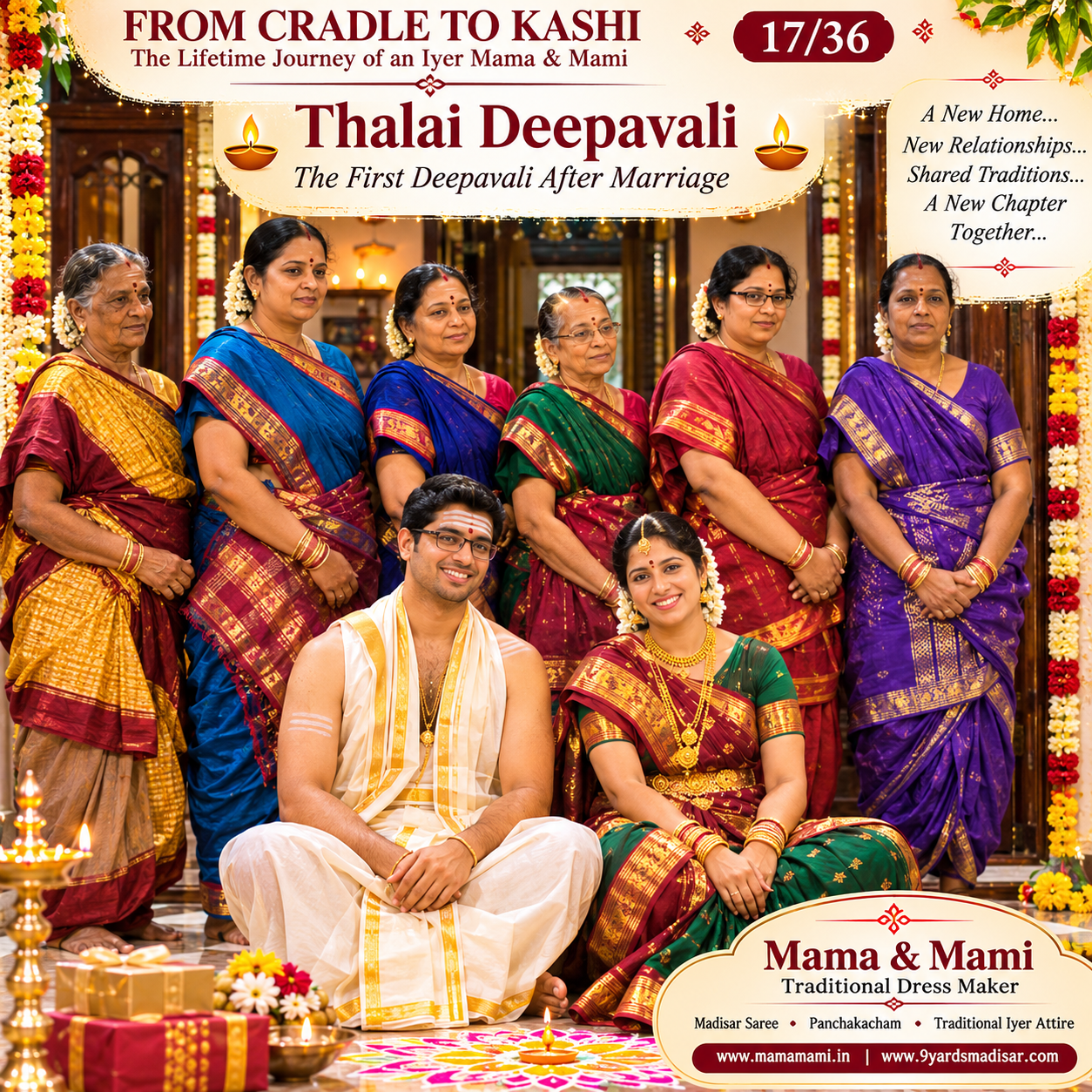
Now imagine a beautiful family photograph.
The newly married couple stands in the centre.
The new Mami wears a rich maroon-and-gold traditional Madisar.
The groom wears a white Panchakacham with a gold border.
Amma stands beside her daughter.
Patti wears a bottle-green Madisar with an arakku border.
Appa and Thatha stand proudly nearby.
The entrance is decorated with kolam.
Brass lamps glow.
Fresh jasmine flowers complete the festive atmosphere.
The photographer clicks.
Years later, the couple may look at this photograph and remember their very first Deepavali together.
18. The Evening Celebrations
As evening approaches, the family gathers again.
The house is illuminated.
Children enjoy the festive atmosphere.
Relatives visit.
Sweets are exchanged.
The newly married couple spends time with cousins and friends.
Where fireworks are part of the family's celebration, they should be used only where permitted, with appropriate safety precautions and consideration for children, animals and neighbours.
Some families prefer celebrating without fireworks.
Either way, the evening offers something precious.
Time together.
The bride sits beside her husband.
Amma watches them.
Appa smiles.
And Patti quietly enjoys another family festival.
19. The Day After Deepavali
The celebrations are gradually coming to an end.
The couple begins packing.
Amma has prepared containers of sweets and savouries.
The daughter protests.
“Amma, we cannot carry so much!”
Amma replies:
“Take it. You can eat it later.”
Patti adds another packet.
“This is for Mappillai.”
The groom smiles.
The bags are heavier than when they arrived.
But the couple is carrying something more valuable than food and gifts.
They are carrying memories.
20. Returning to Their Married Home
The couple returns home.
The bride begins unpacking.
She carefully folds her new saree.
The groom puts away his Panchakacham.
The sweets are arranged in the kitchen.
The photographs are shared with relatives.
Then the bride receives a message from Amma.
“Reached safely?”
She replies:
“Yes, Amma.”
A few minutes later, Patti calls.
“Did you eat?”
The bride laughs.
“Yes, Patti!”
The family may now live in different homes.
But the affection remains.
21. The First Pongal After Marriage
A few months later, another important festival arrives.
Pongal.
For many Tamil families, Pongal celebrates the harvest season, gratitude and the relationship between people, agriculture and nature.
The newly married couple prepares to celebrate its first Pongal together.
Some families observe special customs for the first Pongal after marriage.
Others follow their regular household traditions.
The couple may visit their parents or celebrate at home.
The arrangements vary.
But the occasion provides another opportunity to learn and continue family customs.
22. Bhogi — Preparing for a Fresh Beginning
The Pongal celebrations traditionally begin with Bhogi.
It is associated with renewal and the transition into the harvest festival.
Families may clean their homes and prepare for the coming celebrations.
The new Mami helps arrange the house.
The groom joins her.
Together, they decide how to decorate the entrance.
A beautiful kolam is drawn.
Fresh flowers are arranged.
The pooja items are prepared.
The couple is learning to celebrate festivals as a team.
23. Thai Pongal — Gratitude and Prosperity
On Thai Pongal, families prepare the traditional Pongal dish.
Rice, milk and other ingredients are cooked according to household practice.
When the preparation rises and overflows, the family joyfully calls:
“Pongalo Pongal!”
The celebration expresses gratitude for the harvest, sunlight, food and the natural world.
The couple joins the family prayers.
Patti explains how Pongal was celebrated in her childhood village.
Thatha remembers the harvest celebrations of earlier generations.
The new Mama and Mami listen.
And another part of their cultural heritage becomes meaningful.
24. The First Pongal in Their Own Kitchen
Imagine the couple preparing Pongal together.
The new Mami washes the rice.
The groom arranges the ingredients.
They follow Amma's instructions over a video call.
“Amma, how much jaggery?”
“Wait, let me explain!”
The groom holds the phone.
The bride stirs the preparation.
Patti joins the video call.
“Don't forget the ghee!”
Everyone laughs.
Eventually, the Pongal is ready.
It may not be exactly like Amma's.
But it is special.
Because they prepared it together.
A new family tradition has begun.
25. Mattu Pongal — Remembering the Importance of Cattle
Mattu Pongal honours cattle and their contribution to agriculture and rural life.
In farming communities, cattle may be decorated and honoured according to local tradition.
For families living in cities, the day may be observed through prayers, remembrance and appreciation of agricultural life.
The couple may not own cattle.
They may live in an apartment.
But the festival still provides an opportunity to understand the relationship between food, farmers, animals and nature.
Traditions become more meaningful when their underlying purpose is understood.
26. Kaanum Pongal — Family Visits and Togetherness
Kaanum Pongal is associated with family gatherings, visits and social connections in many Tamil communities.
Customs vary considerably.
Some families visit relatives.
Others spend time outdoors.
Some observe particular family rituals.
For our young couple, it becomes another opportunity to meet loved ones.
They visit Amma and Appa.
They meet cousins.
They spend time with Patti and Thatha.
The family gathers for photographs.
And the first Pongal after marriage becomes another cherished memory.
27. Navaratri — The First Golu Together
Later in the year, Navaratri arrives.
In families that maintain the tradition of Golu, the festival brings another opportunity for the newly married couple to participate in household customs.
The new Mami may help arrange the steps.
Traditional dolls are carefully placed.
The pooja room is decorated.
Neighbours and relatives are invited.
Women may exchange auspicious items according to custom.
Sundal is prepared.
Songs are sung.
The new Mami learns how her husband's family celebrates Navaratri.
She may also introduce traditions from her own childhood home.
The festival becomes a beautiful meeting of two family histories.
28. The Role of Madisar During Festivals
Traditional attire remains an important part of many Iyer household celebrations.
For prescribed religious observances, married women may wear Madisar according to their family practice.
Some prefer silk Madisars for major festivals.
Others choose cotton for comfort.
The nine-yard drape is especially distinctive.
The right-shoulder arrangement.
The grand front zari pallu.
The characteristic waist wrapping.
The traditional lower kacham.
Each detail contributes to the authentic appearance.
For men, veshti and Panchakacham remain important forms of traditional clothing for appropriate ceremonies.
These garments help connect present-day celebrations with earlier generations.
29. Festivals Teach Children About Family
Years from now, our young couple may become parents.
A small child may wake up early on Deepavali.
“Amma, is it time for new clothes?”
Another child may ask:
“Appa, why do we say Pongalo Pongal?”
During Navaratri, a daughter may help arrange the Golu dolls.
A son may ask Thatha about the family's temple traditions.
And Patti may teach the grandchildren an old festival song.
The same traditions that the couple is learning today may become the memories of their children tomorrow.
This is how culture passes from one generation to the next.
30. When Festivals Become Family Memories
Ask an elderly person about Deepavali.
They may not remember every gift they received.
But they may remember their mother's cooking.
Their father's smile.
Their grandmother's Madisar.
The fragrance of sesame oil.
The excitement of new clothes.
The sound of relatives arriving.
The taste of homemade sweets.
The laughter around the dining table.
Festivals are not remembered only because of their rituals.
They are remembered because of the people who shared them.
And that is why the first festivals after marriage become so special.
31. A Festival Without the Elders
There is another truth about family celebrations.
As the years pass, some beloved elders may no longer be present.
One Deepavali, Patti may no longer be there to supervise the sweets.
One Pongal, Thatha may no longer be there to tell his childhood stories.
Their absence will be deeply felt.
But the traditions they taught can continue.
The recipes may be preserved.
The songs may be remembered.
The family photographs may be treasured.
And the younger generation may continue the customs with gratitude.
Sometimes, continuing a family tradition becomes a way of remembering the people who taught it to us.
32. The Importance of Celebrating Both Families
Marriage brings together two people who may have grown up with different household customs.
Even within the Iyer community, festival practices can vary.
One family may prepare a particular dish.
Another may follow a different pooja procedure.
One may celebrate a festival elaborately.
Another may observe it quietly.
The couple should approach these differences with curiosity and respect.
They can visit both families when possible.
They can alternate celebrations when necessary.
They can create new arrangements that suit their lives.
The goal is not to decide which family celebrates a festival better.
It is to build a married life that honours both partners and their relationships.
33. The First Year of Marriage
Slowly, the first year passes.
The couple has celebrated its first Deepavali.
Its first Pongal.
Perhaps its first Navaratri.
Several birthdays.
Family visits.
Temple darisanams.
And perhaps its first wedding anniversary.
The bride has become more comfortable in married life.
The groom has learned more about his wife's family.
Both have discovered that marriage involves constant learning.
They have shared laughter.
They may have faced disagreements.
They have made plans.
They have begun building their future.
And now, another important part of traditional family life awaits.
The blessings of their Kula Deivam.
34. The Kula Deivam — A Connection to Ancestral Roots
For many Tamil families, the Kula Deivam represents a deeply rooted connection with their ancestral tradition.
The family may have worshipped at a particular temple for generations.
The temple may be located in an ancestral village.
Patti and Thatha may remember visiting it during their younger days.
After marriage, many families arrange a visit for the newly married couple.
Some continue the practice annually or at other customary intervals.
The specific requirements vary by family.
For our young Mama and Mami, the visit offers an opportunity to understand their family's spiritual heritage.
We will explore this meaningful tradition in the next chapter.
35. From the First Deepavali to a Lifetime of Festivals
Imagine the couple forty years from now.
They are sitting together on Deepavali morning.
Their hair has turned grey.
Their children are married.
Their grandchildren are visiting.
The house is filled with laughter.
A granddaughter asks:
“Patti, how was your first Deepavali after marriage?”
Patti smiles.
“Oh, that was a very special Deepavali!”
Thatha immediately adds:
“Your great-grandmother made so many sweets!”
Everyone laughs.
The old family album is opened.
And there it is.
A photograph of a young couple celebrating their first Thalai Deepavali.
The new Mami wearing her beautiful traditional saree.
The new Mama standing beside her.
Amma, Appa, Patti and Thatha smiling around them.
The photograph is old.
But the memory is alive.
One Deepavali became a story remembered for generations.
36. The Journey Continues
Our young Mama and Mami have completed another beautiful chapter.
They have celebrated their first festivals together.
They have learned new family customs.
They have spent time with both sets of parents.
They have begun creating traditions of their own.
The Madisar and Panchakacham have become part of their ceremonial wardrobe.
And the bonds between the two families have grown stronger.
But the journey from cradle to Kashi is far from complete.
There will be more temple visits.
More family poojas.
More responsibilities.
Perhaps a new house.
Perhaps children.
And many meaningful milestones along the way.
For now, the couple prepares for another important journey.
A journey that connects them with their ancestors.
Their family deity.
And generations of worship.
Kula Deivam Darisanam.
FROM CRADLE TO KASHI • 17/36
Thalai Deepavali — The First Deepavali After Marriage
The First Festivals Together: Deepavali, Pongal & Family Traditions
The Lifetime Journey of an Iyer Mama & Mami
Previous — 16/36: The Newly Married Couple's First Steps — Grihapravesam, Welcoming the New Mami & Beginning Married Life
Mama & Mami — Traditional Dress Maker
Preserving traditions, one generation at a time.
Madisar Saree • Panchakacham • Traditional Iyer Attire