FROM CRADLE TO KASHI — 13/36
The Iyer Wedding Begins
Vratham, Janavasam & Welcoming the Groom's Family
The Lifetime Journey of an Iyer Mama & Mami
Yesterday, they were two young people getting to know each other.
Then came the family introductions.
The Jathagam discussions.
The first meeting.
The Nichayathartham.
And the blessings of the elders.
Now, the wedding date has finally arrived.
The marriage hall is decorated.
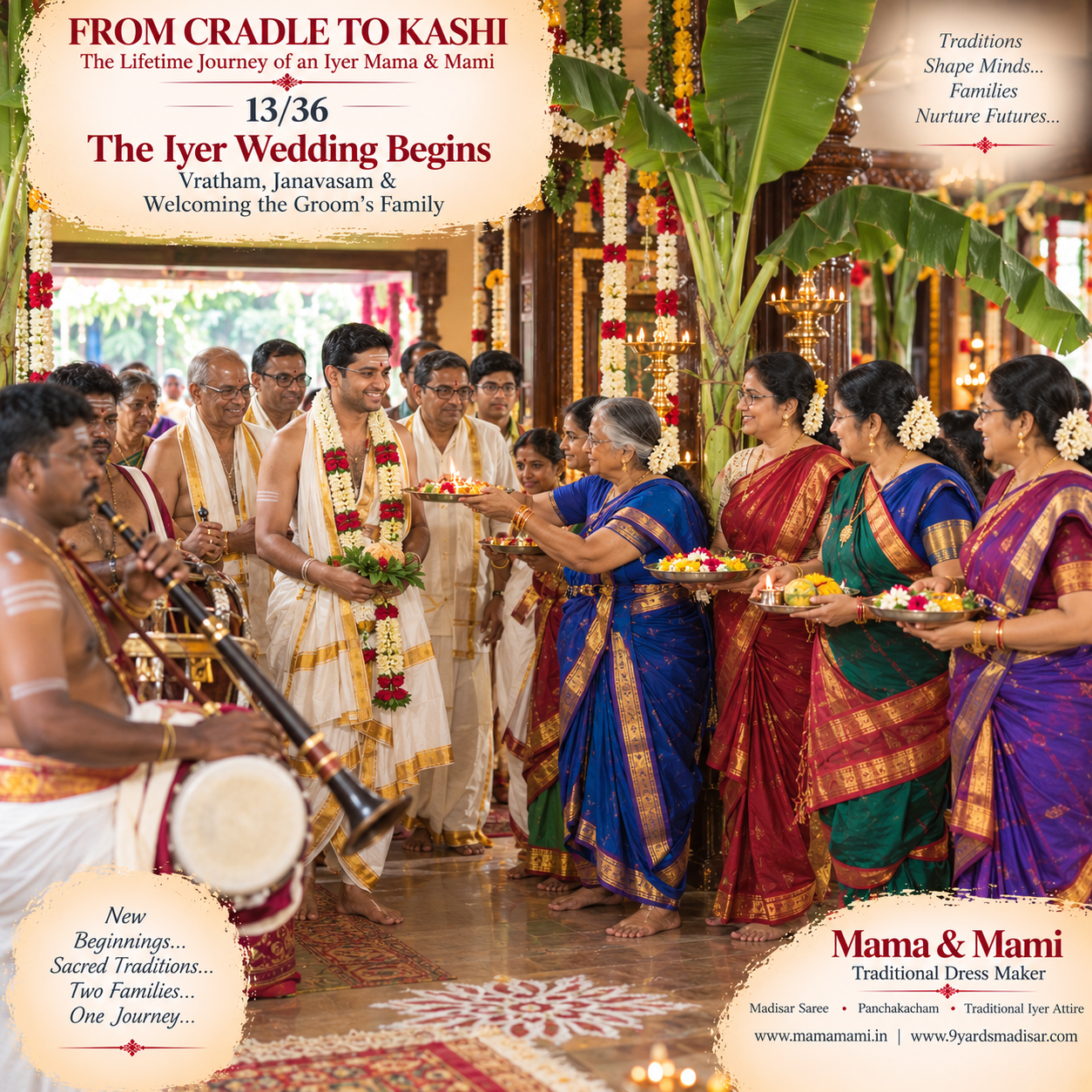
The Nadaswaram musicians are preparing their instruments.
Fresh jasmine and marigold flowers fill the entrance.
Banana trees stand proudly near the doorway.
Relatives have begun arriving from Chennai, Coimbatore, Bengaluru, Mumbai and even overseas.
Patti has carefully packed her Madisar.
Thatha has brought his traditional veshti.
Appa has checked the wedding arrangements for the twentieth time.
And Amma?
She has been awake since 4 AM.
Because today is not an ordinary day.
The little boy and girl we followed from childhood are about to begin their married life together.
And before the sacred Muhurtham, the beautiful traditions of an Iyer wedding must begin.
1. The Wedding Hall Comes Alive
There is something unforgettable about the atmosphere of a traditional Tamil Brahmin wedding.
Even before sunrise, the marriage hall begins to awaken.
The decorators arrange the final flowers.
The caterers prepare the first filter coffee.
The Nadaswaram and Thavil musicians arrive.
The Vadhyar checks the arrangements for the ceremonies.
A beautiful kolam welcomes the guests.
The fragrance of jasmine, sandalwood and fresh flowers fills the air.
Some relatives are already dressed.
Others are still looking for their rooms.
And somewhere, a Mama is asking:
“Coffee vandhucha?”
Has the coffee arrived?
Because no Iyer wedding can properly begin without filter coffee!
2. The Groom's Family Arrives
The groom's family has been preparing for this occasion for months.
Panchakacham.
Veshti.
Angavastram.
Traditional silk sarees.
Madisar.
Jewellery.
Flowers.
Everything has been carefully packed.
The groom's mother is particularly excited.
She remembers holding her son as a baby.
She remembers his Aksharabhyasam.
His Upanayanam.
His first day at college.
The day he left home.
And now, he is standing before her as a bridegroom.
For a moment, she becomes emotional.
Patti notices.
She smiles and says:
“Ippo avanukku kalyanam!”
Now he is getting married!
3. Welcoming the Groom's Family
In many traditional Iyer weddings, the bride's family welcomes the groom and his relatives with warmth and respect.
The exact reception customs differ between families.
The entrance is decorated with flowers, mango leaves and traditional lamps.
The bride's parents receive the groom's family.
Thamboolam and other customary items may be exchanged.
Elders greet one another.
Relatives who have not met for years begin talking.
And the atmosphere quickly becomes joyful.
What began as two separate families is slowly becoming one extended family.
A wedding is not only about welcoming the groom. It is about welcoming new relationships.
4. Vratham — Preparing for a Sacred Responsibility
One of the important ceremonies associated with a traditional Iyer wedding is Vratham.
The word Vratham refers to a religious observance or undertaking.
In the wedding context, the ceremony forms part of the bride's and groom's preparation for entering married life.
Depending on the family's Vedic tradition and customary procedure, the ceremonies may include prayers, prescribed rites and blessings under the guidance of the Vadhyar.
The details should be followed according to the family's sampradayam.
But the broader meaning is beautiful.
Marriage is not simply a celebration. It is the beginning of responsibilities shared by two people.
5. Appa and His Son — Another Special Moment
Remember our Upanayanam chapter?
The young boy sat beside Appa.
The father guided him through an important stage of religious life.
Now, years later, they sit together again.
This time, the son is preparing for marriage.
Appa wears his traditional Panchakacham.
The groom is dressed in appropriate ceremonial attire.
The Vadhyar guides the proceedings.
Mantras are recited.
The sacred fire may be part of the prescribed rites.
Thatha watches quietly.
He remembers when Appa himself was the bridegroom.
Three generations. Three different stages of life. One continuing tradition.
6. The Bride's Vratham
The bride also participates in the wedding's prescribed preparatory ceremonies according to the family's tradition.
She is surrounded by Amma, Patti and close relatives.
Her wedding clothes have been carefully arranged.
Flowers are ready.
Jewellery is being checked.
The Vadhyar explains the next part of the ceremony.
The bride listens attentively.
For her, this is a day filled with many emotions.
Excitement.
Happiness.
A little nervousness.
And perhaps the quiet realisation that life is about to change.
Amma looks at her daughter.
She remembers the little girl who once followed her into the kitchen.
Now that same daughter is preparing to become a wife.
7. Patti's Madisar — Nine Yards of Family Tradition
Among all the beautiful wedding clothes, one traditional garment deserves special attention.
The Iyer Madisar.
Patti has chosen a beautiful nine-yard saree.
Perhaps a bottle-green body with a rich maroon zari section.
Or mango yellow with a traditional red border.
Or royal blue with an elegant gold zari design.
The Madisar is worn with its distinctive traditional construction.
The drape passes over the RIGHT shoulder.
The grand zari-rich portion is arranged prominently across the FRONT, extending from the LEFT toward the RIGHT-hand side.
The waist is securely wrapped and tucked.
The lower kacham forms the characteristic divided-leg structure.
Patti moves confidently through the marriage hall.
She has worn Madisar for decades.
Her daughter has learned from her.
And perhaps the new Mami will learn too.
A nine-yard saree can carry generations of memories.
8. The Groom's Panchakacham
Just as Madisar holds a special place in traditional Iyer women's ceremonial clothing, Panchakacham is an important traditional attire for men.
During the prescribed wedding ceremonies, the groom may wear Panchakacham according to family practice.
The traditional veshti is arranged with the characteristic kacham tuck.
An angavastram may accompany it.
The appearance is dignified and distinctly traditional.
Appa helps the groom prepare if necessary.
Thatha offers advice.
One Mama insists he knows a better way of tying it.
Another Mama disagrees.
The groom smiles.
Even traditional clothing can produce lively family discussions!
9. The Importance of Family Elders
An Iyer wedding brings together more than the bride and groom.
It brings generations together.
Patti.
Thatha.
Appa.
Amma.
Mamas.
Mamis.
Athais.
Periappas.
Periammas.
Chithis.
Chithappas.
Each person has a place in the family's story.
Some help organise the ceremonies.
Some guide the younger generation.
Some preserve the family customs.
Others simply offer their blessings.
And those blessings become among the most meaningful parts of the occasion.
10. Janavasam — The Groom's Ceremonial Arrival
Another memorable wedding tradition is Janavasam, also called Mappillai Azhaippu in some contexts.
In many Tamil Brahmin wedding traditions, Janavasam involves the ceremonial reception or procession of the groom, often associated with the evening before the wedding.
Its exact form varies between families.
Traditionally, the groom might arrive in a decorated vehicle or be taken in a procession.
Nadaswaram music accompanies the occasion.
Relatives gather.
The bride's family welcomes the groom.
There may be garlands, flowers, lights and plenty of photographs.
In modern weddings, Janavasam may be conducted in a simplified form at or near the marriage hall.
But the excitement remains.
11. The Groom Becomes the Centre of Attention
Until now, the groom has been busy with preparations.
Suddenly, everyone wants a photograph with him.
His cousins gather.
Friends arrive.
Mamas offer advice.
The photographer gives instructions.
“Sir, look here.”
“Sir, one more photo.”
“Sir, smile!”
The groom begins wondering whether he will ever be allowed to sit down.
Meanwhile, the bride's cousins are watching the proceedings with great interest.
They are already planning how to tease him during the wedding.
12. The Bride Watches the Celebrations
The bride may watch parts of the celebrations with her family, depending on the arrangements and customs.
She sees the groom surrounded by relatives.
She hears the Nadaswaram.
She notices the decorations.
The wedding that once existed only as a date on the calendar is now happening around her.
Amma comes and stands beside her.
“Happy?”
The bride smiles.
“Yes, Amma.”
Sometimes a single word is enough.
13. Nadaswaram — The Sound of an Iyer Wedding
Ask someone who attended traditional South Indian weddings decades ago what they remember.
Many will mention the Nadaswaram.
Its sound fills the marriage hall with a sense of celebration.
Alongside the Thavil, it creates an atmosphere that is difficult to replace.
Traditional wedding music may include auspicious ragas and compositions appropriate to the occasion.
When the Nadaswaram begins, even relatives busy talking will sometimes stop for a moment.
Because the music tells everyone:
A sacred family celebration is taking place.
14. The Wedding Feast Begins
While ceremonies are taking place, another team is working tirelessly.
The caterers.
Traditional Iyer wedding meals are remembered for their variety, hospitality and familiar flavours.
Depending on the family's arrangements, guests may enjoy dishes such as:
Paruppu, ghee and rice
Sambar and rasam
Poriyal, kootu and pachadi
Avial and other vegetable preparations
Appalam and pickles
Payasam and traditional sweets
Curd rice
A banana-leaf meal is not merely about the food.
It is also about the experience.
Relatives sitting together.
Servers moving quickly between rows.
The familiar question:
“Innum konjam venuma?”
Would you like a little more?
And the guest who says no but somehow receives another serving!
15. The Wedding Hall Becomes a Reunion
Look beyond the ceremony for a moment.
Two cousins who have not met in ten years are talking.
An elderly Mami recognises somebody's grandson.
Children are running between the chairs.
A family from America has arrived.
Another from Singapore.
Somebody is introducing a newly married couple.
Somebody else is discussing the next family wedding.
This is one reason weddings remain important in extended families.
They bring people together who might otherwise rarely meet.
The marriage hall becomes a temporary home for several generations.
16. Amma's Emotions
For the bride's mother, the wedding can be especially emotional.
She has spent years raising her daughter.
Teaching her.
Protecting her.
Celebrating her achievements.
Comforting her during difficult times.
Now her daughter is preparing to establish a new partnership.
There is happiness.
There is pride.
And sometimes there are tears.
But marriage need not mean losing a daughter.
It means watching her build another important relationship while remaining part of the family that raised her.
17. Patti Remembers Her Own Wedding
Patti watches the bride and groom.
Then she looks at Thatha.
Perhaps they have been married for forty or fifty years.
Their own wedding was very different.
The photographs were different.
The clothes may have been different.
The marriage hall may have been smaller.
There were no smartphones.
No social media.
No elaborate wedding reels.
But there was Nadaswaram.
There were relatives.
There were rituals.
There was Madisar.
There was Panchakacham.
And there were two young people beginning a life together.
Patti smiles.
Some things change. Some things remain.
18. The Night Before Muhurtham
As the evening draws to a close, the marriage hall gradually becomes quieter.
The Janavasam celebrations are over.
The preparations for the next day continue.
The bride's wedding saree is kept ready.
The groom's ceremonial clothes are arranged.
The Vadhyar confirms the next morning's schedule.
Amma checks everything again.
Appa speaks with the organisers.
Patti reminds the family about a particular custom.
Thatha finally sits down with a cup of coffee.
Tomorrow is the Muhurtham.
Tomorrow the couple will sit before the sacred fire.
Tomorrow their marriage will be solemnised through the prescribed ceremonies.
But before the central wedding rites, several memorable traditions await them.
Kasi Yatra.
Maalai Maatral.
Oonjal.
And then the sacred marriage rituals.
19. Two Families Are Becoming One
There is something deeply meaningful about the first day of an Iyer wedding.
Until now, two families have been preparing separately.
Each has its own memories.
Its own customs.
Its own traditions.
Its own beloved elders.
Now those stories begin to meet.
The groom's Patti may teach something to the bride.
The bride's Thatha may share a story with the groom.
The two mothers begin discussing future festivals.
The fathers coordinate the ceremonies.
The cousins become friends.
The family circle expands.
And at the centre are two people who have chosen to share their future.
20. Tomorrow, a New Mama & Mami Will Begin Their Journey
Remember where our series started?
A baby in a cradle.
A mother singing softly.
A father watching proudly.
Grandparents offering blessings.
We followed that child through childhood.
Education.
Family traditions.
Growing up.
Marriage conversations.
Nichayathartham.
And now the wedding has begun.
Soon, our young couple will become husband and wife.
There may be a first home.
A first Deepavali together.
Kula Deivam Darisanam.
Grahapravesam.
Children.
Family responsibilities.
Festivals.
Joy.
Challenges.
And eventually, perhaps, grandchildren.
The journey that began with a cradle is now entering one of its most important chapters.
Because every generation begins as somebody's child—and one day may become the elder whose stories the next generation remembers.
A Tradition Worth Preserving
Weddings are changing.
Photography changes.
Decorations change.
Venues change.
Even the way families meet and plan marriages changes.
But the meaning behind many cherished traditions can continue.
The blessings of elders.
The importance of family.
The responsibilities of married life.
The beauty of traditional clothing.
The knowledge passed from one generation to another.
For Mama & Mami, Madisar and Panchakacham are more than wedding attire.
They are part of a living cultural heritage.
And preserving that heritage begins with understanding it.
FROM CRADLE TO KASHI • 13/36
The Iyer Wedding Begins — Vratham, Janavasam & Welcoming the Groom's Family
The Lifetime Journey of an Iyer Mama & Mami
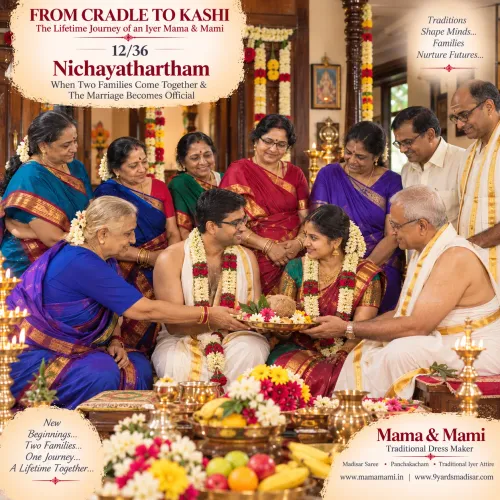
Previous — 12/36: Nichayathartham — When Two Families Come Together & the Marriage Becomes Official
Next — 14/36: Kasi Yatra, Maalai Maatral & Oonjal — The Joyful Traditions Before the Sacred Muhurtham
Mama & Mami — Traditional Dress Maker
Preserving traditions, one generation at a time.
Madisar Saree • Panchakacham • Traditional Iyer Attire