Remembering the Women Who Came Before Us & Seeking Their Blessings
FROM CRADLE TO KASHI • 11/36
The Lifetime Journey of an Iyer Mama & Mami
The marriage has not happened yet.
The wedding hall is still being discussed.
The invitations have not gone out.
The bride and groom are only beginning to imagine the life ahead of them.
But inside the family home, another preparation begins.
Patti opens her Madisar cupboard.
Amma starts making lists.
The kitchen becomes busy.
Banana leaves are arranged.
Traditional dishes are planned carefully.
And the women of the family begin to arrive.
Because before celebrating the generation that is about to begin its married life, many Iyer families pause to remember something equally important:
the generations of women who came before them.
This is Sumangali Prarthanai.
What Is Sumangali Prarthanai?
In families that observe it, Sumangali Prarthanai is a traditional family observance connected with remembering and seeking the blessings associated with married women of earlier generations who passed away while their husbands were living.
It may be performed before an auspicious family event such as a wedding, and some families observe it on other occasions according to their own traditions.
The procedure, number of women invited, food preparations and other details can differ significantly between families.
So, as throughout our journey:
our family elders and Vadhyar remain the best guides for the exact sampradayam followed in our own home.
This chapter is about the meaning surrounding the observance.
Before a New Mami Enters, We Remember the Mamis Before Her
Think about what is happening in our story.
A young man and woman are preparing for marriage.
Soon there will be a new household.
Perhaps one day children.
Then grandchildren.
Another branch will be added to the family tree.
But that tree did not begin with them.
Before today's Amma...
there was her Amma.
And her Patti.
And another generation before that.
Women cooked in these families.
Raised children.
Remembered festivals.
Preserved recipes.
Told stories.
Maintained relationships.
Welcomed daughters-in-law.
Sent daughters into new homes.
Taught Madisar.
Kept family customs alive.
Some of their names are still spoken frequently.
Others survive only in an old photograph.
Sumangali Prarthanai asks the family to remember.
Patti Knows Their Names
The younger generation may know only a few.
But Patti remembers more.
She points to an old photograph.
“That is your great-grandmother.”
Another photograph.
“That is her sister.”
Another.
“She used to make the best puliyodarai.”
Suddenly these aren't distant ancestors.
They become people.
One was strict.
One laughed loudly.
One made wonderful sweets.
One wore a particular Madisar.
One always visited a certain temple.
Family history becomes real when we remember the human details.
The House Wakes Early
On the morning of Sumangali Prarthanai, the house is awake long before the younger generation would prefer.
The entrance is cleaned.
Kolam appears.
The pooja area is prepared.
Brass lamps are polished.
Flowers arrive.
The kitchen is already active.
This is not a restaurant meal.
Each preparation carries the weight of family custom.
Amma checks one item.
Patti checks everything.
Twice.
The Kitchen Becomes the Heart of the House
There are vegetables being cut.
Dal cooking.
Coconut being grated.
Appalam waiting.
Payasam being prepared.
Traditional dishes may be made according to the family's particular practice.
And somewhere in the middle of all this activity, a younger family member asks:
“Why exactly do we make this dish?”
Patti stops.
There is a story.
Of course there is.
Perhaps a particular preparation has always been made in their family.
Perhaps Patti learned it from her mother-in-law.
Perhaps Amma learned it from Patti.
Recipes are rarely written into family genealogies.
But perhaps they should be.
Taste can carry ancestry too.
The Sumangalis Begin to Arrive
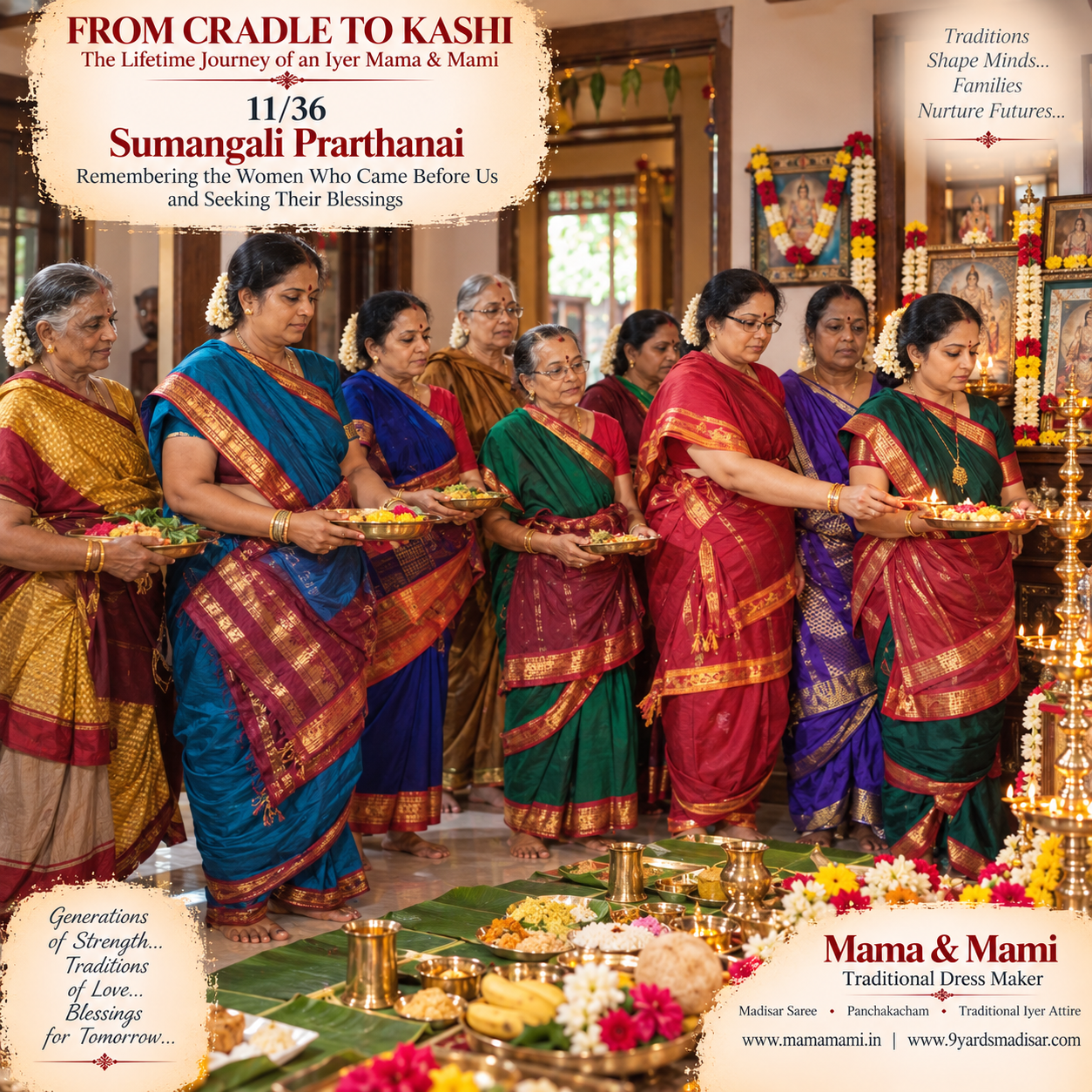
One by one, the invited married women enter the home.
Mamis.
Athais.
Periammas.
Chithis.
Close family women.
The exact number and manner of invitation vary according to family tradition.
They are welcomed respectfully.
Manjal.
Kumkum.
Flowers.
Traditional hospitality.
Soon the house fills with conversation.
Some women have not met for months.
Within five minutes they are speaking as though they met yesterday.
Today, Madisar Fills the House
For our From Cradle to Kashi journey, this is one of the most visually beautiful chapters.
Because several women may be dressed traditionally.
Patti wears her nine-yard Madisar.
Amma may wear Madisar.
Other Mamis may wear their traditional Madisar according to family practice.
Different colours.
Deep maroon.
Bottle green.
Mango yellow.
Royal blue.
Purple.
Arakku.
Traditional checks.
Rich zari.
But regardless of colour, our visual standard remains strict:
The Iyer Madisar passes over the RIGHT shoulder.
The grand zari-rich portion is displayed prominently across the FRONT, travelling from the LEFT toward the RIGHT side.
The waist is firmly wrapped and tucked.
And the lower portion forms the characteristic kacham, giving Madisar its authentic divided-leg structure.
Not a normal six-yard saree.
Not an invented AI drape.
A recognisable Iyer Madisar.
The Bride Watches Carefully
Our future Mami is there too.
Perhaps she has never attended Sumangali Prarthanai so closely before.
She watches Patti.
She watches Amma.
She listens to the women discussing what must be done.
One Mami explains something.
Another immediately corrects her.
A third says:
“In our house, we do it differently.”
Everyone laughs.
And that single conversation explains something important.
There is no one photograph that can represent every Iyer family's sampradayam.
Families carry variations.
That is why traditions are best learned inside the family that practises them.
A Special Place Is Prepared
According to the household's custom, the family makes the appropriate arrangements representing and remembering the Sumangalis of earlier generations.
The details can differ, and we need not turn this chapter into a step-by-step ritual manual.
What matters is the intention.
For a few hours, the family behaves as though the women who once occupied these rooms have not been forgotten.
Their names are remembered.
Their place in the family is acknowledged.
Their blessings are sought.
The Young Bride Suddenly Understands Something
Until now, marriage discussions have been about the future.
Wedding date.
Venue.
Clothes.
Jewellery.
Photography.
Guest list.
Career.
Where the couple will live.
But today she is seeing marriage from another direction.
Backward.
She is about to enter a family with a history that existed long before she arrived.
And the groom is entering hers too.
Marriage doesn't erase either family.
Ideally, it expands both.
Patti Looks at the Future Mami
Perhaps Patti calls her closer.
She adjusts a flower in the young woman's hair.
They talk.
Nothing dramatic.
But imagine what that moment represents.
One woman has already travelled through decades of married life.
The other is standing at its beginning.
Patti has been a bride.
A wife.
A daughter-in-law.
A mother.
A mother-in-law.
A grandmother.
The young woman has not yet experienced most of those roles.
There is an entire lifetime between them.
“Will You Teach Me Madisar?”
Perhaps the young bride asks the question we have been waiting for.
“Patti, will you teach me how to wear Madisar?”
Patti smiles.
“Kandippa.”
Of course.
Not because every woman must prove her tradition by wearing Madisar every day.
But because knowledge survives when somebody wants to learn and somebody is willing to teach.
One day, perhaps before another family ceremony, nine yards of silk will be unfolded.
Patti will stand beside her.
Right shoulder.
Front pallu.
Waist tuck.
Kacham.
Slowly.
Patiently.
And another woman will know.
Then Comes the Meal
Banana leaves are laid.
The invited Sumangalis are seated according to family custom.
Food is served carefully.
Rice.
Traditional preparations.
Vegetables.
Kootu.
Pachadi.
Payasam.
Appalam.
Other family-specific dishes.
The menu itself may vary.
But anybody who has watched an Iyer family ceremonial meal being served knows one thing:
Nobody is allowed to leave hungry.
Not remotely hungry.
Not theoretically hungry.
Not capable of becoming hungry within the next six hours.
Another spoon of payasam will appear whether requested or not.
The Bride Helps Serve
Perhaps our future Mami joins Amma in serving.
Patti watches.
The groom helps somewhere else—or is told repeatedly to move because he is standing in everybody's way.
There is laughter.
The formality of the marriage discussions is disappearing.
The bride is no longer merely “the girl whose Jathagam matched.”
She has a name.
A laugh.
Preferences.
Relationships.
She is slowly becoming part of the family.
And the groom is doing the same within hers.
Manjal, Kumkum & Thamboolam
According to the family's tradition, the invited women may be honoured with items such as manjal, kumkum, flowers, betel leaves, areca nut, fruits, blouse material or other customary offerings.
Again, exact practices vary.
The gesture is what matters in our story.
The women leave carrying something tangible.
The family remains carrying something intangible.
Blessings.
What About Sumangali Prarthanai After Marriage?
As we discussed when designing our 36-part journey, some families may observe Sumangali Prarthanai at different times or in connection with different auspicious occasions.
So this chapter should not imply:
“Every family must perform it exactly here, exactly this way.”
Our story places it before marriage because it gives us a powerful transition:
remembering the women of previous generations before welcoming the woman who will become part of the next one.
Families should follow their own sampradayam.
Tradition Is Not Only the Ritual
Look around the room after the formal observance.
That may actually be where tradition becomes most visible.
Patti teaching the bride the name of a dish.
Mami explaining a family story.
Amma packing food for somebody to take home.
Athai reminding everyone about another relative.
Women comparing how customs differ between their families.
Children running through the room without understanding any of it.
Yet.
Twenty years later, one of those children may remember this exact morning.
That is how cultural memory works.
The Women Who Are Missing Are Still Part of the Story
Eventually the conversation becomes quieter.
Someone remembers an elder who is no longer there.
“If she were alive, she would have been so happy to see this wedding.”
Everyone knows exactly who they mean.
For a moment, the room changes.
There are people whose absence becomes especially noticeable during happy occasions.
A grandmother.
A mother.
An Athai.
A beloved Mami.
Someone who should have been sitting right there.
We cannot bring them back.
But we can remember their place in the family.
And perhaps that is one of the deepest meanings we can take from this observance.
A Family Is More Than the People in Today's Photograph
Take a family photograph today.
You will see Patti.
Amma.
The future bride.
Mamis.
Athais.
Perhaps the groom standing somewhere behind them.
But the family is larger than the photograph.
Behind Patti stands another generation.
Behind that generation, another.
Names disappear.
Photographs fade.
Houses change.
Cities change.
But something keeps travelling forward.
A recipe.
A prayer.
A story.
A Madisar drape.
A family deity.
A phrase.
A habit.
A value.
Sometimes that is how ancestors remain with us.
Now the Wedding Can Come Closer
The banana leaves are cleared.
The kitchen slowly becomes quiet.
The invited women leave.
Patti sits down at last.
Amma looks exhausted.
The bride smiles.
One more family observance has been completed.
And now...
the wedding preparations accelerate.
There will be shopping.
Invitations.
Jewellery.
Veshti.
Panchakacham.
Madisar.
Seer.
Relatives.
Travel.
Music.
Food.
Confusion.
Laughter.
And approximately seventeen people asking the same question:
“Everything ready?”
No.
Everything is never ready.
But the wedding will arrive anyway.
And before the wedding itself, there is another beautiful moment.
Nichayathartham — the formal engagement and the moment two families publicly say: this marriage is going forward.
That is where our journey goes next.
FROM CRADLE TO KASHI • 11/36
Sumangali Prarthanai Before Marriage
Remembering the Women Who Came Before Us & Seeking Their Blessings
Previous — 10/36:
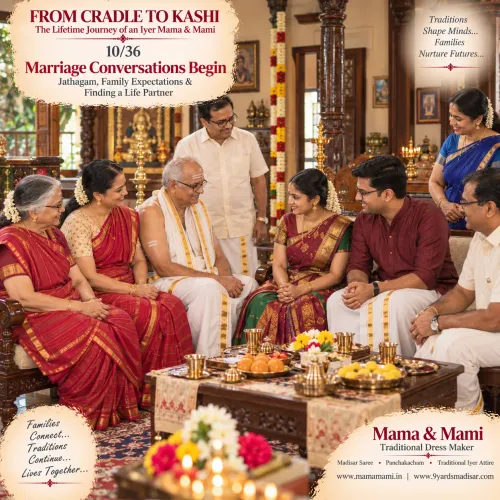
Marriage Conversations Begin: Jathagam, Family Expectations & Finding a Life Partner
Next — 12/36:
Nichayathartham — When Two Families Make the Marriage Official
Mama & Mami – Traditional Dress Maker
Preserving traditions, one generation at a time.
Madisar Saree • Panchakacham • Traditional Iyer Attire