09/36 — School, College & Leaving Home
When Tradition Travels With the Next Generation
FROM CRADLE TO KASHI • 09/36
The Lifetime Journey of an Iyer Mama & Mami
There was a time when Amma had to hold his hand while crossing the road.
There was a time when Appa guided his tiny finger through rice during Aksharabhyasam.
There was a time when Patti had to remind him of the words of a simple slokam.
There was a time when Thatha patiently showed him how things were done.
Then came school.
Upanayanam.
Examinations.
Friends.
Ambitions.
And suddenly, without anybody noticing exactly when it happened...
the little boy became a young man.
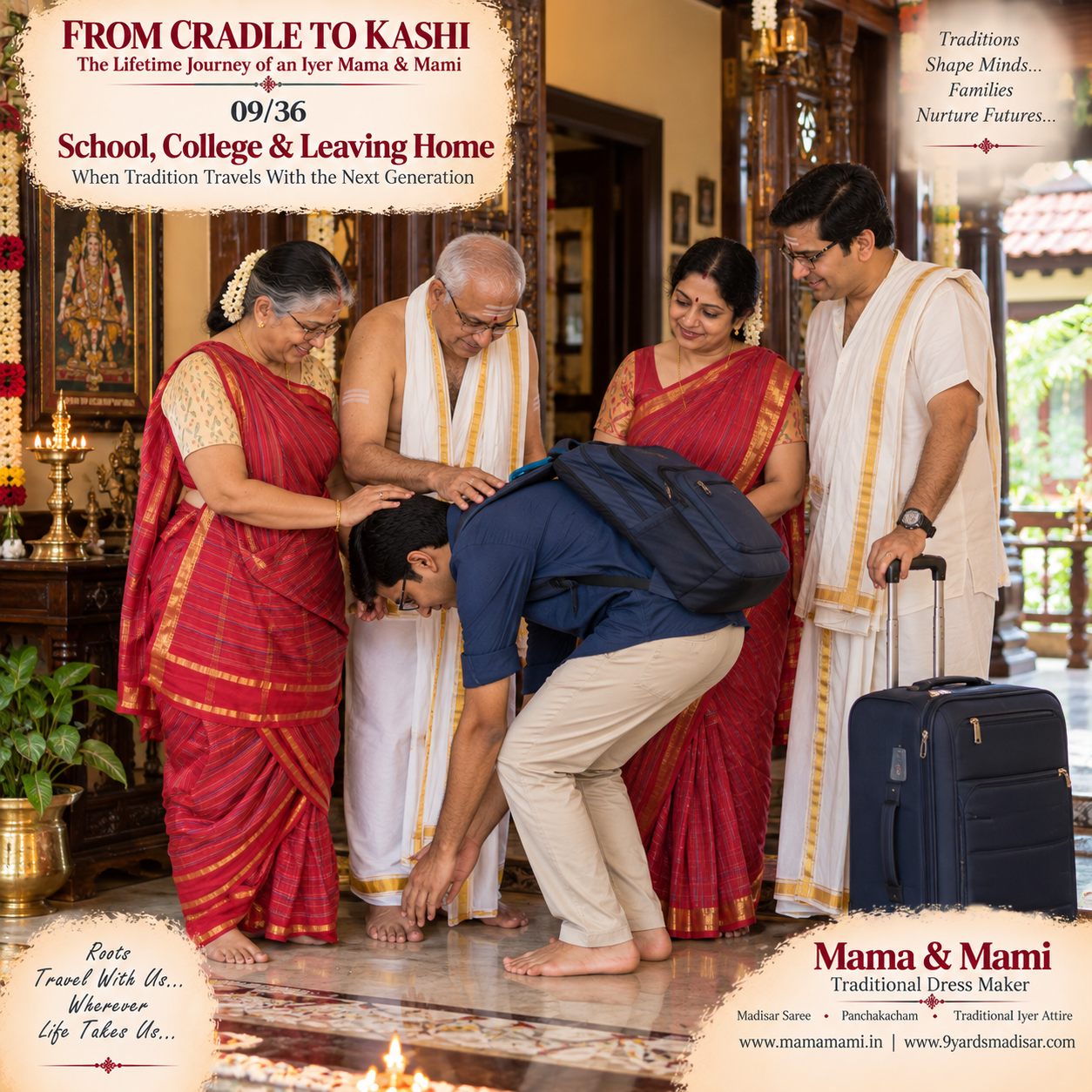
Today there is a suitcase in the middle of the room.
And Amma doesn't like looking at it.
“Did We Pack Everything?”
The suitcase is already full.
Amma opens it again.
“Where is your towel?”
“Amma, it's there.”
“Medicines?”
“Yes.”
“Documents?”
“Yes.”
“Extra veshti?”
“Yes, Amma.”
“Did you take—”
“AMMA!”
Appa smiles from across the room.
He knows better than to interfere.
Because Amma isn't really worried about the towel.
Her son is leaving home.
From Aksharabhyasam to College Admission
Remember that little brass tray filled with rice?
The child could barely trace his first letters.
Those letters became words.
Words became school books.
School books became examinations.
Examinations became applications.
And now an admission letter sits on the table.
Perhaps engineering.
Medicine.
Commerce.
Law.
Music.
Science.
Research.
Or an entirely different path.
For the family, the profession matters.
But something else matters more.
The child has begun choosing his own road.
The First Day of School Feels Like Yesterday
Amma still remembers the first school uniform.
The oversized bag.
The water bottle.
The tiny shoes.
Perhaps he cried at the gate.
Perhaps Amma cried after he went inside.
Appa probably said:
“He'll be fine.”
And he was.
Now, years later, Appa says the same thing.
“He'll be fine.”
But this time the destination may be hundreds—or thousands—of kilometres away.
Patti Doesn't Ask Whether He Packed His Laptop
Patti has different priorities.
“Did you take the small picture of Perumal?”
“Yes, Patti.”
“Kumkum?”
“Yes.”
“Vibhuti?”
“Yes.”
“Call when you reach.”
“Yes, Patti.”
“And don't forget Sandhyavandanam.”
A slightly longer pause.
“Yes, Patti.”
She looks at him carefully.
Patti knows exactly which “yes” sounded less convincing than the others.
Thatha Gives Advice Differently
Thatha doesn't pack anything.
He waits until the room becomes quieter.
Then he calls his grandson.
“Come here.”
The young man sits beside him.
Thatha doesn't give a twenty-minute lecture.
Perhaps he says only:
“Study well. Choose your friends carefully. Look after yourself. Don't forget where you came from.”
Four sentences.
A lifetime of meaning.
Tradition Is About to Leave the House Too
Until now, tradition was always nearby.
If the boy forgot something, Appa was there.
If he had a question, Thatha could explain.
Festivals happened automatically because Amma and Patti prepared everything.
The Kula Deivam visit appeared on the family calendar.
Deepavali meant waking up to a house already transformed.
Navaratri meant Golu because somebody else opened the boxes.
But what happens when the child lives alone?
That is when inherited tradition encounters an important test.
What will he choose to carry with him?
The First Deepavali Away From Home
Perhaps college is too far away.
Perhaps examinations are approaching.
Perhaps travel isn't possible.
For the first time, Deepavali morning begins without Amma knocking on the door.
No Patti in the kitchen.
No Thatha already dressed.
No Appa organising the morning.
The young man wakes in a hostel room.
He checks his phone.
Twenty-three family messages.
Then a video call.
Amma appears first.
“Happy Deepavali!”
Patti appears somewhere behind her.
“Show me what you're wearing!”
Suddenly the distance becomes very real.
A Veshti in a Hostel Cupboard
Among jeans, T-shirts and formal clothes sits something Amma insisted he carry.
A traditional veshti.
Perhaps Panchakacham is required for an observance he participates in later.
Perhaps he wears traditional attire for a temple visit.
Perhaps another Tamil family invites him for a festival.
Clothing can become surprisingly emotional when you are far from home.
At home, a veshti was ordinary.
Away from home, it can feel like a piece of home itself.
And Somewhere at Home Is Patti's Madisar
Patti still opens the same cupboard.
The Madisars are still carefully folded.
On festival mornings, she wears them in the familiar way the child has known since childhood:
over the RIGHT shoulder, with the grand zari-rich section displayed across the FRONT from LEFT toward RIGHT, the waist firmly tucked, and the traditional kacham completing the nine-yard drape.
But now someone is missing from the breakfast table.
Patti notices.
Of course she does.
Amma Learns to Parent Through a Phone
“Did you eat?”
This may be the most internationally recognised Indian mother's greeting.
Not:
“How are you?”
Not:
“How was class?”
First:
“Did you eat?”
“Yes.”
“What?”
Silence.
That silence is dangerous.
“What did you eat?”
“Something.”
“Something means what?”
The interrogation begins.
Distance has not reduced Amma's authority.
Technology has merely given it Wi-Fi.
Appa's Calls Are Shorter
Appa calls too.
“How are things?”
“Good.”
“Money okay?”
“Yes.”
“Studies?”
“Fine.”
“Okay. Call Amma.”
Conversation complete.
But sometimes Appa sends money before the son asks.
Sometimes he quietly checks whether the train ticket has been booked.
Sometimes he stays awake until the “Reached” message arrives.
Parents do not always express love in the same language.
Then Comes the First Real Failure
Growing up away from home also means nobody can protect the child from everything.
Perhaps an examination goes badly.
Perhaps a friendship ends.
Perhaps an internship is rejected.
Perhaps the first job application fails.
The young man calls home.
For once, he doesn't know what to do.
And suddenly the people whose advice once felt unnecessary become exactly the people he wants to hear.
Appa says:
“Try again.”
Amma says:
“Come home for a few days.”
Patti says:
“Everything will be all right.”
Thatha says very little.
But he listens.
Sometimes that is enough.
Education Is More Than a Degree
Families can become so focused on marks, ranks, universities and careers that we forget what education is supposed to produce.
Not merely a successful employee.
Not merely a high salary.
Not merely a degree framed on a wall.
But a human being capable of thinking.
Choosing.
Taking responsibility.
Treating others well.
Understanding where he came from without being imprisoned by it.
And building something meaningful of his own.
Tradition Must Also Learn to Travel
Our grandparents often lived close to extended family.
Many families today do not.
Children move from Chennai to Bengaluru.
Coimbatore to Mumbai.
India to Singapore.
India to Dubai.
India to London.
India to the United States.
Families become distributed across time zones.
Does tradition disappear?
Not necessarily.
But its form may change.
A slokam may be learned through a video call.
A festival may be celebrated in a small apartment.
A Panchakacham tutorial may happen over the phone with Appa.
A family may travel thousands of kilometres for a wedding.
A Kula Deivam visit may become the first item on the itinerary whenever they return to India.
Distance changes tradition. It does not automatically end it.
The Best Traditions Become Chosen Traditions
As children become adults, parents lose something important.
Control.
And perhaps that is necessary.
A child may follow customs because Amma insists.
An adult eventually has to decide:
What does this mean to me?
That transition can worry families.
But there is also something beautiful about it.
A tradition followed voluntarily, after questioning and understanding it, may become stronger than one followed only because somebody was watching.
“When Are You Coming Home?”
Soon this becomes the family's favourite question.
Semester holidays.
Long weekends.
Deepavali.
Pongal.
A cousin's wedding.
A temple visit.
Any reason is good enough.
Then finally the message arrives:
“Tickets booked.”
The house changes immediately.
Amma begins planning food.
Patti asks what he wants to eat.
Appa checks the arrival time.
Thatha pretends not to be particularly excited.
Nobody believes him.
The Door Opens
The young man enters.
The suitcase lands in exactly the wrong place.
Amma complains.
Then feeds him.
Patti says he has become thin.
He has not.
Thatha asks about college.
Appa wants to know about the journey.
Within thirty minutes, it feels as though he never left.
That is one of the strange comforts of home.
You can grow somewhere else and still return to the place that remembers every earlier version of you.
But Something Has Changed
The boy who left is not exactly the person who returned.
He has lived independently.
Made decisions.
Met people from different backgrounds.
Encountered different ways of thinking.
Perhaps questioned some things he once accepted automatically.
That is not necessarily a loss of tradition.
It may be the beginning of understanding it as an adult.
Patti tells a story he has heard ten times.
This time he listens differently.
Thatha explains something.
This time he asks a better question.
Growing up changes not only what we know.
It changes what we are ready to understand.
The Family Photograph Changes Again
Remember the photograph from Aksharabhyasam?
A tiny child.
Remember Upanayanam?
A young boy beside Appa.
Now another photograph appears.
A young man stands between Amma and Appa.
Patti and Thatha beside them.
He is taller than almost everyone.
Patti looks at the photograph.
“When did you become so big?”
Nobody has an answer.
And Then the Conversations Begin
At first they are casual.
A relative asks Amma:
“How old is he now?”
Another asks:
“Finished college?”
Another:
“Working?”
Then somebody smiles and asks the question that changes the direction of our story.
“So... when are you going to start looking?”
The young man suddenly becomes very interested in something on his phone.
Amma smiles.
Appa changes the subject.
Patti does not.
Because another major chapter of the Iyer Mama & Mami journey is approaching.
Marriage.
But before a wedding comes a world of conversations.
Family expectations.
Jathagam.
Introductions.
Penn Paarthal.
Compatibility.
The hopes of two families.
And, most importantly, the choices of the two people whose lives may be joined.
The little boy from our cradle has grown up.
Soon, our story will introduce the young woman who may walk beside him through the rest of this journey.
FROM CRADLE TO KASHI • 09/36
The Lifetime Journey of an Iyer Mama & Mami
Previous — 08/36:
Upanayanam: The Sacred Thread, Gayatri Mantra & a Boy's New Responsibility
Next — 10/36:
Marriage Conversations Begin: Jathagam, Family Expectations & Finding the Right Life Partner
Mama & Mami – Traditional Dress Maker
Preserving traditions, one generation at a time.
Madisar Saree • Panchakacham • Traditional Iyer Attire