When Two Families Come Together & the Marriage Becomes Official
FROM CRADLE TO KASHI • 12/36
The Lifetime Journey of an Iyer Mama & Mami
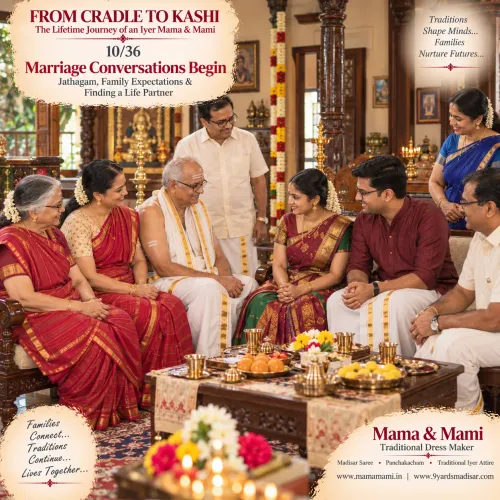
The conversations have happened.
The families have met.
The young man and woman have spoken.
Questions were asked.
Jathagam was considered, where followed.
Both families have agreed.
And most importantly...
the bride and groom have said yes.
Until now, everyone has been talking about a possible marriage.
Today that changes.
Relatives gather.
Traditional clothes come out of the cupboards.
Flowers arrive.
Thamboolam is prepared.
The house becomes festive.
And two families come together to formally announce:
“The marriage has been agreed upon.”
Welcome to Nichayathartham.
From “Penn Paarthal” to “Nichayam”
Remember our previous chapters?
A photograph arrived.
A biodata was discussed.
Phone numbers were exchanged.
The first conversation was slightly awkward.
Then came another.
And another.
The families met.
The prospective bride and groom were finally allowed to speak without twenty relatives listening.
And eventually came that small but life-changing answer:
“Yes.”
Now the relationship moves from discussion towards commitment.
For families that observe Nichayathartham, this becomes an important milestone before the wedding.
What Is Nichayathartham?
Nichayam carries the idea of something being decided or confirmed.
Nichayathartham is therefore commonly understood as the formal engagement or confirmation of the proposed marriage.
The exact customs can differ considerably between Iyer families depending on family tradition, Veda shakha, region and the guidance of elders or the Vadhyar.
Some families keep it intimate.
Some conduct it as part of a larger function.
Some combine particular engagement customs with wedding-related ceremonies.
So, as always in our series, we are telling the family story and significance, rather than claiming that every Iyer household follows one identical procedure.
The Bride's House Is Busy
The function may begin at a perfectly reasonable hour.
The preparations do not.
Amma has been awake for hours.
Patti has been awake even longer.
Someone is arranging flowers.
Someone is checking fruits.
Someone is looking for a missing plate.
Someone is calling a relative who is already late.
And Appa has been asked the same question approximately fifteen times:
“Everything ready?”
His answer remains optimistic.
“Almost.”
It is never almost.
Patti's Madisar Comes Out Again
Today, Patti has selected one of her beautiful Madisars.
Perhaps deep bottle green with an arakku-red zari section.
Perhaps royal blue and maroon.
Perhaps mango yellow.
Perhaps traditional red.
Whatever the colour, the drape carries the unmistakable construction we have established throughout our journey.
RIGHT shoulder.
The rich zari section prominently across the FRONT, moving from LEFT toward RIGHT.
Firm waist wrapping.
Authentic lower kacham.
Nine yards worn as Madisar—not a six-yard saree made to look vaguely traditional.
Amma may also wear Madisar for the occasion according to family custom.
And suddenly the house itself looks different.
The Groom's Family Arrives
Cars stop outside.
The door opens repeatedly.
“Vango! Vango!”
Come in.
The groom enters with his parents and relatives.
Mamas.
Mamis.
Athais.
Periappas.
Periammas.
Cousins.
Everyone is welcomed.
The bride's family receives them warmly.
Within minutes, footwear fills the entrance.
That may be the unofficial sign that an Indian family function has properly begun.
Thamboolam Is Ready
Traditional trays are beautifully arranged.
Betel leaves.
Areca nuts.
Fruits.
Coconut.
Flowers.
Manjal.
Kumkum.
Other customary items according to the family's practice.
Perhaps clothes and gifts are also arranged.
Every tray has been checked repeatedly.
Then Patti notices something.
One item has been placed in the wrong tray.
Naturally.
It is corrected immediately.
Order is restored.
The Bride Is Getting Ready
Inside another room, a completely different operation is underway.
Her saree is being adjusted.
Flowers are being fixed into her hair.
Jewellery is checked.
Someone adjusts the pleats.
Someone else adjusts what the first person just adjusted.
Amma enters.
“Ready?”
Almost.
Patti enters.
She looks at her granddaughter.
And for a moment she says nothing.
The little girl who once followed her around the house is standing before her as a bride-to-be.
The Groom Is Pretending to Be Relaxed
Outside, the groom sits with Appa, Thatha and the other men.
He appears calm.
He is not.
His phone is probably receiving messages from cousins sitting only three metres away.
He looks toward the doorway occasionally.
Everyone notices.
Nobody says anything.
For approximately thirty seconds.
Then one Mama smiles.
The teasing begins.
And Then the Bride Walks In
Conversation quietens slightly.
The bride enters.
For the groom, perhaps this isn't the first time he has seen her.
But it is different today.
Today their families are gathered around them.
Today everyone knows why they are here.
Today she is no longer the person from a biodata.
And he is no longer the prospective groom.
They are slowly becoming:
the bride and groom.
The Formal Confirmation
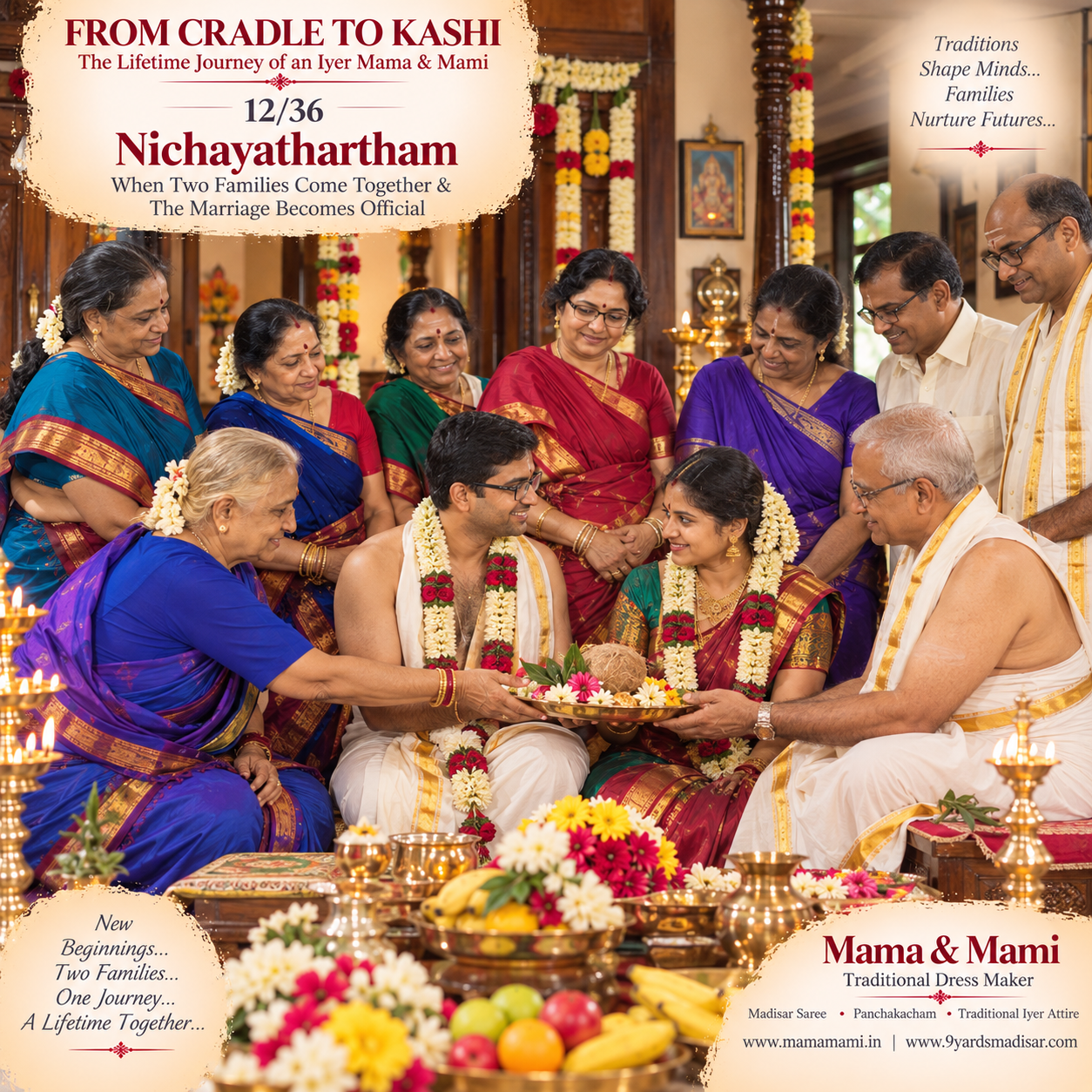
At the appropriate stage, according to family custom, the marriage agreement is formally acknowledged.
Family elders participate.
Traditional items may be exchanged.
The details differ between households.
In some traditions, the agreed marriage details are formally read or announced.
The atmosphere is both ceremonial and deeply personal.
A decision once discussed privately between a handful of people is now being recognised before the extended family.
The marriage is moving forward.
The Lagna Patrikai
In families where this forms part of the practice, the Lagna Patrikai or formal record/announcement of the marriage details becomes an important part of the occasion.
Names.
Family details.
Wedding date.
Muhurtham.
Venue or other relevant information.
What had been conversations and calendar discussions now becomes something concrete.
Patti listens carefully.
Appa listens even more carefully.
Amma is already thinking about everything that must happen before that date.
The bride and groom look at each other.
They are probably thinking:
“This is actually happening.”
Blessings From the Elders
Then comes one of the simplest and most meaningful moments.
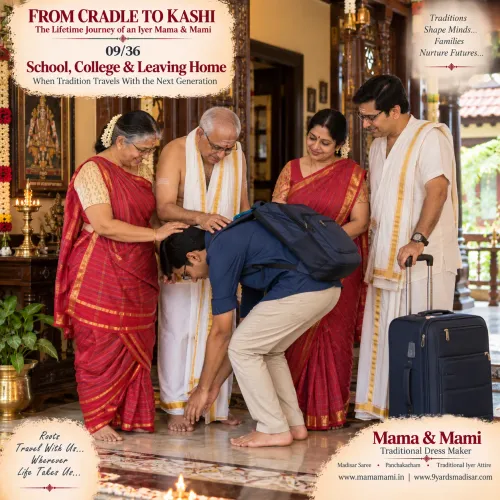
The couple seeks the blessings of their elders.
First the parents.
Then Patti and Thatha.
Other senior relatives.
The bride and groom bend respectfully.
Hands rest gently on their heads.
Words of blessing are spoken.
“Nanna irungo.”
Be well.
“Sandhoshama irungo.”
Live happily.
“Deergha Sumangali Bhava.”
Blessings for a long and auspicious married life may be offered to the bride according to tradition.
No expensive decoration can replace this moment.
Patti Has Been Waiting for This
The couple comes before Patti.
She looks at them together.
Perhaps her blessing lasts slightly longer.
Because Patti sees more than an engagement.
She sees the next branch of the family beginning.
One day these two may establish their own home.
Perhaps buy their first house.
Perform Grahapravesam.
Visit their Kula Deivam.
Celebrate their first Deepavali together.
Perhaps have children.
Perhaps one day become Appa and Amma themselves.
Patti cannot see the future.
But she has lived enough of life to imagine it.
Two Families, Not Two Opposing Teams
This is an important point.
Traditional weddings sometimes create language such as:
“Bride's side.”
“Groom's side.”
Useful for organising responsibilities.
Dangerous if taken too seriously.
A marriage should not become a competition between two families.
Who gave more?
Who invited more?
Who spent more?
Whose custom should dominate?
Who received what?
These questions can quickly overshadow the reason everyone gathered in the first place.
Two people are trying to build a life together.
The families should make that journey easier.
Not heavier.
Gifts Are Not the Measure of a Marriage
Engagements and weddings often involve gifts according to family customs.
But affection cannot be measured by the price of silk, jewellery or silver.
Nor should tradition become an excuse for pressure or demands.
What matters far more is whether the couple enters marriage with:
respect, willingness, clarity and support.
A simple Nichayathartham filled with genuine happiness is worth far more than an extravagant celebration filled with anxiety.
The Family Photograph
Then comes our inevitable moment.
“Everybody come for photo!”
The bride and groom stand together.
Amma and Appa join.
The groom's parents join.
Patti and Thatha are called.
Then siblings.
Then Mamas and Mamis.
Then cousins.
Then someone who went to get coffee has to be called back.
Eventually everyone looks toward the camera.
Almost everyone.
Click.
Another photograph enters the family archive.
The Bride and Groom Get One Photograph Alone
Finally, somebody manages to remove the relatives from the frame.
For perhaps ten seconds.
The couple stands together.
There is still a little formality between them.
They smile.
Click.
Years later, their children may find this photograph.
“Appa, you looked so young!”
“Amma, look at your saree!”
The parents will protest.
The children will laugh.
The photograph will survive the moment that created it.
Then Comes Food
Because no major family milestone is complete until somebody asks:
“Saaptiya?”
Have you eaten?
Banana leaves are laid or the meal is served according to the arrangement.
Relatives sit together.
Conversations become louder.
The formal part is over.
Now everybody can concentrate on what Indian families do exceptionally well:
discussing the next function while still attending the current one.
Wedding Planning Begins Immediately
The engagement has barely finished.
Already:
“When are you buying the wedding saree?”
“Has the hall been booked?”
“What about the caterer?”
“Nadaswaram?”
“Photographer?”
“Accommodation?”
“How many guests?”
“What about the seer?”
“Madisar ready?”
“Panchakacham?”
The bride looks at the groom.
The groom looks at the bride.
Welcome to wedding planning.
The Clothes Now Carry Special Importance
For the coming wedding, traditional clothing will become an important part of our story.
The groom will require appropriate veshti and Panchakacham for different ceremonies.
The women of the family will prepare their sarees and Madisars.
And our future Mami may soon begin learning something that Patti promised to teach.
Nine yards.
Right shoulder.
Front zari section.
Waist tuck.
Kacham.
The Madisar that once belonged only to the world of Patti and Amma is about to become part of another generation.
But Before the Muhurtham...
An Iyer wedding is not simply one moment when a thaali is tied.
There are ceremonies, family customs and beautiful traditions surrounding the wedding itself.
The wedding atmosphere begins building long before the final Muhurtham.
Relatives arrive.
The bride's home transforms.
The groom's family prepares.
Traditional clothing is unpacked.
The wedding hall begins filling.
And soon we reach one of the most colourful parts of our entire 36-part journey:
the Iyer wedding celebrations.
There will be Vratham.
There will be Janavasam.
There will be Kasi Yatra.
There will be Oonjal.
There will be laughter.
There will be tears.
There will be Madisar.
There will be Panchakacham.
And ultimately, two people who once appeared on each other's phone screens will sit together before Agni.
Our little child from the cradle is about to become...
Mama or Mami.
FROM CRADLE TO KASHI • 12/36
Nichayathartham
When Two Families Come Together & the Marriage Becomes Official
Previous — 11/36:
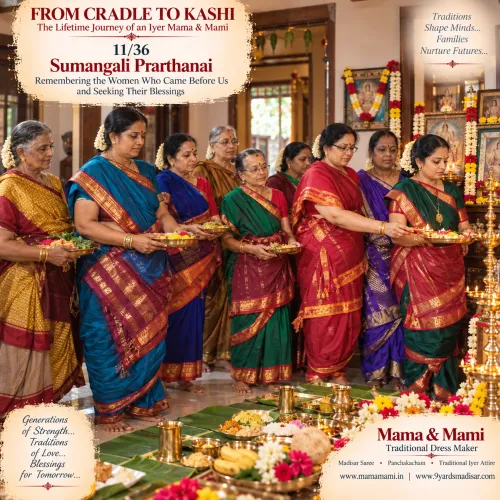
Sumangali Prarthanai — Remembering the Women Who Came Before Us & Seeking Their Blessings
Next — 13/36:
The Iyer Wedding Begins — Vratham, Janavasam & Welcoming the Groom's Family
Mama & Mami – Traditional Dress Maker
Preserving traditions, one generation at a time.
Madisar Saree • Panchakacham • Traditional Iyer Attire