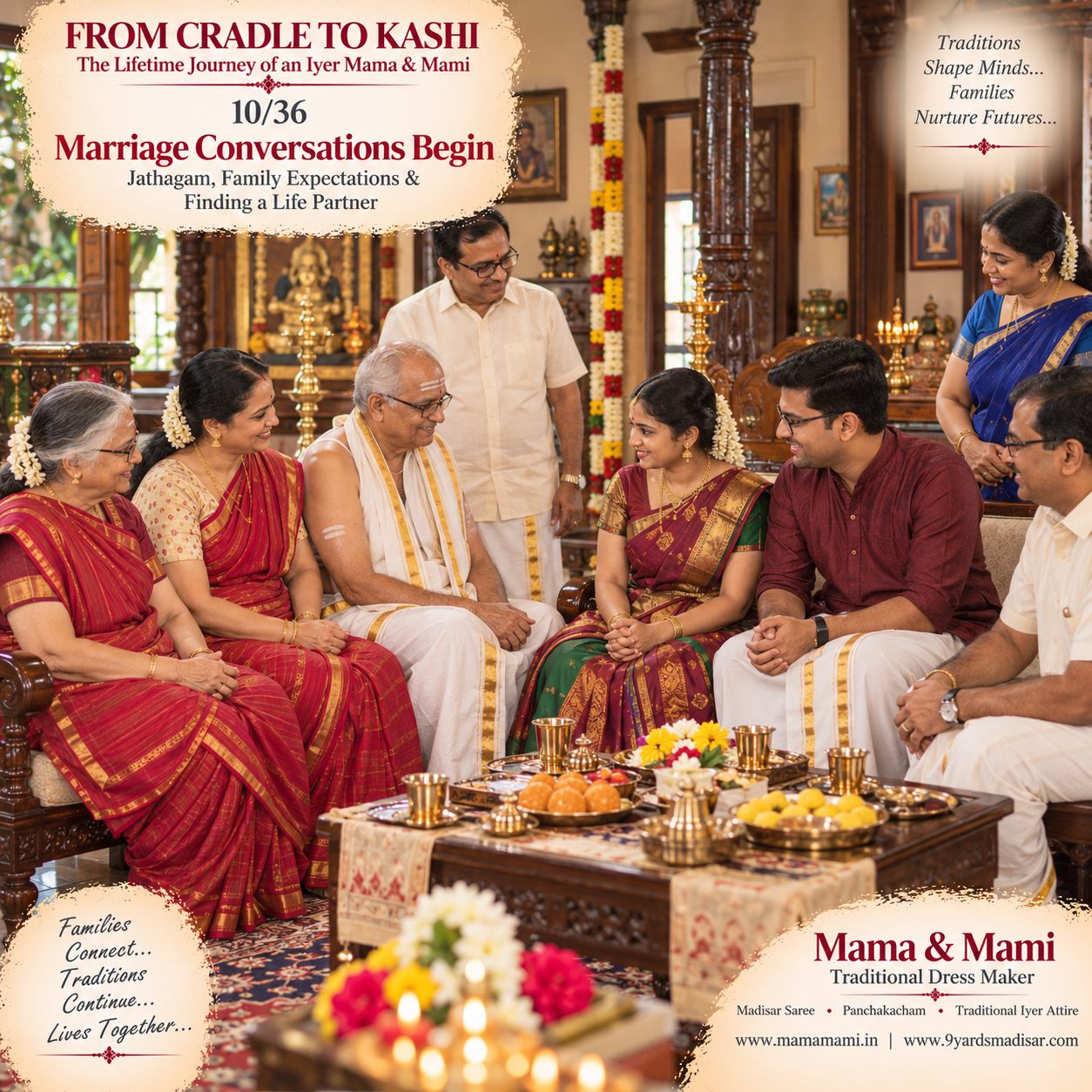
10/36 — Marriage Conversations Begin
Jathagam, Family Expectations & Finding a Life Partner
FROM CRADLE TO KASHI • 10/36
The Lifetime Journey of an Iyer Mama & Mami
There was once a cradle in this house.
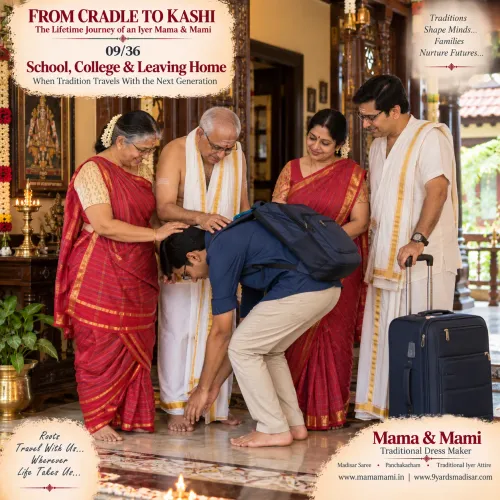
Then came first food, first letters, school, Upanayanam or a daughter's coming-of-age traditions, college, and eventually the day the child left home carrying a suitcase.
Now the suitcase comes home less often.
The child has become an adult.
There is a career.
There are responsibilities.
There is independence.
And then, during what appears to be an entirely ordinary family conversation, somebody asks the question everyone knew would eventually arrive:
“Shall we start looking for a marriage alliance?”
Suddenly, another chapter begins.
The Question Is Simple. The Answer Isn't.
For Patti's generation, marriage conversations may have happened very differently.
For Amma and Appa's generation, things had already changed.
For today's generation, they have changed again.
Education matters.
Career matters.
Where each person wants to live matters.
Family expectations matter.
Lifestyle matters.
Values matter.
And most importantly:
the two people getting married must want the marriage.
A wedding can be organised by hundreds of people.
A marriage must ultimately be lived by two.
First Comes the Conversation at Home
Amma doesn't begin with a biodata.
She begins with her child.
“What kind of person are you looking for?”
There may be silence.
Perhaps the son or daughter has never seriously thought about it.
Or perhaps they have thought about it extensively and simply never discussed it at home.
Appa joins the conversation.
Patti listens.
Thatha listens.
Everyone has an opinion.
Naturally.
But this conversation needs something more important than opinions.
Listening.
“What Kind of Family?”
For many traditional families, marriage has never been viewed only as the union of two individuals.
Two families are also entering one another's lives.
So questions begin.
What is the family like?
Where are they from?
What values do they follow?
What does the boy or girl do?
Where do they live?
What are their plans?
How traditional are they?
How modern are they?
And perhaps the most useful question of all:
Will these two people actually be happy living together?
Then Patti Asks the Question Everyone Expected
“Jathagam irukka?”
Do we have the horoscope?
Of course we do.
Somewhere.
Amma begins looking.
Appa thinks he knows where it is.
He does not.
A cupboard opens.
Old files appear.
Birth certificates.
School records.
Photographs.
Temple receipts.
Documents nobody has seen in fifteen years.
Eventually:
“Kidaichuduthu!”
Found it.
Another traditional part of the marriage conversation has entered the room.
Jathagam and Horoscope Matching
In many Iyer families that follow the practice, Jathagam or horoscope matching forms part of marriage discussions.
Families may consult a trusted astrologer or Vadhyar and consider traditional compatibility factors.
Other families may place less emphasis on horoscope matching, and some may not use it at all.
Our series isn't here to decide that question for every family.
What matters is recognising that for many households, this remains part of the traditional process.
But even when families consider Jathagam important, a horoscope cannot replace something fundamental:
the willingness and compatibility of the two people themselves.
The Biodata Arrives
Then comes the document that can apparently summarise an entire human being in one page.
Name.
Age.
Height.
Education.
Profession.
Location.
Family details.
Nakshatram.
Gothram.
Perhaps hobbies.
And a photograph.
Patti puts on her glasses.
Amma zooms into the photograph.
Appa reads the educational details.
The prospective bride or groom says:
“Can I please see the phone?”
Everyone suddenly remembers whose marriage this actually is.
Marriage Conversations Have Changed
Earlier generations often depended on relatives, community networks and known families.
Then came matrimonial advertisements.
Then matrimonial websites.
Today, introductions can happen through relatives, friends, professional networks, matrimonial platforms and many other routes.
The method changes.
The important questions remain surprisingly similar.
Who is this person?
What kind of life do they want?
Can we communicate?
Can we respect each other?
Can we build a life together?
A Photograph Cannot Tell You Enough
A photograph can show a face.
A biodata can show qualifications.
A horoscope can present an astrological framework for families who follow it.
But none of them can tell you everything about a person.
Does the person listen?
How do they behave when angry?
How do they treat parents?
How do they think about money?
Do they want children?
Where do they want to live?
How important are religious practices?
What about careers after marriage?
How will household responsibilities be shared?
How much involvement will extended families have?
These conversations may not look romantic.
But they can matter enormously.
Patti Has Her Own Checklist
Patti's questions are different.
“Does the family know our customs?”
“Do they visit their Kula Deivam?”
“Will they come for family functions?”
“Does she know Madisar?”
Or perhaps:
“Does he know Panchakacham?”
The younger generation smiles.
But underneath Patti's questions is a genuine concern.
She isn't merely asking whether someone knows how to wear nine yards of silk.
She is asking:
“Will the traditions I spent my life carrying continue after me?”
That is a much deeper question.
But Tradition Can Be Learned
Perhaps the prospective bride has never worn Madisar.
That doesn't mean she cannot learn.
Perhaps the prospective groom cannot tie Panchakacham without help.
That can be learned too.
A person doesn't need to arrive at marriage already knowing every family custom.
Traditions survive because people teach them patiently.
One day, perhaps Patti herself will stand beside the new Mami, carefully showing her where the nine-yard saree must go.
RIGHT shoulder.
Front drape correctly arranged.
Grand zari section across the front from LEFT toward RIGHT.
Waist firmly tucked.
Kacham correctly formed.
Not simply clothing.
A lesson passed from one generation to another.
The First Phone Call
Eventually, after families have spoken and both individuals agree, telephone numbers are exchanged.
The phone rings.
“Hello?”
“Hi.”
A pause.
Both have been told approximately fifty things about the other person.
Neither knows what to say.
“How was your day?”
“Good.”
Another pause.
This may not look like the beginning of an epic love story.
Give them time.
The Conversations Become Longer
One call becomes another.
Messages follow.
The formal questions slowly become real conversations.
Work.
Music.
Food.
Travel.
Family.
Career.
Religion.
Friends.
Money.
Where to live.
What marriage means to each person.
Perhaps they agree on many things.
Perhaps they disagree on some.
That is not necessarily a problem.
The more important question is:
Can they discuss disagreement with respect?
Then Comes the First Meeting
For many families, there eventually comes a meeting sometimes loosely described as Penn Paarthal, though modern meetings can look very different from older versions of the custom.
Perhaps both families meet at home.
Perhaps they meet in a restaurant.
Perhaps the prospective bride and groom have already spoken several times.
Still, the day feels important.
Amma has been preparing since morning.
Appa says:
“Don't make it too elaborate.”
Nobody listens.
The Doorbell Rings
The other family arrives.
Introductions begin.
Coffee appears.
Then snacks.
Then more snacks.
Nobody knows exactly how much food is appropriate, so naturally there is enough for a small wedding.
The prospective bride and groom sit somewhere within the group.
Every elder is trying very hard not to look as though they are observing them.
Nobody succeeds.
“Let Them Talk”
Eventually somebody says the sentence both people have been waiting for.
“Let them talk for a while.”
They move somewhere quieter.
For the first time, the families are no longer controlling the conversation.
Now it belongs to them.
This may be the most important part of the entire day.
Because beneath the flowers, coffee, Jathagam and family introductions is a very simple reality:
Two people are deciding whether they want to share a life.
There Should Be Space to Say No
This deserves to be said clearly.
Not every introduction needs to become a marriage.
A meeting is not a commitment.
A horoscope match is not consent.
Family enthusiasm is not consent.
A beautiful biodata is not compatibility.
Either person should have the freedom to say:
“I don't think this is right for me.”
That answer may disappoint people.
But a respectful “no” before marriage is far better than an unwilling “yes” followed by years of unhappiness.
And Sometimes the Answer Is Yes
Perhaps something feels comfortable.
The conversations continue.
The families meet again.
Questions are answered.
Expectations become clearer.
There is laughter now.
The phone calls no longer feel formal.
Amma notices her child smiling at the phone.
Patti notices too.
Patti notices everything.
Then one evening:
“What do you think?”
A pause.
A smile.
“I think we can proceed.”
The entire atmosphere in the house changes.
One Family Calls the Other
Appa makes the call.
The conversation is warm.
Both families are happy.
Patti immediately wants to know what comes next.
Dates.
Vadhyar.
Jathagam details.
Venue.
Relatives.
Clothes.
Guest lists.
Nothing has actually been booked.
Patti has mentally completed half the wedding.
Amma Looks at Her Child Differently
Marriage preparations haven't even started.
But Amma already understands something.
Her son or daughter is about to build another home.
Until now, whenever they said “home,” they meant this house.
Soon there may be another home.
Another family.
Another set of relationships.
Another kitchen.
Another pooja room.
Another Deepavali morning.
This is happiness.
And like many forms of parental happiness, it carries a little sadness inside it.
Patti Opens the Madisar Cupboard
Not yet for the wedding.
There are several chapters before that.
But Patti is already thinking.
Which Madisar for the engagement?
Which one for the wedding?
Should we buy another?
Of course we should buy another.
Some questions have very easy answers.
And elsewhere, discussions begin about the groom's Panchakacham and the traditional clothing required for the ceremonies.
Slowly, the wedding stops being an idea.
It starts becoming real.
But Before Marriage Comes Sumangali Prarthanai
For many families following the tradition, an important observance may take place in connection with the forthcoming marriage.
Sumangali Prarthanai.
The women of the family gather.
Married women are honoured.
Ancestors are remembered according to family custom.
Food is prepared carefully.
Madisar once again becomes part of the visual language of the home.
And the family seeks blessings before moving toward the wedding.
That deserves a chapter of its own.
Because our journey is no longer only about one child growing up.
It is about two families preparing to become connected.
And that is where we go next.
FROM CRADLE TO KASHI • 10/36
Marriage Conversations Begin
Jathagam, Family Expectations & Finding a Life Partner
Previous — 09/36:
School, College & Leaving Home: When Tradition Travels With the Next Generation
Next — 11/36:
Sumangali Prarthanai Before Marriage — Remembering the Women Who Came Before Us & Seeking Their Blessings
Mama & Mami – Traditional Dress Maker
Preserving traditions, one generation at a time.
Madisar Saree • Panchakacham • Traditional Iyer Attire