08/36 — Manjal Neerattu Vizha
When a Little Girl Steps Into a New Chapter of Her Life
FROM CRADLE TO KASHI • 08/36 — GIRL'S JOURNEY
The Lifetime Journey of an Iyer Mama & Mami
Yesterday, Amma was still telling her:
“Finish your homework.”
Patti was calling her into the kitchen to taste something.
Appa was reminding her not to spend so much time on the phone.
Thatha was asking about school.
She was simply the little girl of the house.
And then one day, something completely natural happened.
She attained puberty.
For the girl, it is a biological milestone.
For Amma, it is an emotional moment.
For Appa, it is another reminder that his little daughter is growing up.
And for Patti...
perhaps it brings back memories from decades ago—of her own childhood, of Amma reaching the same stage, and now of her granddaughter beginning another chapter.
In families that observe the tradition, this occasion may be marked with Manjal Neerattu Vizha, or a related puberty observance according to family custom.
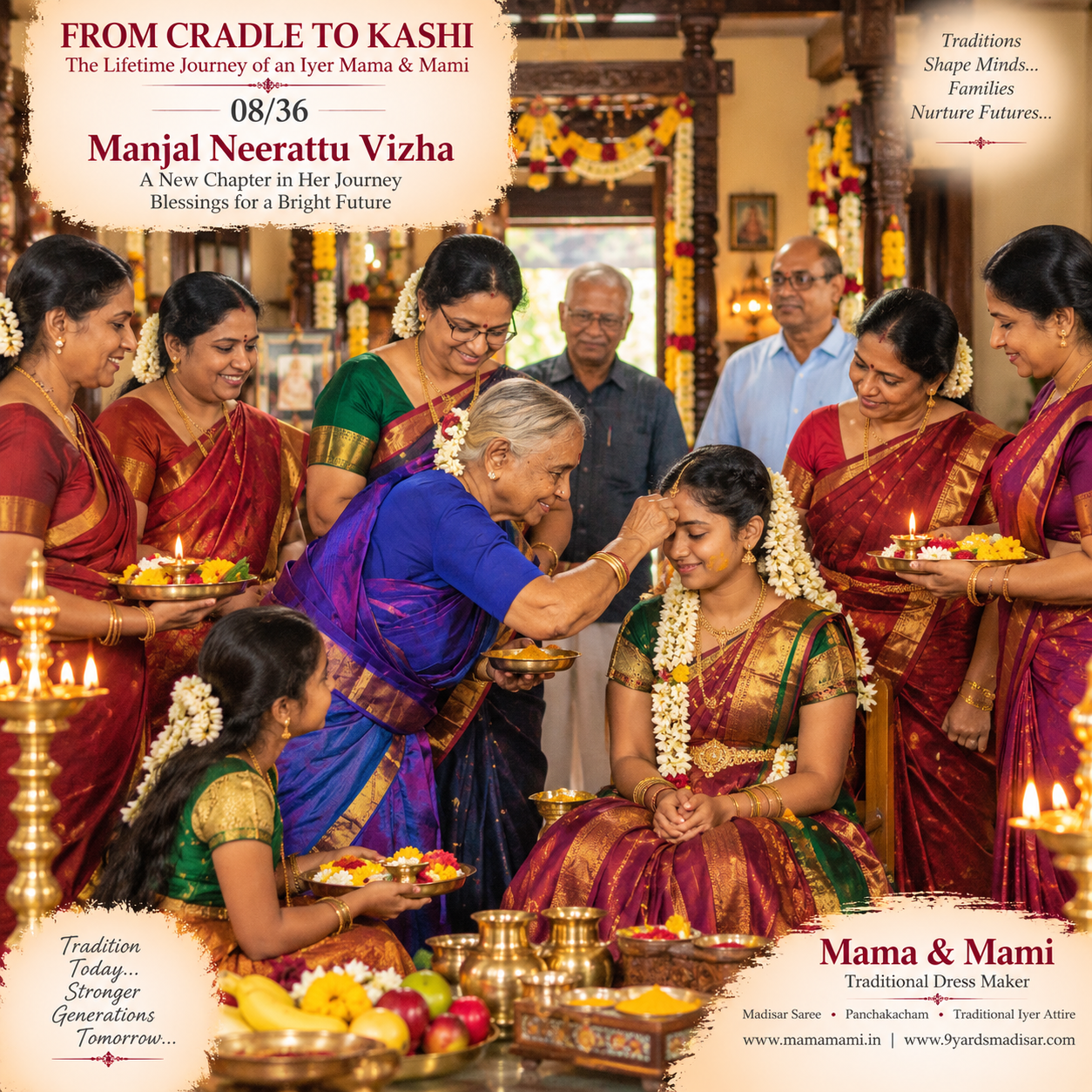
Today, the women of the family gather around their girl.
Not because childhood has suddenly disappeared.
But because life has quietly opened another door.
From a Little Girl to a Young Woman
Do you remember her?
She was once the baby sleeping peacefully in the cradle.
Amma held her during her earliest ceremonies.
She visited the family's Kula Deivam.
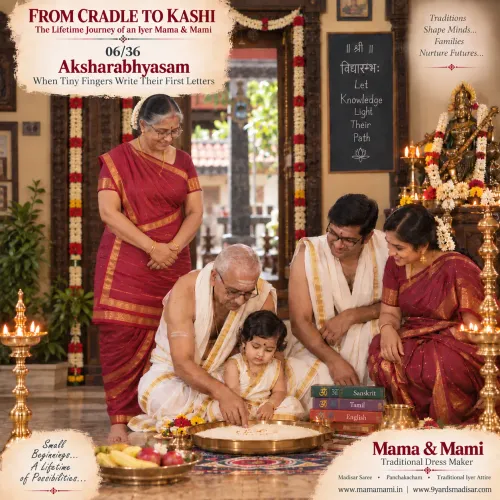
Her tiny fingers traced their first letters during Aksharabhyasam.
She sat beside Patti watching her draw kolam.
She followed Patti around the house asking endless questions.
And somewhere between school uniforms, notebooks, birthday cakes and summer holidays...
she grew up.
Nobody noticed exactly when it happened.
That is childhood.
You see your child every day, so the changes seem tiny.
Then suddenly you look at her...
and wonder where the little girl went.
What Is Manjal Neerattu Vizha?
Across Tamil families, puberty observances can differ considerably in their names and customs.
Some families may refer to the celebration as Manjal Neerattu Vizha. Other families may use different names or follow a simpler household observance.
And importantly, not every Iyer family follows exactly the same procedure—or necessarily holds a large public function.
Customs can vary according to family tradition, region and generations.
Our story therefore isn't intended as a ritual manual.
It is about the meaning surrounding the moment:
A daughter has reached puberty, and her family acknowledges that she has entered a new stage of growing up.
Amma Understands Before Anyone Needs to Explain
For the daughter, the experience may initially be unfamiliar.
There may be questions.
Perhaps nervousness.
Perhaps embarrassment.
Perhaps curiosity.
Amma sits beside her.
And one of the most important conversations between a mother and daughter begins.
This is where tradition and modern understanding should work together.
Explain what is happening.
Explain menstruation naturally.
Teach hygiene and self-care.
Answer questions without embarrassment.
And most importantly, help the girl understand:
This is a normal part of growing up.
The ceremony may last a day.
What Amma teaches her daughter now may remain with her for life.
Patti Has Been Here Before
Then comes Patti.
Perhaps she doesn't immediately begin with instructions.
Perhaps she simply sits beside her granddaughter.
Because Patti remembers.
Long before sanitary products came in convenient packages...
long before anyone could search a question on a phone...
long before today's open conversations...
she was once a young girl experiencing the same change.
Her world was different.
Her mother's world was different again.
And now three generations meet around one experience.
Patti. Amma. Daughter.
Three women.
Three different generations.
The same passage of life.
The Women of the Family Begin to Arrive
Soon, depending upon the family's custom, the house becomes busier.
Mami arrives.
Then Athai.
Periamma.
Chithi.
Perhaps cousins.
Grandmothers.
Other Sumangalis and close women relatives.
Someone brings flowers.
Someone brings fruits.
Someone brings sweets.
Someone has brought a gift.
And naturally, somebody has brought advice.
Lots of advice.
The quiet house slowly becomes a family gathering.
Manjal — The Colour of the Occasion
Turmeric has a longstanding place in many South Indian household and ceremonial traditions.
According to the family's practice, manjal may form part of the observance, including ceremonial bathing or other customs associated with the occasion.
The details vary.
But visually, the colour itself becomes memorable.
The yellow of turmeric.
Fresh flowers.
Kumkum.
Traditional lamps.
Mango leaves.
The brightness of silk.
The entire house begins to feel festive.
Then Comes the Traditional Bath
Where the family follows the custom, the girl is prepared for a ceremonial Manjal Neerattu.
The women of the family take the leading role.
Amma is nearby.
Patti is nearby.
Mamis and Athais participate according to the household's tradition.
There is laughter.
There are instructions.
Someone is telling everyone where to stand.
Someone else is trying to take photographs.
And the girl at the centre of everything is probably wondering:
“Why are there so many people?”
A New Dress Is Waiting
After the traditional observances comes one of the moments the young girl may remember most clearly.
Her new clothes.
Depending upon age and family tradition, she may be dressed beautifully in a Pavadai-Dhavani / half saree or another appropriate traditional outfit.
The colours are rich.
Her hair is neatly arranged.
Fresh jasmine flowers are added.
A small pottu.
Traditional jewellery.
Bangles.
Perhaps a necklace that belonged to Amma.
Perhaps something Patti has carefully taken from her jewellery box.
The girl looks into the mirror.
For a moment, even she notices something.
She looks different.
Patti Opens Her Cupboard Again
Remember Patti's saree cupboard from our earlier chapter?
Today it opens again.
Patti chooses an important Madisar.
Perhaps green with a rich maroon zari section.
Perhaps arakku red.
Perhaps mango yellow.
Perhaps royal blue.
The colour can change.
But the Madisar construction does not.
For our From Cradle to Kashi journey, Patti's authentic Iyer Madisar remains exactly as we established from the real-life references:
the saree passes over the RIGHT shoulder.
The grand zari-rich section forms the prominent front drape.
It travels across the front from LEFT toward the RIGHT side.
The waist is firmly wrapped and tucked.
And below is the distinctive kacham, creating the traditional divided-leg structure of the nine-yard Madisar.
Today, Patti isn't simply wearing traditional clothing.
She is standing beside the next generation.
Amma May Wear Madisar Too
Depending upon the family's custom and the nature of the observance, Amma may also choose Madisar.
And that creates one of the most beautiful photographs of this chapter.
Patti in Madisar.
Amma in Madisar.
The daughter in Pavadai-Dhavani.
Three generations standing together.
The clothing itself tells the story.
Grandmother.
Mother.
Daughter.
The Girl Is Seated
Now imagine the main family moment.
The young girl sits comfortably in the centre.
Flowers decorate the background.
A kuthuvilakku glows nearby.
Traditional kolam decorates the floor.
In front of her are fruits, flowers, coconut, manjal and kumkum arranged according to the family's custom.
The women gather around.
Patti comes first.
She blesses her granddaughter.
Amma follows.
Then the Mamis.
Athais.
Periammas.
Chithis.
Each woman approaches with affection and blessings.
Nalangu and Aarathi
Where followed as part of the family's tradition, Nalangu and Aarathi may add colour and warmth to the gathering.
The exact customs differ between households, so again there is no need for us to pretend that one procedure represents every family.
What matters in our story is the atmosphere.
The girl is surrounded by women who have themselves travelled further along the road she has just begun.
They aren't strangers observing her.
They are her people.
Then Come the Blessings
The older generation blesses her.
Patti places her hands affectionately on her granddaughter's head.
Thatha gives his blessings.
Amma and Appa stand beside their daughter.
Relatives come forward.
Someone gives her a small gift.
Someone gives money.
Someone gives jewellery.
Someone says:
“Nanna padichu, nanna irukkanum.”
Study well.
Be happy.
Grow beautifully.
Different words.
The same hope.
Appa Is Standing Slightly Away
In photographs of such occasions, attention naturally falls on the girl and the women surrounding her.
But look for Appa.
He is there.
Perhaps organising guests.
Perhaps speaking with relatives.
Perhaps making sure everything is arranged.
Perhaps standing slightly away and watching his daughter.
For fathers, milestones like these can be strangely emotional.
Yesterday, she sat on his shoulders.
Today, relatives are blessing her as a young woman.
Appa doesn't need to make a speech.
His face may say enough.
Thatha Sees Another Generation Growing
Thatha has already watched this story once.
His own daughter grew up.
Perhaps he remembers Amma at this age.
Now Amma is standing beside her daughter.
That is the extraordinary thing about becoming a grandparent.
Life begins repeating familiar scenes...
only the people standing in each position have changed.
The Celebration Should Never Become a Burden for the Girl
There is something important we should say in a modern telling of this tradition.
The girl herself matters more than the function.
She may enjoy a large celebration.
She may prefer something private.
She may feel shy discussing menstruation in front of relatives.
Families today may choose to observe the milestone differently from previous generations.
That is perfectly understandable.
Tradition should preserve affection and meaning without ignoring the girl's comfort, dignity and privacy.
The celebration belongs to her.
She should not feel that she belongs to the celebration.
Menstruation Should Not Be Something She Fears
For generations, many girls grew up with incomplete information about menstruation.
Some were frightened when their first period arrived.
Others were taught through whispers and euphemisms.
Today we can do better.
Tradition and accurate health education do not need to be enemies.
A daughter can receive Patti's blessings...
wear flowers...
participate in family customs...
and also understand clearly what is happening to her body.
She should know how to manage menstruation hygienically.
She should know whom to approach when she has questions.
And she should never be made to feel ashamed of a normal biological process.
That may be one of the most valuable gifts Amma can give her today.
Tomorrow She Is Still the Same Girl
This is worth remembering.
After all the flowers...
all the photographs...
all the relatives...
all the blessings...
tomorrow morning she will wake up.
Her school books will still be there.
Her friends will still call.
Her homework will still need to be completed.
She may still argue with her brother.
She may still forget where she left something.
She hasn't suddenly become an entirely different person.
She has simply entered another stage of growing up.
One Photograph Will Become Very Special
Before everyone leaves, somebody calls:
“Family photo!”
The girl sits in the centre in her beautiful traditional dress.
Amma stands beside her in Madisar.
Patti stands on the other side in Madisar.
Appa and Thatha join them.
Mamis and Athais gather around.
The photographer asks everyone to look forward.
Click.
Today it is simply another photograph.
Thirty years from now, the daughter may find it again.
She will first notice herself.
Then Amma.
Then Patti.
Then perhaps she will stare at Patti's Madisar and remember exactly how she looked.
She may show the photograph to her own daughter.
“Who is that?”
She will point.
“That's your great-grandmother.”
And once again...
a photograph becomes a family story.
One Day Patti May Teach Her Madisar
Not today.
Today the girl is still young.
But years will pass.
There may be college.
A career.
Perhaps marriage.
Perhaps another city.
Perhaps another country.
And one day, before an important family occasion, she may stand in front of Patti or Amma holding nine yards of silk and say:
“How do I wear this?”
Patti may smile.
Remember what she said many chapters ago?
“One day I'll teach you.”
That day will eventually arrive.
Two Children, Two Different Milestones
This is why our 08/36 chapter deserves two parallel stories.
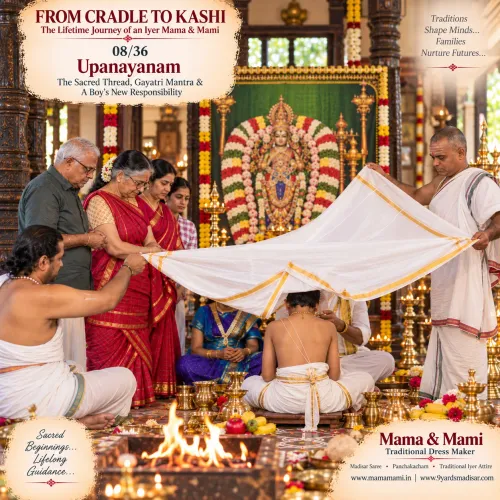
For a son in families observing the tradition, we followed Upanayanam—the sacred thread, Brahmopadesam, Gayatri Mantra and new religious responsibilities.
For a daughter, we now follow Manjal Neerattu Vizha / the family's puberty observance—a very different milestone centred around growing up, the women of the family, blessings and the beginning of another stage of life.
They are not equivalent rituals and should not be presented as if one substitutes for the other.
They are simply two different branches in our lifetime journey.
And after them, those branches come together again.
Because both children will continue growing.
Both will study.
Both will dream.
Both may leave home.
Both will discover the world outside the family that raised them.
And Soon, the Suitcase Will Appear
Today she is surrounded by Patti, Amma, Appa and Thatha.
But the little girl is becoming independent.
School will become college.
College may become a career.
Home may become a hostel.
Chennai may become Bengaluru.
Coimbatore may become Mumbai.
India may become Singapore, London, Dubai or America.
One day, just like the son in our other journey, the daughter may stand at the doorway with a suitcase.
Amma will ask whether everything has been packed.
Appa will check the documents.
Patti will slip something traditional into the bag.
Thatha will give his quiet advice.
And another chapter will begin.
Because sons and daughters may take different paths through some traditions...
but eventually every parent faces the same difficult and beautiful task.
Letting their child grow.
FROM CRADLE TO KASHI • 08/36 — GIRL'S JOURNEY
Manjal Neerattu Vizha
When a Little Girl Steps Into a New Chapter of Her Life
Parallel Chapter — 08/36 Boy's Journey:
Upanayanam: The Sacred Thread, Gayatri Mantra & a Boy's New Responsibility
Next — 09/36:
School, College & Leaving Home: When Tradition Travels With the Next Generation
Mama & Mami – Traditional Dress Maker
Preserving traditions, one generation at a time.
Madisar Saree • Panchakacham • Traditional Iyer Attire