FROM CRADLE TO KASHI
The Lifetime Journey of an Iyer Mama & Mami
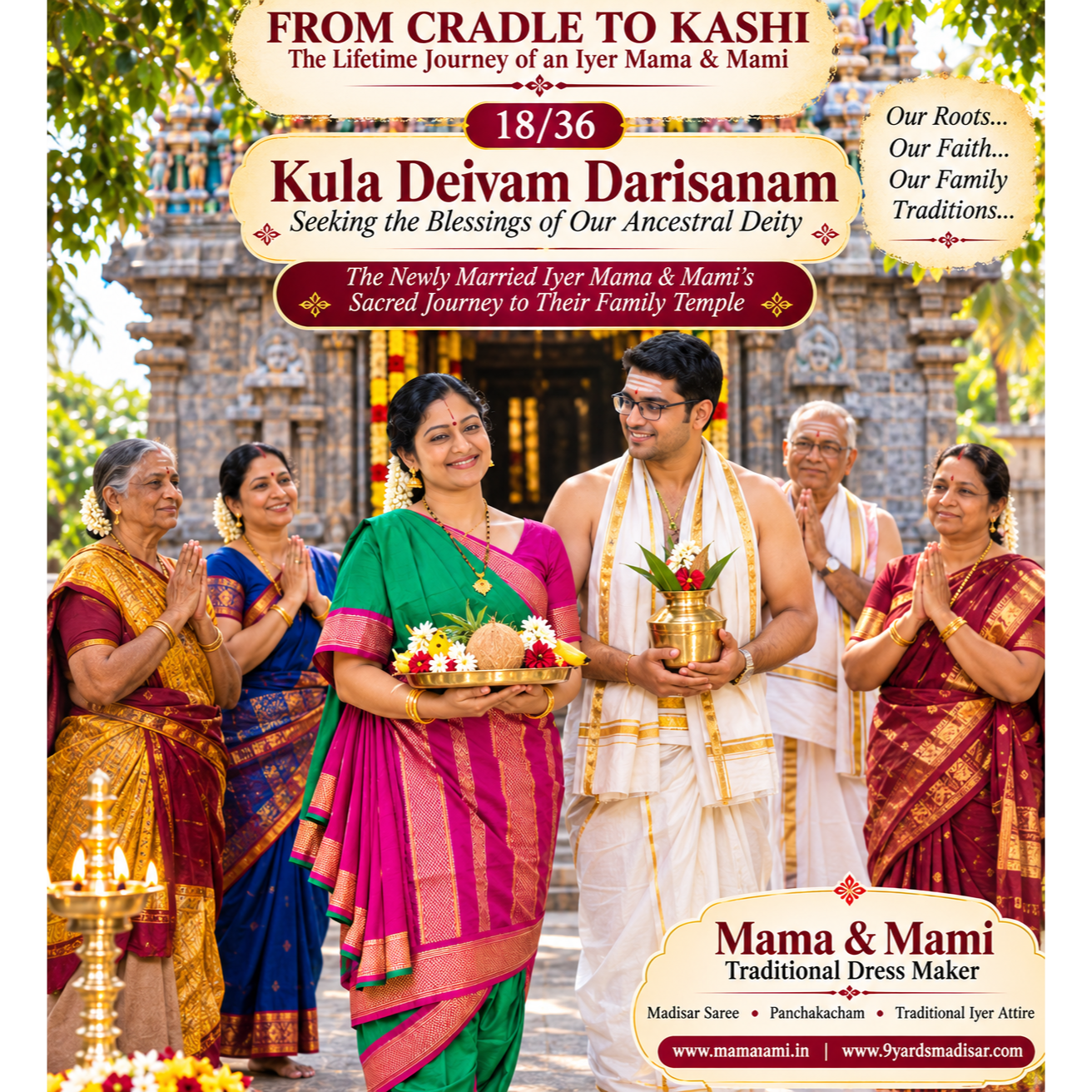
18/36 — Kula Deivam Darisanam
Seeking the Blessings of Our Ancestral Deity
Our Roots… Our Faith… Our Family Traditions…
Traditions Shape Minds… Families Nurture Futures…
A Sacred Journey That Connects Generations
The wedding celebrations have ended.
The newly married Iyer Mama and Mami have begun their beautiful journey together.
They have received blessings from their parents, grandparents and relatives. Their new life is slowly settling into a routine.
One morning, Patti lovingly asks the young couple:
“Kanna, neenga rendu perum namma Kula Deivam kovilukku poi vandheengala?”
My children, have both of you visited our ancestral family deity's temple?
The young Mami smiles and replies:
“Innum illai, Patti.”
Not yet, Patti.
Patti gently explains:
“Marriage brings two people together. But our Kula Deivam reminds us of the generations who came before us. We must remember our roots and seek the blessings of the deity our family has worshipped for generations.”
And so begins another meaningful chapter in their married life.
18/36 — Kula Deivam Darisanam.
1. What Is Kula Deivam?
Kula Deivam (குலதெய்வம்) means the ancestral deity traditionally worshipped by a family or lineage.
In many Tamil families, this tradition has been followed for several generations.
The deity may be associated with the family's ancestral village, temple or particular lineage.
Different families worship different deities, and the customs followed can vary considerably.
For some, the ancestral deity is a form of Amman. For others, it may be Shiva, Vishnu, Sastha, Murugan or another deity according to family tradition.
The temple may be small and situated in a quiet village.
It may not be famous.
But to the family, it carries memories of grandparents, great-grandparents and ancestors.
A Kula Deivam temple is not merely a place of worship. It can also be a living connection to family history.
2. Why Do Newly Married Couples Visit Their Kula Deivam?
In many Tamil families, visiting the Kula Deivam after marriage is considered an auspicious custom.
The newly married couple visits the ancestral temple to offer prayers and seek blessings for their married life.
The family may pray for:
A happy and harmonious marriage.
Good health and prosperity.
Mutual understanding between husband and wife.
The well-being of parents and grandparents.
Strength and wisdom during life's challenges.
The welfare of future generations.
The timing and procedures differ according to the family's traditions.
For our young Mama and Mami, this is their first visit together to the groom's ancestral temple.
It is a journey of faith, love and family togetherness.
3. Patti Remembers Her Younger Days
As the family prepares for the journey, Patti begins sharing memories.
“During our days, we did not have comfortable cars. We travelled by bus, carrying food and pooja items from home.”
Thatha smiles.
“Your Patti was very excited when we first visited the temple after our wedding!”
Patti laughs.
“And your Thatha forgot the way to the village!”
Everyone bursts into laughter.
The young Mami listens with interest.
She realises that the temple has witnessed many generations of her husband's family.
Patti once visited as a young bride.
Her mother-in-law had guided her.
Today, Patti is guiding another young Mami.
The people change, but the affection and traditions continue.
4. Preparing for the Temple Visit
The family selects a suitable day according to its customs and the temple's arrangements.
Amma prepares the pooja items.
Fresh flowers, fruits, coconuts and other offerings appropriate to the temple are arranged.
Appa checks the travel arrangements.
Thatha recalls the route to the ancestral village.
And the young Mami begins preparing her traditional attire.
For this special occasion, she chooses a beautiful nine-yard Iyer Madisar saree.
A rich bottle-green silk Madisar with a maroon-and-gold zari pallu.
Her hair is neatly tied and decorated with jasmine flowers.
She wears traditional jewellery, bangles and kumkum.
The Madisar is carefully draped in the family's traditional Iyer style, with the pallu over her right shoulder, the grand zari portion displayed prominently in front and the characteristic lower kacham.
The young Mama wears a traditional white Panchakacham with a golden border.
Amma and Patti also wear their beautiful Madisars.
Three generations are ready for the sacred journey.
5. The Journey to Their Ancestral Village
Early in the morning, the family begins travelling.
The busy city roads gradually give way to coconut groves, green fields and quiet village streets.
Thatha points towards a distant road.
“This is the route we travelled when I was young.”
Appa remembers visiting during school holidays.
Amma recalls family festivals.
Patti shares stories about relatives and ancestral customs.
The newly married couple listens carefully.
The young Mami asks:
“Patti, did your mother-in-law also bring you here?”
Patti smiles.
“Yes, kanna. Just like I am bringing you today.”
The young Mami feels deeply touched.
She is becoming part of a continuing family story.
6. The First Darisanam
Finally, the family reaches the temple.
The entrance is decorated with flowers.
Traditional brass lamps illuminate the surroundings.
The fragrance of incense fills the air.
The temple priest welcomes the family.
Appa introduces the newly married couple.
“Our son and daughter-in-law have come to offer prayers after their marriage.”
The couple stands together before the deity.
The priest performs the worship according to the temple's established practices.
The family joins in prayer.
The temple bell rings.
The deeparadhana is shown.
Everyone folds their hands reverently.
The young Mama and Mami silently pray for a peaceful, loving and meaningful life together.
For a few moments, there are no worries about work, responsibilities or the future.
There is only gratitude.
7. The Blessings of Parents and Grandparents
After the pooja, the newly married couple approaches their elders.
They offer their respects to Patti and Thatha.
Patti places her hands lovingly on their heads.
“Neenga rendu perum nalla sandhoshama, otrumaiya vaazhanum.”
May both of you live happily and in harmony.
Thatha adds:
“Always respect each other. Support each other during difficult times. That is the foundation of a good marriage.”
Appa and Amma smile proudly.
The young Mami feels the warmth of being welcomed into another family.
And the young Mama understands that marriage is not simply about beginning a new life.
It is also about carrying forward meaningful family values.
8. The Importance of Madisar and Panchakacham
Traditional attire has a special place in many Iyer religious ceremonies.
The nine-yard Madisar is a distinctive form of saree draping associated with married women in traditional Tamil Brahmin households.
Its construction is different from an ordinary six-yard saree.
The traditional Iyer Madisar includes:
The pallu passing over the woman's right shoulder.
A prominently displayed zari-rich front section.
The distinctive waist tucking and lower kacham.
Carefully arranged fabric folds that allow the traditional drape to retain its shape.
Panchakacham is likewise an important traditional garment worn by men during appropriate religious occasions.
For our young couple, wearing Madisar and Panchakacham during the temple visit makes the occasion even more memorable.
These garments are not simply ceremonial clothing.
They represent traditional craftsmanship, family identity and cultural continuity.
9. The Ancestral Home and Forgotten Memories
After the temple visit, Thatha takes the family through the village.
He points towards an old house.
“This was where our family once lived.”
The young couple looks at the traditional doorway.
Thatha remembers the thinnai where elders gathered in the evenings.
He remembers his mother preparing food in the kitchen.
He remembers festivals when relatives travelled from different towns to celebrate together.
The young Mami asks:
“Thatha, do you have photographs of those days?”
He smiles.
“Yes. When we return home, I will show you.”
The couple realises that their family history is filled with stories waiting to be discovered.
10. Respecting Both Families' Traditions
The young Mami also has her own ancestral heritage.
Her parents may worship a different Kula Deivam according to their family tradition.
Those memories and customs remain meaningful after marriage.
During the return journey, the groom turns towards his wife.
“We should visit your family's Kula Deivam temple too.”
She smiles.
“Yes! Amma and Appa will be very happy.”
Marriage is a union of two individuals who bring their own family histories and traditions.
Respecting both families creates a deeper understanding between husband and wife.
Traditions become more meaningful when they are shared with affection and mutual respect.
11. The Family Photograph That Will Last for Generations
Before leaving the temple, Amma suggests taking a family photograph.
Everyone gathers near the temple entrance.
Thatha stands proudly beside Patti.
Appa and Amma join them.
The newly married couple stands in the centre.
The young Mami looks beautiful in her bottle-green Madisar with a maroon zari pallu.
The young Mama stands beside her in his white Panchakacham.
The temple forms a beautiful background.
Everyone smiles.
Click!
One more photograph enters the family album.
Years later, their children may look at it and ask:
“Amma, where was this photograph taken?”
And she may reply:
“This was our first visit to the Kula Deivam temple after our wedding.”
Another family story will begin.
12. Why Younger Generations Should Know Their Ancestral Traditions
Today, many families live far away from their ancestral villages.
Children grow up in cities.
They move abroad for education and employment.
Their lives become busy.
Gradually, some may lose touch with the places and stories associated with their ancestors.
Visiting an ancestral temple can become an opportunity to reconnect.
Ask your parents and grandparents about your family's Kula Deivam.
Learn the name and location of the temple.
Understand the traditions your family follows.
Preserve old photographs and family stories.
Share this knowledge with the next generation.
Because the memories we preserve today can become the heritage our children cherish tomorrow.
13. A New Beginning for the Young Mama and Mami
The temple visit is complete.
The family returns home with happy memories.
The young Mami carefully folds her Madisar and places it in her cupboard.
She remembers the morning prayers.
The temple bells.
Patti's stories.
Thatha's blessings.
And the photograph taken outside the ancestral temple.
She turns towards her husband.
“I am happy we went together.”
He smiles.
“So am I.”
Their married life is still young.
There will be many responsibilities ahead.
Many happy moments.
Many challenges.
And many more family milestones.
But this journey will remain special.
Because it connected their new beginning with the generations that came before them.
14. The Deeper Meaning of Kula Deivam Darisanam
The significance of Kula Deivam worship is not identical for every family.
The deity, temple, offerings and ceremonial practices depend on ancestral customs.
But for many families, the emotional meaning is shared.
It is about remembering one's roots.
Honouring family heritage.
Spending meaningful time with elders.
And passing cherished memories to the next generation.
Our young Mama and Mami began the journey as newlyweds visiting a temple.
They returned with a deeper understanding of their family's history.
The temple may be centuries old. The marriage may be only a few months old. But together, they become part of a continuing family story.
15. The Journey Continues…
That evening, the young couple sits together looking at their temple photographs.
The groom says:
“One day, we should bring our children here.”
The young Mami smiles.
“Definitely.”
Then she asks:
“Have you thought about our future home?”
He looks at her.
“A home of our own?”
She nods.
“A place where we can celebrate festivals, welcome our parents and create our own family memories.”
He smiles.
“Then perhaps that should be our next dream.”
And so, from the blessings of their ancestral deity, the young Mama and Mami begin looking towards another beautiful milestone.
A home of their own. A new beginning. A place where traditions will continue.
FROM CRADLE TO KASHI — 18/36
Kula Deivam Darisanam
Seeking the Blessings of Our Ancestral Deity
Our Roots… Our Faith… Our Family Traditions…
Traditions Shape Minds… Families Nurture Futures…
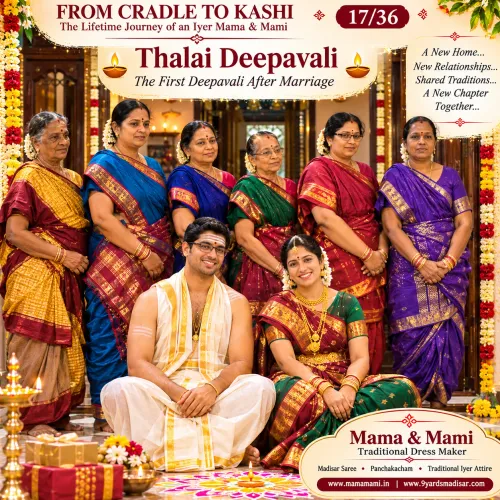
Previous Chapter — 17/36: Thalai Deepavali & the First Festivals After Marriage
Next Chapter — 19/36: Our First Home — Grihapravesam and New Beginnings
Mama & Mami — Traditional Dress Maker
Preserving Traditions, One Generation at a Time.
Madisar Saree • Panchakacham • Traditional Iyer Attire
From the first cradle ceremony to the wisdom of Kashi, every stage of life carries a tradition, a memory and a blessing.
Our Heritage. Our Traditions. Our Pride.