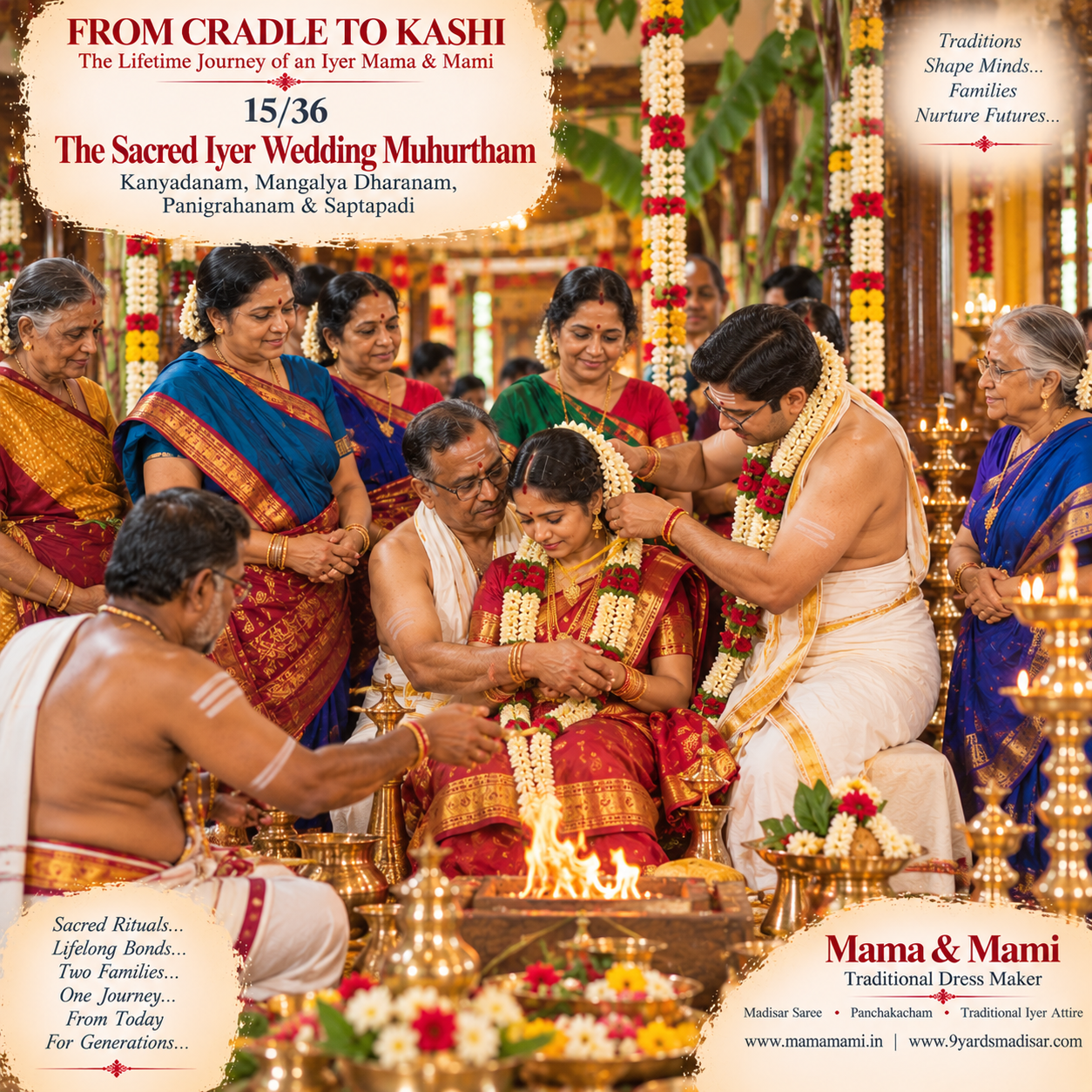
Kanyadanam, Mangalya Dharanam, Panigrahanam & Saptapadi
The Lifetime Journey of an Iyer Mama & Mami
The marriage hall is filled with the beautiful sound of Nadaswaram.
The sacred fire is being prepared.
The bride is dressed in her beautiful Koorai Pudavai.
The groom is wearing his traditional Panchakacham.
Patti has carefully arranged her nine-yard Madisar.
Amma is sitting beside Appa, trying to hide her emotions.
Thatha is watching the preparations with quiet happiness.
Relatives have gathered from different parts of the world.
The Vadhyar checks the auspicious Muhurtham time.
The bride and groom are called to the wedding mandapam.
And suddenly, the atmosphere changes.
The laughter of Kasi Yatra has passed.
The playful excitement of Maalai Maatral is over.
The beautiful Oonjal songs have been sung.
Now comes the moment for which everyone has gathered.
The sacred Iyer wedding Muhurtham.
A son is about to become a husband.
A daughter is about to become a wife.
Two families are about to enter a new relationship.
And our journey from cradle to Kashi reaches one of its most meaningful milestones.
1. The Wedding Mandapam — Where a New Life Begins
The wedding mandapam is beautifully decorated.
Fresh jasmine garlands hang from the pillars.
Banana leaves and mango leaves add traditional greenery.
Brass lamps glow on either side.
The sacred fire occupies its prescribed place.
The ceremonial vessels, flowers, rice and other materials are arranged according to the family's sampradayam.
The Vadhyar begins reciting the Vedic mantras.
The bride and groom sit with their parents and elders nearby.
For a few moments, everyone becomes quiet.
Because this is no longer simply a family celebration.
It is a sacred commitment between two individuals, witnessed by their families and solemnised through their religious tradition.
2. The Groom in Panchakacham
Remember our little boy from the earlier chapters?
He was once sitting beside Appa during his Upanayanam.
He learned the importance of Gayatri Mantra and the responsibilities associated with Brahmacharya.
Years have passed.
He has completed his education.
He has started his career.
He has met the woman he wishes to marry.
Today, he sits before the sacred fire wearing Panchakacham.
The traditional veshti is carefully arranged with its distinctive kacham.
An angavastram completes his ceremonial appearance.
Appa looks at him proudly.
Thatha remembers his own wedding.
And Patti smiles.
The boy who once needed help tying his veshti is now ready to begin Grihastha Ashrama.
3. The Bride and Her Koorai Pudavai
The bride enters the wedding mandapam.
Her hair is beautifully decorated with jasmine.
Traditional jewellery adorns her.
Her forehead carries kumkum.
Her hands are decorated with bangles.
Her wedding attire has been carefully selected.
In many Tamil Brahmin wedding traditions, the Koorai Pudavai has a special ceremonial role, with its timing and manner of wearing determined by the family's custom.
The bride looks beautiful.
But Amma is not thinking about the jewellery.
She remembers a different day.
The day her daughter was born.
The tiny fingers.
The first smile.
The first steps.
The first day at school.
The day she left home for college.
And now...
The little girl is sitting before Agni, preparing for married life.
4. Kanyadanam — A Father's Emotional Moment
One of the important ceremonies in many traditional Iyer weddings is Kanyadanam.
The word is commonly associated with the ceremonial giving of the bride in marriage.
According to the prescribed family tradition, the bride's parents participate in the ritual under the guidance of the Vadhyar.
The procedure may involve sacred water, mantras and prescribed gestures.
The exact sequence differs among Vedic traditions and families.
But for our story, there is an emotional moment that deserves special attention.
Appa sits beside his daughter.
He remembers carrying her on his shoulders.
He remembers holding her hand while crossing the road.
He remembers helping her learn to ride a bicycle.
He remembers the day she first travelled alone.
Today, he participates in a ceremony that marks her entry into married life.
It is a moment of happiness.
But also a moment of reflection.
A daughter is not a possession being transferred. She is an individual entering marriage through her own willing choice.
The traditional ceremony can be understood and celebrated while respecting her independence and equal place in the marriage.
5. Amma's Role in Kanyadanam
Amma sits beside Appa.
Her participation is important according to the prescribed ceremony.
She has been part of every stage of her daughter's life.
The sleepless nights.
The school examinations.
The childhood illnesses.
The birthday celebrations.
The college admissions.
The first job.
The marriage discussions.
And now, the wedding.
Perhaps Amma has been too busy with arrangements to become emotional.
But when she sees her daughter sitting beside the groom, something changes.
Patti notices her eyes filling with tears.
She gently places a hand on Amma's shoulder.
No words are necessary.
Because Patti has experienced this moment before.
6. Panigrahanam — Holding Hands for a Lifetime
Another significant Vedic wedding rite is Panigrahanam.
Pani means hand, and grahanam means taking or grasping.
During the prescribed ritual, the groom takes the bride's hand while the appropriate mantras are recited.
The rite signifies an important step in their marriage.
Imagine the scene.
The bride sits beside the groom.
The Vadhyar chants.
The groom gently takes her hand.
The families watch.
The sacred fire burns nearby.
For the couple, it is a simple physical gesture.
But symbolically, it represents something much larger.
Two people are beginning a life in which they will support one another.
Not only during celebrations.
Not only during festivals.
But also through difficult decisions, illness, financial challenges, family responsibilities and the ordinary uncertainties of life.
Holding hands is easy during a wedding.
Continuing to stand together through the years is what gives the gesture meaning.
7. Mangalya Dharanam — The Moment Everyone Waits For
Now comes one of the most anticipated moments of a South Indian wedding.
Mangalya Dharanam.
The sacred marriage ornament, commonly called the Thaali or Mangalyam, is prepared according to the family's custom.
The Vadhyar guides the ceremony.
The bride and groom take their places.
The relatives move closer.
The Nadaswaram musicians prepare for the auspicious moment.
And Amma looks towards the clock.
The Muhurtham is approaching.
8. Getti Melam — The Sound of Celebration
At the appointed moment, the Nadaswaram and Thavil become especially lively.
“Getti Melam! Getti Melam!”
The familiar call brings excitement to the marriage hall.
The groom ties the Mangalyam around the bride's neck according to the prescribed custom.
In many Tamil wedding traditions, the groom ties the initial knot, while additional knots may be tied by a designated female relative according to family practice.
The exact procedure varies.
Akshathai, or auspicious rice, may be showered by the assembled relatives.
The musicians play.
The elders bless the couple.
The photographers capture the moment.
And the bride and groom smile.
The marriage has reached one of its most recognisable ceremonial moments.
9. The Three Knots — A Cherished Tradition
In many Tamil families, the tying of three knots is an important part of the wedding custom.
Families may explain their symbolism in different ways.
Some associate them with commitment, family relationships and the responsibilities of married life.
However, these interpretations should not be confused with a single universally prescribed Vedic explanation.
What matters is the reverence with which the family observes its tradition.
For the bride, the Mangalyam becomes a significant symbol of her marriage.
For the groom, the moment represents the responsibilities he has undertaken.
For the parents, it is the culmination of months of preparation and years of raising their children.
And for Patti...
It is another generation beginning its married life.
10. Akshathai — Blessings From Everyone
As the wedding reaches its auspicious moment, relatives may shower the couple with Akshathai according to family custom.
The grains are associated with auspicious blessings.
Patti blesses the couple.
Thatha joins her.
Appa and Amma smile.
The groom's parents watch happily.
Mamas and Mamis offer their blessings.
The younger cousins enthusiastically participate.
Somebody throws slightly too much rice.
Everyone laughs.
And the couple sits together, surrounded by affection.
A wedding may be solemnised through sacred rites.
But its joy is multiplied by the blessings of the people who love the couple.
11. Saptapadi — Seven Steps Towards a Shared Future
One of the central rites of many Vedic Hindu marriage traditions is Saptapadi.
Sapta means seven.
Padi refers to steps.
Under the guidance of the Vadhyar, the couple performs the prescribed seven-step rite.
The specific procedure and mantras vary according to the Vedic tradition being followed.
Saptapadi is commonly associated with the establishment of the marital bond and the couple's shared duties.
The seven steps are traditionally connected with aspirations such as nourishment, strength, prosperity, well-being, family life and lasting companionship, although the precise interpretation follows the ritual texts used.
The deeper message is meaningful even today.
Marriage is not one promise made on one day.
It is a commitment renewed through daily life.
12. The First Step — Building a Home Together
A marriage may begin in a beautifully decorated mandapam.
But everyday married life happens somewhere else.
In a kitchen.
At a dining table.
During a late-night conversation.
While planning monthly expenses.
While caring for elderly parents.
While deciding where to live.
While preparing for the arrival of a child.
A home is not created only by walls and furniture.
It is created by the people who share responsibility for the life inside it.
Our young couple may one day buy their own house.
They may perform Grahapravesam.
They may establish a pooja room.
They may welcome their first child.
But today, those future chapters are only dreams.
13. The Second Step — Strength Through Difficult Times
Every married couple experiences challenges.
A job may change.
A business may struggle.
A family member may become ill.
Plans may fail.
Unexpected responsibilities may arise.
The strength of a marriage is not measured by the absence of difficulties.
It is often revealed by how the couple responds to them.
Can they listen?
Can they disagree respectfully?
Can they make decisions together?
Can they support one another?
These are the questions that matter long after the wedding decorations have been removed.
14. The Third Step — Prosperity With Responsibility
During wedding preparations, families may discuss jewellery, clothes, gifts and expenses.
But true prosperity in married life is not limited to wealth.
It also includes security.
Health.
Trust.
Education.
Meaningful work.
A peaceful home.
And the ability to help others.
Our future Mama and Mami may both pursue careers.
They may support their parents.
They may save for their first house.
They may plan for children.
They may face unexpected expenses.
Financial responsibility is one of the practical foundations of a stable married life.
15. The Fourth Step — Happiness and Mutual Respect
Marriage brings two individuals together.
But they do not stop being individuals.
Each person has their own interests.
Their own opinions.
Their own friendships.
Their own ambitions.
A happy marriage makes room for both people to grow.
The bride may wish to continue her career.
The groom may have professional responsibilities.
They may need to move to another city.
They may choose to live near their parents or independently.
Whatever their decisions, mutual respect must remain central.
Tradition becomes stronger when it is carried forward with understanding rather than pressure.
16. The Fifth Step — Family and Future Generations
For many couples, married life eventually includes children.
Others may follow different paths.
Every family's journey is unique.
In our From Cradle to Kashi series, we will follow the couple as they establish their household and, later, welcome the next generation.
One day, our young bride may become Amma.
The groom may become Appa.
Today's Amma may become Patti.
Today's Appa may become Thatha.
And the cycle of family life will continue.
The cradle from our first chapter may appear again.
But this time, a different generation will stand beside it.
17. The Sixth Step — Walking Through Life Together
Marriage is a long journey.
There will be joyful festivals.
Temple visits.
Family weddings.
Birthdays.
Anniversaries.
New homes.
Children's achievements.
There may also be grief.
The passing of beloved elders.
Difficult family responsibilities.
Moments when life feels uncertain.
Through all these experiences, the couple will need patience and understanding.
The wedding promises are made in a few minutes.
Their meaning unfolds over decades.
18. The Seventh Step — Companionship for Life
One of the most beautiful ideas associated with Saptapadi is lasting companionship.
The couple is not simply entering a ceremonial relationship.
They are beginning a partnership.
They may be young today.
But imagine them forty years from now.
Perhaps their hair has turned grey.
Their children have grown.
Their grandchildren are visiting.
They sit together in the evening.
Patti prepares coffee.
Thatha reads the newspaper.
A grandchild asks:
“How did you get married?”
And the old wedding album comes out again.
The seven steps taken during the wedding have become a lifetime of walking together.
19. Ammi Midithal — Standing Firm Together
Another meaningful custom associated with many South Indian wedding traditions is Ammi Midithal.
The bride places her foot on a grinding stone according to the prescribed procedure.
The groom may assist or guide her as required by the family's ritual practice.
The stone is commonly interpreted as symbolising firmness and stability.
The message is powerful.
Life will not always be easy.
But the couple should strive to remain steady in their commitments.
Like the stone beneath the foot, they are encouraged to develop strength and resilience.
20. Arundhati Darisanam — Looking Towards the Stars
In many traditional Hindu weddings, Arundhati Darisanam forms part of the ceremonies.
The couple is directed towards the star associated with Arundhati, traditionally remembered with Sage Vasishta.
Arundhati is honoured in Hindu tradition as an example of marital fidelity and virtue.
The custom is associated with the aspiration for a harmonious married life.
In some modern wedding settings, the actual star may not be visible because of daylight, weather or the marriage hall's location.
The ceremony is then observed according to the guidance of the Vadhyar and family tradition.
For our young couple, the symbolism is memorable.
Their married life is beginning under the blessings and ideals carried by generations before them.
21. The Bride's Madisar — A New Chapter in Traditional Attire
Now we come to a particularly meaningful part of our Mama & Mami journey.
The traditional Iyer Madisar.
In many Iyer family traditions, the married woman wears Madisar for important religious ceremonies and auspicious occasions.
The exact time when the bride first changes into Madisar during wedding-related observances varies by family custom.
For our story, imagine the new Mami learning how to wear her nine-yard saree.
Amma stands beside her.
Patti watches carefully.
A senior Mami helps arrange the folds.
The saree passes over the RIGHT shoulder.
The rich zari section is prominently displayed across the FRONT, extending from the LEFT towards the RIGHT-hand side.
The waist is wrapped securely.
The lower kacham is properly formed.
The drape must be authentic, not an ordinary six-yard saree.
The new Mami looks into the mirror.
Patti smiles.
“Ippo nee Mami aayitte!”
Now you have become a Mami!
Of course, becoming a wife is not defined by knowing how to wear Madisar.
But learning the traditional drape can become a cherished connection to family heritage.
22. A Special Photograph — Three Generations of Madisar
Imagine one photograph.
Patti stands on the left.
Amma stands beside her.
The newly married Mami stands in the centre.
All three wear beautiful Madisars.
Patti wears a traditional green and maroon combination.
Amma wears royal blue with gold zari.
The new Mami wears a rich traditional red.
The Madisar construction is correct in every detail.
The women smile.
Behind them stand Thatha, Appa and the groom in traditional attire.
The photographer clicks.
Years later, this photograph may become one of the family's most treasured possessions.
Because it represents something more meaningful than beautiful clothing.
Three generations connected by tradition.
23. The Groom's Mother Welcomes the New Mami
For the groom's mother, the wedding is also an emotional occasion.
Her son has married.
A new relationship is beginning.
She welcomes her daughter-in-law with affection.
Perhaps she remembers her own wedding day.
She remembers entering a new household.
Learning new customs.
Understanding new relationships.
Now she has an opportunity to make the experience easier for another young woman.
A good relationship between mother-in-law and daughter-in-law is built through patience, respect and kindness.
Not through unnecessary expectations.
Not through comparisons.
Not through demands.
A new Mami should feel welcomed into the family, not tested by it.
24. The Bride's Parents — Happiness and Tears
The wedding ceremonies are nearing completion.
Appa looks relieved.
Months of preparation have finally reached this moment.
Amma smiles through tears.
Their daughter is married.
But she is still their daughter.
Her relationship with her parents does not end at the wedding mandapam.
It continues.
Through phone calls.
Visits.
Festivals.
Family celebrations.
And the ordinary conversations that make family life meaningful.
Marriage creates new relationships.
It need not weaken the old ones.
25. The Blessings of Patti and Thatha
The newly married couple approaches the elders.
They bow respectfully according to family custom.
Patti blesses them.
Thatha offers his blessings.
Other senior relatives follow.
The words may be simple.
“Sandhoshama irungo.”
Live happily.
“Nalla otrumaiya irungo.”
Live together in harmony.
“Ella nalladhum nadakkanum.”
May good things happen in your lives.
These blessings carry the hopes of generations.
26. The Wedding Feast — A Celebration of Togetherness
After the sacred ceremonies, the guests gather for the wedding meal.
Banana leaves are arranged.
Traditional dishes are served.
The caterers move quickly between the rows.
Relatives discuss the ceremonies.
Someone praises the payasam.
Someone asks for another appalam.
A Mama is already discussing the evening arrangements.
The bride and groom finally get a moment to eat.
Perhaps not much of a moment.
Because the photographer arrives again.
“Sir, one more photo!”
Even on their wedding day, the newly married couple may struggle to finish a meal peacefully.
27. When the Wedding Hall Becomes Quiet
Eventually, the ceremonies conclude.
Relatives begin leaving.
The Nadaswaram grows quiet.
The flower decorations remain.
The brass lamps are extinguished at the appropriate time.
The wedding hall slowly empties.
Amma looks around.
Only yesterday, the hall was filled with preparations.
Today, the wedding is complete.
Patti carefully folds her Madisar.
Thatha gathers his belongings.
The groom's family prepares for the next customs.
And the bride and groom begin looking towards the future.
The wedding may have lasted a few days.
The marriage is intended to last a lifetime.
28. Marriage Is the Beginning, Not the Destination
A beautiful wedding is a wonderful memory.
But a successful marriage is built through everyday actions.
Respect.
Trust.
Communication.
Shared responsibilities.
Patience.
Affection.
And the ability to grow together.
Traditional ceremonies provide a meaningful beginning.
But the couple must create the life that follows.
They may establish a home.
Visit their Kula Deivam.
Celebrate their first Deepavali.
Perform family poojas.
Welcome children.
Care for their parents.
Face life's joys and difficulties.
And eventually become the elders whose blessings another generation will seek.
29. From Cradle to Wedding Mandapam
Think about our journey so far.
We began with a newborn baby.
We watched the child grow.
We followed the family through childhood traditions.
We saw the first letters being written.
We followed the boy through Upanayanam and the girl's coming-of-age chapter.
We watched them leave for education.
We saw marriage conversations begin.
We attended Nichayathartham.
We remembered earlier generations during Sumangali Prarthanai.
We celebrated Vratham and Janavasam.
We laughed during Kasi Yatra.
We enjoyed Maalai Maatral.
We listened to Oonjal songs.
And now...
We have witnessed the sacred wedding Muhurtham.
The child from our first chapter has become a married adult.
But our story is far from over.
Because the next part of life begins after the wedding.
30. Tomorrow, They Begin a New Life
The couple may now travel to the groom's home or begin other post-wedding observances according to their family tradition.
There may be a formal welcome.
A new household.
New relationships.
New responsibilities.
And importantly, the couple may visit their Kula Deivam to seek blessings.
In many families, this visit holds special significance after marriage and continues as a regular family practice.
The bride and groom will also begin learning how to balance their own lives with the customs of both families.
One day, they may buy their first house.
And we will follow them through Grahapravesam.
One day, perhaps, a baby will be born.
And the journey will return to the cradle.
But now...
A new Mama and Mami have begun their lifetime journey.
31. A Wedding Photograph That Will Outlive the Day
Years from now, the couple may open their wedding album.
They will see the mandapam.
The sacred fire.
The Mangalyam.
The seven steps.
Patti wearing Madisar.
Thatha wearing Panchakacham.
Amma smiling.
Appa trying not to cry.
Mamas and Mamis gathered around.
Some faces may no longer be present in their lives.
But the photographs will remain.
And the stories will continue.
A grandchild may point to the picture and ask:
“Patti, is that you?”
She will smile.
“Yes. That was my wedding.”
And once again, a family story will begin.
32. Preserving the Traditions That Connect Generations
At Mama & Mami, we believe traditional attire has a meaningful place in preserving cultural heritage.
The Iyer Madisar is not simply nine yards of fabric.
Its distinctive construction represents a clothing tradition passed through generations.
Similarly, Panchakacham remains an important ceremonial garment in many traditional households.
These garments appear during weddings, religious observances, family celebrations and significant life events.
Their colours may change.
Their fabrics may change.
But their traditional identity deserves to be understood and preserved.
Because when a new generation learns a tradition, it gives that tradition another opportunity to live.
FROM CRADLE TO KASHI • 15/36
The Sacred Iyer Wedding Muhurtham
Kanyadanam, Mangalya Dharanam, Panigrahanam & Saptapadi
The Lifetime Journey of an Iyer Mama & Mami
Previous — 14/36: Kasi Yatra, Maalai Maatral & Oonjal — The Beautiful Traditions Before the Sacred Muhurtham
Next — 16/36: The Newly Married Couple's First Steps — Grihapravesam, Welcoming the New Mami & Beginning Married Life
Mama & Mami — Traditional Dress Maker
Preserving traditions, one generation at a time.
Madisar Saree • Panchakacham • Traditional Iyer Attire