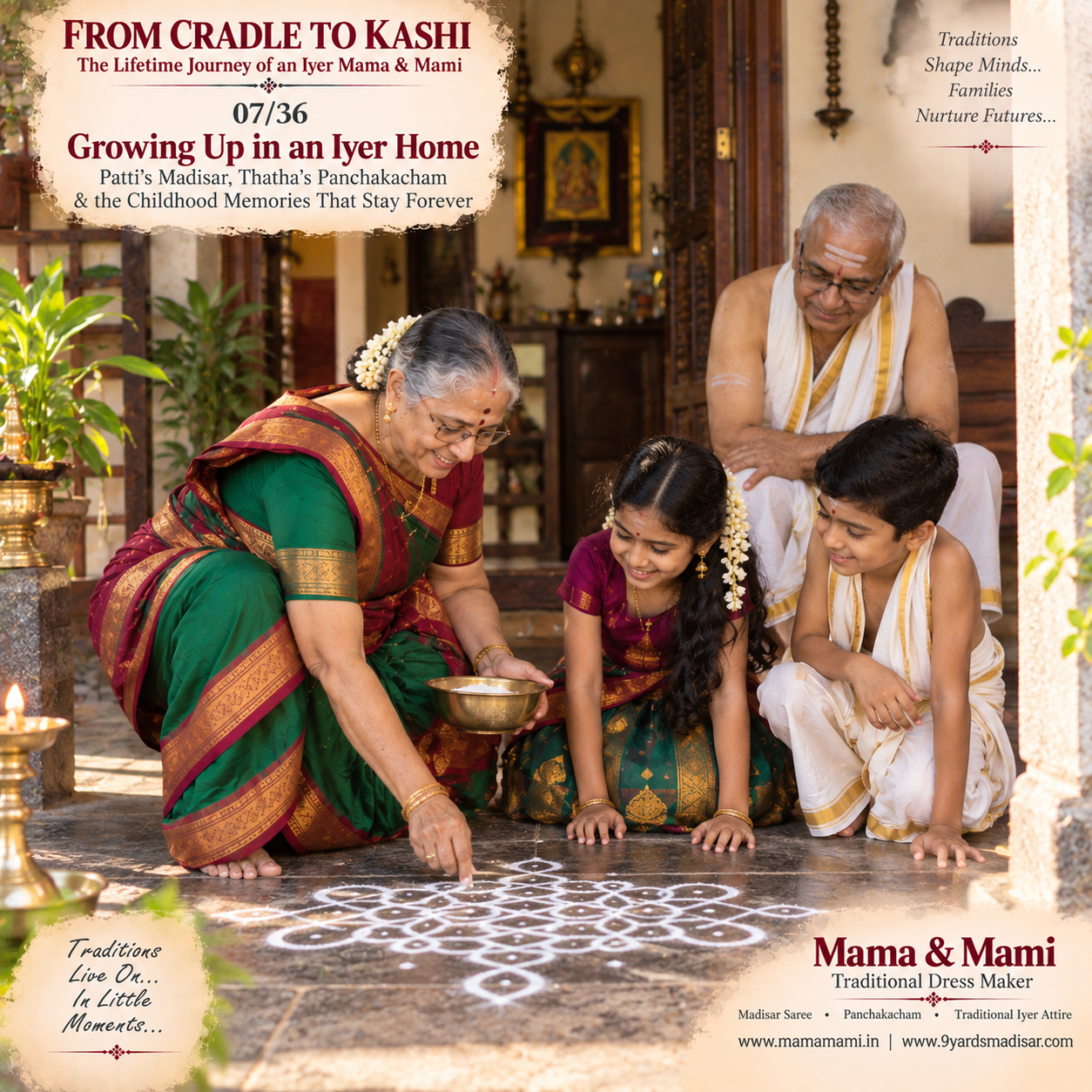
Patti’s Madisar, Thatha’s Panchakacham & the Childhood Memories That Stay Forever
FROM CRADLE TO KASHI • 07/36
The Lifetime Journey of an Iyer Mama & Mami
There is no Vadhyar coming today.
No Homam has been arranged.
No invitation has been sent.
There is no special ceremony.
And yet, some of the most important parts of our child's journey are happening right now.
Because tradition is not learned only during weddings, Upanayanams, Homams or temple visits.
Much of it is learned on completely ordinary mornings.
By watching.
By listening.
By asking questions.
And very often...
by following Patti and Thatha around the house.
Childhood Is Made of Ordinary Days
Our little child is growing quickly now.
The tiny fingers that recently wrote their first letters during Aksharabhyasam are becoming more confident.
School has begun.
There are books in the house.
Pencils disappear mysteriously.
Shoes are never where Amma left them.
The school bag somehow becomes heavier every month.
But another kind of education is happening alongside school.
The child is beginning to understand the rhythm of an Iyer home.
Morning prayers.
Kolam.
The lamp.
Temple visits.
Festivals.
Relatives.
Food.
Slokams.
Madisar.
Panchakacham.
And hundreds of little customs nobody formally sits down to teach.
The Morning Begins With Patti
Wake up early enough and Patti is already awake.
Of course she is.
The entrance has been cleaned.
A kolam may already be appearing outside.
The child watches those experienced fingers transform a few lines and dots into something beautiful.
“Patti, how do you know where the next line goes?”
Patti smiles.
She has probably drawn thousands of kolams.
But once, many decades ago, somebody held her hand and taught her the first one.
Perhaps her mother.
Perhaps her Patti.
And now another small pair of eyes is watching.
This is how tradition often travels.
Not through instruction manuals.
From one pair of hands to another.
Then Comes the Smell of Filter Coffee
Some childhood memories don't need photographs.
They have smells.
Fresh filter coffee.
Sambrani.
Jasmine.
Sambar from the kitchen.
Freshly washed clothes drying in the morning sun.
Camphor from the pooja room.
Deepavali marundhu.
Ghee melting over hot pongal.
Years later, the child may live thousands of kilometres away.
And one familiar smell can suddenly bring this entire house back.
“Patti, Why Are You Wearing This Saree Differently?”
Eventually, the question comes.
The child has seen women wearing sarees many times.
But Patti's saree looks different on certain traditional occasions.
“Why is your saree like this?”
Patti looks down.
“Idhu Madisar.”
This is Madisar.
And suddenly nine yards of fabric become a lesson in family culture.
Madisar Is Something the Child Recognises Before Understanding It
To the child, Madisar may first mean only one thing:
Patti.
Later, the child begins noticing its construction.
The saree comes over the right shoulder.
The grand zari-rich pallu forms an important and highly visible part of the front drape, travelling from the left toward the right-hand side.
The waist is wrapped and tucked securely.
The lower portion forms the distinctive kacham, giving Madisar its characteristic divided-leg structure.
It is not an ordinary six-yard saree.
And it is not simply a saree made to resemble a dhoti.
It is a traditional nine-yard draping style with its own construction.
Perhaps Patti doesn't explain every detail today.
She simply says:
“One day I'll teach you.”
The Saree Cupboard Is a Family Archive
Patti opens her cupboard.
Immediately the child wants to look inside.
There are sarees carefully folded one above another.
Green.
Maroon.
Mustard.
Blue.
Purple.
Traditional checks.
Temple borders.
Rich zari pallus.
But Patti doesn't describe them only by colour.
She says:
“I wore this for your Amma's wedding.”
Another one:
“This was for your Mama's Upanayanam.”
Another:
“Your Thatha bought this many years ago.”
And perhaps one particularly old saree:
“This belonged to my Amma.”
Suddenly the cupboard isn't storing clothes.
It is storing time.
Thatha Has His Own Morning Routine
Meanwhile, Thatha is preparing for his daily practices.
The child has seen this many times.
The veshti.
The angavastram.
The poonal.
Sandhyavandanam.
The quiet concentration.
The familiar mantras.
At first, the child watches simply because children watch everything.
Then come the questions.
“What are you doing?”
“Why are you doing it?”
“What are you saying?”
And Thatha begins explaining.
Perhaps not everything at once.
A little today.
A little tomorrow.
Panchakacham Appears on Important Days
On ordinary days, the child may see Thatha or Appa in a regular veshti.
But during certain ceremonies, something changes.
The veshti is tied differently.
Panchakacham.
The child notices immediately.
“Why is Thatha wearing it like that?”
Another conversation begins.
Traditional clothing is doing something interesting here.
It is making the child curious.
And curiosity creates an opportunity to explain tradition.
The Pooja Room Is Full of Stories
Look carefully at an old family pooja room.
Every object may have a story.
A small Krishna vigraham.
A framed photograph of a deity from a particular temple.
A silver lamp given during a wedding.
A Saligrama worshipped for generations.
A picture brought back from Kashi.
A container holding kumkum from the Kula Deivam temple.
The child sees objects.
Patti and Thatha see memories.
“Where did this come from?”
Another story.
“Who gave this?”
Another story.
“Why do we keep this?”
Another story.
A home becomes a museum whose exhibits are understood only when somebody explains them.
Then Come the Slokams
Patti has decided the child should learn one small slokam.
Just one.
The child repeats the first line.
Wrong.
Patti repeats it.
The child tries again.
Still wrong.
Again.
Eventually it is correct.
Tomorrow another line is added.
Weeks later, something wonderful happens.
The child knows the entire slokam.
Years later, the grown child may not remember when it was learned.
But the words remain.
And sometimes Patti's voice remains with them too.
Festivals Make Childhood Magical
Then comes the calendar of the Iyer home.
Pongal.
Tamil New Year.
Rama Navami.
Krishna Jayanthi.
Avani Avittam.
Vinayaka Chaturthi.
Navaratri.
Deepavali.
Karthigai Deepam.
Each arrives with its own sounds, foods, preparations and memories.
The child doesn't need anyone to explain that a festival is coming.
The house itself announces it.
Navaratri Means Patti's Golu
Boxes emerge from storage.
The child immediately becomes interested.
Inside are dolls wrapped carefully in old newspapers and cloth.
Some are older than Amma.
Some may even be older than Appa.
The steps are assembled.
Patti knows exactly where certain dolls belong.
The child has different ideas.
A small argument follows.
Patti wins.
Naturally.
Soon the house is filled with visitors, songs, sundal and children comparing whose Golu has what.
Another tradition has quietly entered the child's memory.
Deepavali Begins Before Sunrise
Then comes one of childhood's great mornings.
Deepavali.
The house wakes while the world outside is still dark.
Oil bath.
New clothes.
Sweets.
Savouries.
The excitement of opening packages.
Amma repeatedly asking everyone to get ready.
Appa organising things.
Patti supervising.
Thatha already prepared.
And somewhere in the middle of it all, the child is counting how many sweets can reasonably be eaten before breakfast.
Food Is Also Family History
Ask somebody why their family's rasam tastes a particular way.
The answer may be:
“That's how my Amma made it.”
Recipes move through generations just like rituals.
Patti doesn't measure everything.
“How much?”
“Konjam.”
A little.
“How much is a little?”
Patti looks confused by the question.
She simply knows.
One day Amma learns.
Perhaps one day the child will too.
And decades later, in another kitchen, somebody may taste that rasam and say:
“This tastes exactly like Patti's.”
Few compliments could mean more.
Then There Are the Family Gatherings
A function means relatives.
Lots of them.
Mamas.
Mamis.
Athais.
Chithis.
Chithappas.
Periappas.
Periammas.
Cousins.
People the child has met only twice but who somehow know everything about the child.
“Do you remember me?”
The child does not.
Amma quietly provides assistance.
Soon the house is noisy.
Some women are in Madisar.
Men are in veshti or Panchakacham according to the occasion.
Banana leaves appear.
Children disappear into another room.
Adults discuss people the children have never heard of.
This is how the child slowly discovers something larger than the immediate household.
Family extends backwards, sideways and forwards.
“Who Is That in the Photograph?”
One afternoon, Thatha opens an old album.
There are black-and-white photographs.
The child points at a young man.
“Who is this?”
Thatha laughs.
“That's me.”
Impossible.
The child studies the photograph again.
Thatha was young?
Then comes another photograph.
A woman wearing Madisar.
“Who is she?”
“My Amma.”
The child pauses.
Patti had an Amma.
Thatha had an Amma.
Suddenly the idea of generations begins to make sense.
Record These Stories While You Can
This may be one of the most important lessons in our entire series.
Ask your elders questions.
Where was Thatha born?
Where was Patti born?
What was their childhood home like?
What was the family's native village?
Which temple did they visit?
Who taught Patti to wear Madisar?
Who taught Thatha his traditional practices?
What ceremonies did their parents perform?
What recipes came from earlier generations?
What family stories have never been written down?
Record them.
Because one day you may finally think of the question...
after the person who knew the answer is no longer there.
Childhood Doesn't Know It Is Becoming Memory
That is perhaps the strangest thing about growing up.
The child thinks today is simply Tuesday.
Patti made dosa.
Thatha told the same story again.
Amma complained about the school bag being left on the floor.
Appa came home late.
Nothing important happened.
But twenty-five years later, the grown child may give anything to experience that completely ordinary Tuesday once more.
To hear Patti calling from the kitchen.
To see Thatha sitting in his usual chair.
To smell the filter coffee.
To hear the pressure cooker.
To see that familiar Madisar.
To walk through that house again.
Ordinary life becomes precious only after it stops being ordinary.
Tradition Is Often Learned Without Being Taught
Nobody gave the child a textbook titled:
How to Grow Up in an Iyer Family.
Yet slowly, the child knows.
Remove footwear before entering the pooja area.
Respect prasadam.
Seek elders' blessings.
Don't step on books.
Know the Kula Deivam.
Recognise festival days.
Understand that certain clothes belong to certain occasions.
Know that Patti's Madisar isn't simply another saree.
Know that Thatha's Panchakacham isn't a costume.
Know that rituals connect people across generations.
Not perfectly.
Not identically in every family.
But meaningfully.
And Soon Childhood Will Change Again
The child is getting older.
For a boy in families that observe the tradition, another significant samskara is approaching.
One that changes his religious responsibilities.
One involving Vedic mantras, elders, a sacred thread and a ceremony that families may prepare for months in advance.
Patti will take out an important Madisar.
Appa will prepare his Panchakacham.
Relatives will travel.
The Vadhyar will arrive.
And the boy who once traced his first letters in rice will sit before his father for another important lesson.
The Gayatri Mantra.
Our next chapter takes us to one of the major milestones in the traditional journey of an Iyer boy.
Upanayanam.
FROM CRADLE TO KASHI • 07/36
The Lifetime Journey of an Iyer Mama & Mami
Previous — 06/36:
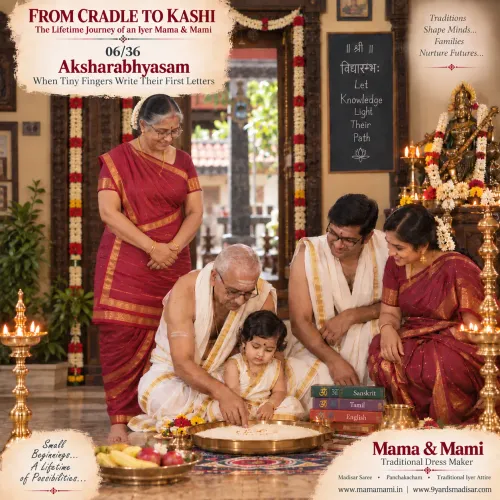
Aksharabhyasam: When Tiny Fingers Write Their First Letters
Next — 08/36:
Upanayanam: The Sacred Thread, Gayatri Mantra & a Boy's New Responsibility
Mama & Mami – Traditional Dress Maker
Preserving traditions, one generation at a time.
Madisar Saree • Panchakacham • Traditional Iyer Attire