08/36 — Upanayanam
The Sacred Thread, Gayatri Mantra & a Boy’s New Responsibility
FROM CRADLE TO KASHI • 08/36
The Lifetime Journey of an Iyer Mama & Mami
There is something different about the house today.
The boy who once slept peacefully in a cradle...
who tasted his first food while twenty relatives watched...
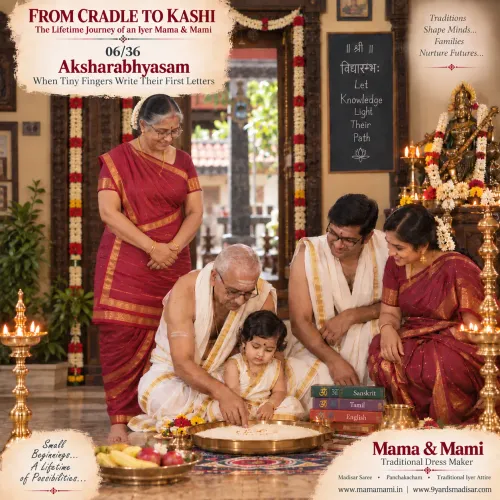
who wrote his first letters in rice...
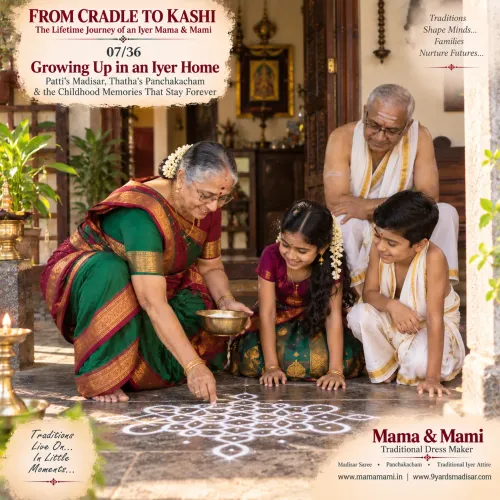
who sat beside Patti while she drew kolam...
is no longer a baby.
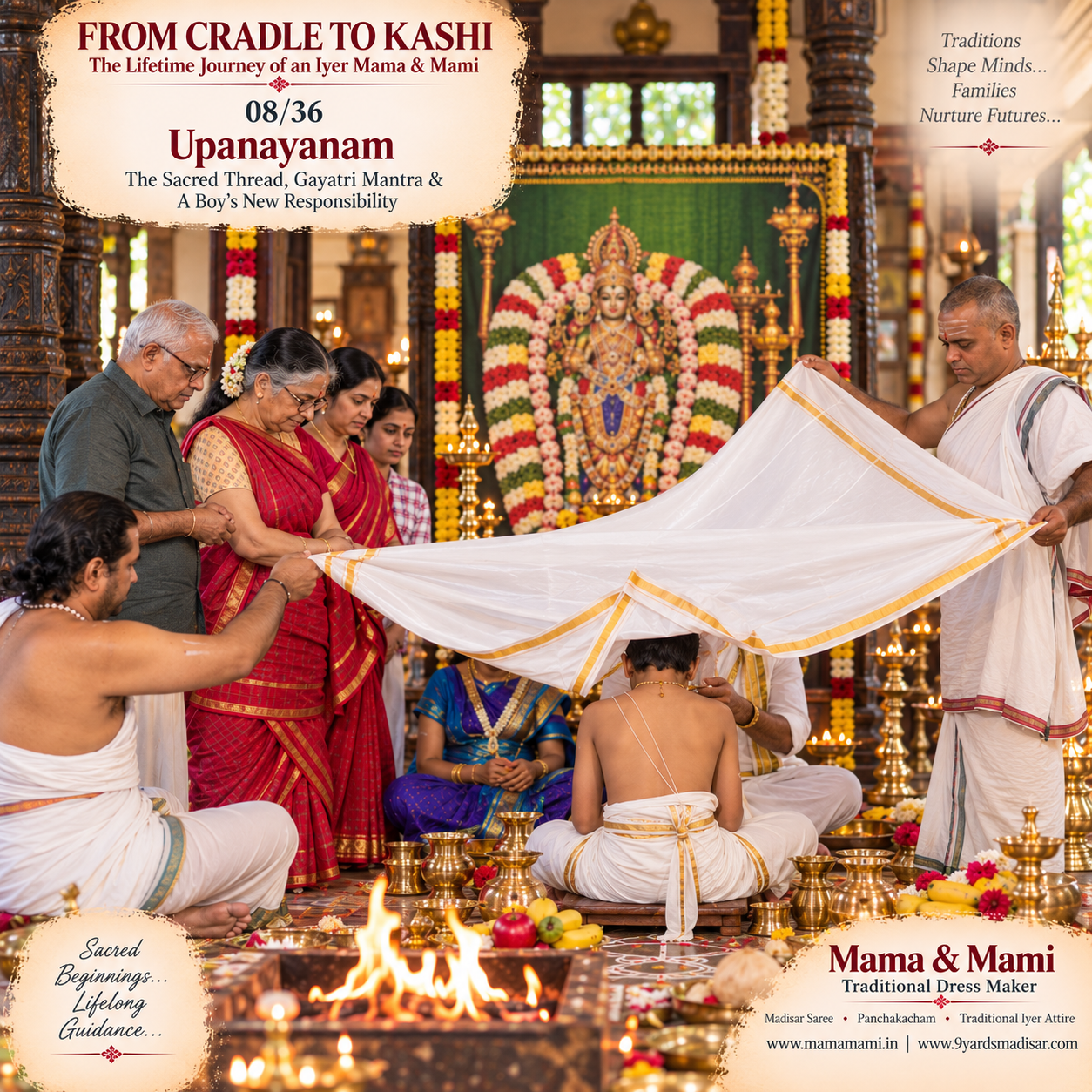
Today, he sits beside his father.
Around them are grandparents, Mamas, Mamis, relatives and the Vadhyar.
The sacred fire burns.
Mantras fill the room.
Patti watches from nearby in her Madisar.
Thatha looks at his grandson with an expression that contains both happiness and memory.
Because today is not simply another family celebration.
For families that observe this samskara, Upanayanam marks an important new stage in a boy's traditional religious life.
What Does Upanayanam Mean?
The Sanskrit idea behind Upanayana carries the sense of being led near—traditionally, being brought near a teacher and into a disciplined path of learning.
In Iyer families that follow the practice, the ceremony includes the investiture of the Yajnopavita, or sacred thread, together with important rites and instruction.
But Upanayanam is not merely about putting a thread across a boy's body.
The visible thread represents something much larger.
Responsibility.
Learning.
Discipline.
Daily practice.
And the beginning of another stage in the child's spiritual education.
The precise procedures differ by Veda shakha, sutra, family tradition and the guidance of the family's Vadhyar. Our journey therefore focuses on the meaning and family experience rather than presenting one household's procedure as universal.
The House Has Been Preparing for Days
This morning may look effortless in the photographs.
It wasn't.
Amma knows that.
Lists have been made.
Relatives have been contacted.
Clothes have been prepared.
Flowers have arrived.
Pooja materials have been checked.
Food arrangements have been made.
Someone has forgotten something.
Someone else has been sent to get it.
Appa has spoken with the Vadhyar repeatedly.
And Patti has been supervising everything with the authority of someone who has already seen several Upanayanams.
Patti Has Chosen Her Madisar Carefully
Today is one of those occasions when Patti opens her saree cupboard and pauses.
Not every Madisar carries the same memories.
Perhaps she chooses a traditional green body with a rich maroon zari section.
Or deep arakku.
Mango yellow.
Traditional blue.
Whatever the colour, the drape itself carries the unmistakable structure of the Iyer Madisar.
The saree passes over her RIGHT shoulder.
The grand, zari-rich pallu is displayed prominently across the FRONT, travelling from the LEFT toward the RIGHT-hand side.
The waist is securely wrapped and tucked.
Below, the authentic kacham creates the distinctive separated-leg construction.
Years from now, when the grandson sees today's photographs, he may immediately remember:
“That was Patti's Madisar at my Upanayanam.”
Appa Is Preparing Too
Today, Appa is not merely organising the ceremony.
He has an important role within it.
He dresses traditionally in Panchakacham, according to the family's practice.
Perhaps the boy has seen Appa dressed this way at ceremonies before.
But today feels different.
Because today, Appa will pass something to his son that was once passed to him.
The relationship between father and son is about to acquire another dimension.
And Thatha Remembers Another Boy
Look at Thatha.
He is watching his grandson.
But perhaps, for a few moments, he is seeing someone else.
His own son.
Years earlier.
Maybe Appa sat before him at his Upanayanam.
Perhaps Thatha remembers adjusting the young boy's clothing.
The nervousness.
The instructions.
The relatives.
The photographs.
And now that boy has become a father preparing his own son.
Three generations are present in one ritual.
That is one of the most beautiful things about family samskaras.
The Boy Is Excited — and Slightly Confused
The adults understand that today is important.
The boy understands that everybody keeps telling him today is important.
Those are not necessarily the same thing.
He has been told where to sit.
When to stand.
What to hold.
What to repeat.
How to place his hands.
When to listen.
There are many instructions.
He tries.
Sometimes he gets them right.
Sometimes the Vadhyar patiently corrects him.
Patti smiles.
Amma watches carefully.
Appa remains focused.
The Sacred Thread
At an appropriate stage in the ceremony, according to the family's tradition, the boy receives the Yajnopavita—the sacred thread.
For an observer, this may appear to be the defining visual moment.
But the thread is not meant to function merely as jewellery or ceremonial decoration.
It accompanies religious responsibilities and practices that the boy is expected to learn and maintain.
The ceremony therefore makes little sense if we photograph the thread beautifully but never explain what follows it.
Tradition is not only what we wear.
It is what we undertake.
Then Comes a Deeply Personal Moment
Among the most significant moments associated with Upanayanam is the Brahmopadesam, in which the father traditionally imparts the Gayatri Mantra to his son according to prescribed practice.
The atmosphere changes.
The father and son come close.
The instruction is not announced like a performance for the room.
It is treated with seriousness and reverence.
For a moment, the crowd seems less important.
There is a father.
There is a son.
And there are words that have travelled through generations.
The Gayatri Mantra
The boy may have heard the sound before.
Perhaps from Appa.
Perhaps from Thatha.
But today his relationship with it changes.
He is being initiated into a discipline that he will gradually need to understand and practise.
He may not grasp its full philosophical depth today.
That is perfectly natural.
Few children understand the complete meaning of every responsibility on the day it is given to them.
Understanding develops through practice.
Thatha Watches Quietly
This may be one of the most emotional moments of the day for Thatha.
Once, he taught his son.
Now his son teaches his grandson.
Nobody needs to make a speech about continuity.
It is happening in front of him.
Thatha → Appa → Son.
One generation transmitting responsibility to another.
And Patti Is Watching Too
Tradition is sometimes described only through the people performing the central ritual.
But look beyond the centre.
Who woke the boy?
Who ensured everything was ready?
Who remembered which relatives had to be called?
Who knows the family's customs?
Who made sure everyone ate?
Who has spent years telling this child the stories that gave these ceremonies context?
Very often, women have carried enormous amounts of cultural memory within families.
Patti's role may look different from Appa's role today.
It is not insignificant.
Bhikshacharanam — A Lesson in Humility
Another memorable part of Upanayanam in many traditions is Bhikshacharanam, performed according to the prescribed family practice.
The newly initiated boy seeks bhiksha.
For a child surrounded by relatives who have spent years giving him everything, the symbolism is striking.
He is being introduced to humility.
Dependence.
Discipline.
And the idea that learning is not accompanied by entitlement.
Amma watches her son approach.
Perhaps she has been waiting for this moment all morning.
“Bhavati Bhiksham Dehi”
The familiar request is heard.
The atmosphere immediately softens.
Amma responds according to the custom.
Patti may participate at the appropriate time.
Other women of the family may follow as prescribed.
The boy who normally opens the refrigerator without asking anybody is suddenly standing formally before the women of his family seeking bhiksha.
There will probably be some smiles.
But beneath the smiles is meaning.
Then Comes the Family Photograph
No important Iyer family function escapes this moment.
“Everybody come.”
“Where is Mama?”
“Call Mami.”
“Where did the children go?”
“Thatha, please stand here.”
“Patti, come closer.”
“Appa, look at the camera.”
The newly initiated boy stands at the centre.
Appa beside him in Panchakacham.
Amma nearby.
Patti in her authentic Madisar.
Thatha proudly standing close.
Mamas and Mamis surrounding them.
Click.
The photograph takes one second.
Its value may increase for the next fifty years.
Tomorrow Is More Important Than Today
This is perhaps the most important point of the entire chapter.
An elaborate Upanayanam can be organised beautifully.
There can be flowers.
Photography.
Traditional clothing.
Excellent food.
Hundreds of guests.
But the deeper purpose lies beyond the function itself.
What happens tomorrow morning?
Will the boy learn Sandhyavandanam properly?
Will somebody patiently explain it?
Will Appa practise alongside him?
Will Thatha help when he forgets?
Will questions be welcomed?
Will meaning accompany repetition?
A samskara becomes truly alive when the responsibility continues after the guests leave.
Appa Has a New Responsibility Too
We often say the boy has acquired responsibilities after Upanayanam.
But Appa has acquired one as well.
A child cannot be expected to maintain a practice nobody helps him understand.
Teaching takes patience.
The first few days may be enthusiastic.
Then comes school.
Homework.
Examinations.
Sports.
Friends.
Travel.
Teenage years.
The modern world will become increasingly busy.
Tradition will need more than instruction.
It will need example.
“But Why Do I Have to Do This?”
One day, the question will almost certainly arrive.
Perhaps at age twelve.
Perhaps fifteen.
Perhaps twenty-five.
“Why?”
That question should not frighten us.
It may actually be an opportunity.
Because a tradition that can survive sincere questions becomes stronger than one maintained only through fear of asking them.
Explain.
Learn together if necessary.
Ask the Vadhyar.
Read.
Understand the philosophy.
Tell the child:
“You should know what you are doing and why.”
The Boy Is Growing Into a Young Man
School years move quickly.
The sacred thread that looked so new on Upanayanam day becomes part of everyday life.
The boy grows taller.
His voice changes.
The grandparents grow older.
Patti's hair becomes greyer.
Thatha walks a little slower.
Amma begins saying:
“When did you become this tall?”
Appa starts discussing college.
And suddenly the next stage of life is approaching.
Education Will Take Him Beyond the Home
The first letters written during Aksharabhyasam have become textbooks.
Textbooks become examinations.
Examinations become choices.
Engineering?
Medicine?
Commerce?
Arts?
Research?
Music?
Business?
Something nobody in the family has done before?
The family that carefully preserved tradition must now do something equally important:
allow the next generation to build its own future.
Roots matter.
But roots are not meant to prevent branches from growing.
One Day He May Leave Home
There will be a suitcase.
Documents.
Tickets.
Perhaps a hostel room.
Perhaps another city.
Perhaps another country.
Amma will pack far more food than necessary.
Appa will check the documents repeatedly.
Patti will put something into the bag at the last moment.
Thatha will give advice.
The young man will say:
“I'll be fine.”
Everyone knows he probably will be.
That doesn't make saying goodbye easier.
But Today He Is Still Here
Today, there is no airport.
No university.
No job.
No wedding.
No house of his own.
Today he is still the boy sitting beside Appa.
The sacred thread is new.
The mantras are new.
The responsibilities are new.
Patti is nearby in her Madisar.
Thatha is watching proudly.
Amma is trying to remember every detail.
And Appa has just passed something forward.
Something his father once passed to him.
That is how generations move.
Not by remaining the same.
But by handing something meaningful to the next person and trusting them to carry it forward.
FROM CRADLE TO KASHI • 08/36
The Lifetime Journey of an Iyer Mama & Mami
Previous — 07/36:
Growing Up in an Iyer Home: Patti's Madisar, Thatha's Panchakacham & the Childhood Memories That Stay Forever
Next — 09/36:
School, College & Leaving Home: When Tradition Travels With the Next Generation
Mama & Mami – Traditional Dress Maker
Preserving traditions, one generation at a time.
Madisar Saree • Panchakacham • Traditional Iyer Attire