Aksharabhyasam
When Tiny Fingers Write Their First Letters
FROM CRADLE TO KASHI • 06/36
The Lifetime Journey of an Iyer Mama & Mami
Until now, almost everything in this child's life has been done for the child.
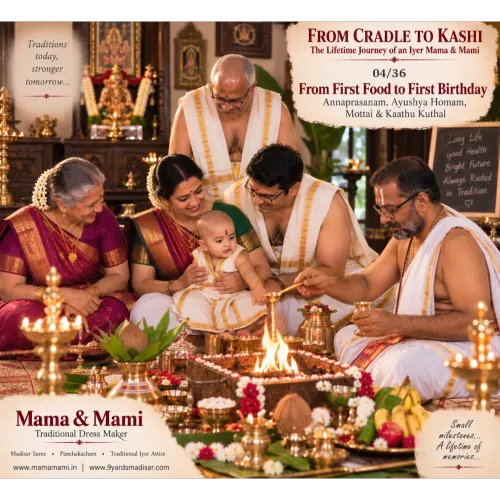
Amma fed the first ceremonial food.
Appa carried the little one to the temple.
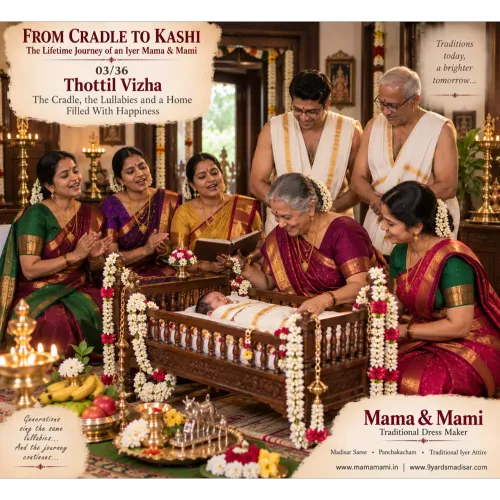
Patti sang beside the cradle.
Thatha offered blessings.
The family chose a name.
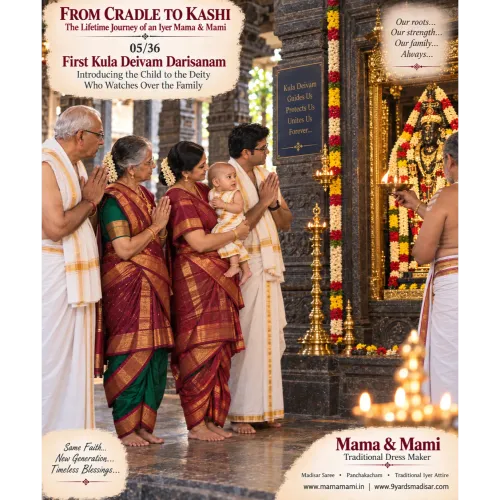
The elders took the child for Kula Deivam Darisanam.
But today is different.
Today, a tiny hand is going to do something for itself.
It is going to write.
Perhaps not perfectly.
Perhaps not even recognisably.
But for Amma, Appa, Patti and Thatha, those first uncertain marks will be among the most beautiful things ever written.
Today is Aksharabhyasam.
From the Cradle to the First Letter
Only a few chapters ago, our child was sleeping peacefully in a decorated thottil.
Now the house sounds completely different.
There are little footsteps.
Questions.
Laughter.
Toys everywhere.
And one word that seems to appear every few minutes:
“Why?”
Why is the lamp burning?
Why does Patti put kolam?
Why are we going to the temple?
Why does Thatha say his prayers?
Why does Patti wear Madisar?
Why does Appa wear Panchakacham for some ceremonies?
The child who once simply watched the world has begun trying to understand it.
And that makes this the perfect time for another beginning.
The beginning of learning.
What Is Aksharabhyasam?
Aksharabhyasam, also called Vidyarambham in some traditions and regions, marks the child's ceremonial introduction to letters and learning.
The exact age, auspicious day, place and procedure can differ according to family custom. Some families perform it at home, some at a temple, and others at a place associated with Saraswati or learning.
Families should naturally follow their own tradition and the guidance of elders and their Vadhyar.
But the central idea is beautiful.
Before asking a child to accumulate knowledge, the family first teaches the child to respect knowledge.
The Morning Begins Differently
Amma wakes the child earlier than usual.
A bath.
Fresh clothes.
Hair neatly arranged.
A small pottu.
Perhaps flowers for a little girl.
Appa is already preparing.
Patti has been awake much longer than everybody else.
She has checked the pooja items.
Twice.
Thatha is waiting.
The child wants to know where everyone is going.
Patti smiles.
“Innikku nee ezhudha pora.”
Today, you are going to write.
The child looks at her.
Writing does not sound nearly as exciting as the adults seem to think it is.
Saraswati — Before Learning Comes Reverence
Learning occupies a special place in Indian tradition.
Books are not casually stepped on.
If a foot accidentally touches a book, many of us instinctively touch it respectfully.
Children are taught that knowledge deserves reverence.
Saraswati represents learning, wisdom, music, language and the arts.
So Aksharabhyasam isn't simply the ancient equivalent of a preschool admission ceremony.
Its message is larger:
May this child's journey toward knowledge begin with humility and blessings.
Patti Arrives in Madisar
For an important family observance, Patti has chosen her traditional nine-yard Madisar.
And throughout our From Cradle to Kashi visual journey, we will preserve the authentic Iyer Madisar construction.
The saree travels over the right shoulder.
The richly woven grand pallu is displayed prominently across the front, moving from the left side toward the right.
The waist is securely wrapped and tucked.
The lower portion forms the characteristic kacham, creating the distinctive separated-leg construction of the Madisar.
It is not simply a six-yard saree worn differently.
It has its own identity.
Perhaps the child doesn't understand any of that today.
To the child, this is simply:
“Patti's saree.”
Years later, those words may mean much more.
Thatha Sits Beside the Child
Thatha has been waiting for this moment.
Perhaps he remembers his own Aksharabhyasam.
Perhaps he doesn't.
But he certainly remembers teaching his children their first letters.
Now another generation sits beside him.
A plate or tray is prepared according to family custom.
Rice may be spread evenly across it for the child to trace upon, or another traditional method may be followed.
The child's finger is held gently.
Everyone becomes quiet.
One Tiny Finger
Thatha guides the hand.
Or perhaps Appa does.
The little finger touches the rice.
Slowly, they begin.
A sacred invocation or first letters may be written according to the family's tradition.
The child doesn't fully understand what is happening.
The first line is crooked.
The second may be worse.
Patti is delighted.
Amma is taking photographs.
Appa is trying to participate while simultaneously making sure someone records the moment.
Thatha remains patient.
Again.
Slowly.
One more letter.
The First Writing May Disappear in Seconds
That is the wonderful thing about writing in rice.
The marks don't last.
One movement of a small hand and everything disappears.
Yet everybody remembers.
The physical letters vanish.
The beginning does not.
Perhaps that is why rituals are powerful.
The object itself need not survive.
The memory does.
“My Grandchild Has Started Writing!”
Patti is proud.
Very proud.
Anyone who telephones that afternoon may receive a full report.
The child wrote beautifully.
The child sat patiently.
The child understood everything.
Amma and Appa may remember events slightly differently.
But Patti's version is now official family history.
Grandparents are allowed certain privileges.
The First Book
After the ceremonial writing, the child may be introduced to a book, slate, alphabet board or another learning object according to family practice.
Perhaps Amma has bought a colourful alphabet book.
Appa opens it.
“A.”
The child repeats something vaguely resembling A.
Everybody celebrates.
“B.”
The child has lost interest.
There is something much more fascinating on the other side of the room.
Education has officially begun.
But Learning Started Long Before Today
Of course, Aksharabhyasam isn't actually the first time the child learned anything.
The child has been learning since birth.
Amma's voice.
Appa's face.
Patti's songs.
Thatha's prayers.
The smell of the kitchen.
The sound of temple bells.
How to recognise home.
How to ask for water.
How to make everybody laugh.
How to get exactly what one wants from Patti even after Amma has said no.
Children are learning constantly.
Aksharabhyasam simply gives the family a moment to stop and say:
From today, may your pursuit of knowledge be blessed.
Patti Is Also a Teacher
Years ago, education often happened around grandparents without anyone formally calling it education.
Patti might teach a slokam while preparing dinner.
She might explain why a lamp is lit.
She might teach the names of Nakshatrams.
She might tell stories from the Ramayana or Mahabharata.
She might teach a granddaughter how to make a simple kolam.
Later, perhaps, how to drape Madisar.
Thatha may teach Sandhyavandanam to a grandson.
He may explain family history.
He may teach a prayer.
Or simply tell stories about the village where he grew up.
Not every lesson arrives from a classroom.
And Amma and Appa Have a Different Responsibility
Modern parents face something previous generations encountered differently.
The world available to their children is enormous.
School.
Television.
YouTube.
Tablets.
Phones.
Artificial intelligence.
International education.
Languages from across the world.
Children can access more information in minutes than earlier generations could find in days.
So perhaps the challenge is no longer simply:
“How do we give our children knowledge?”
It is also:
“How do we give them wisdom about what to do with knowledge?”
That distinction may become increasingly important as our little child grows.
What Language Will the Child Speak?
This question appears in many modern Iyer families.
Tamil at home?
English at school?
Hindi?
Kannada?
Telugu?
Malayalam?
Another language because the family lives overseas?
A child growing up in California, Singapore, Dubai or London may experience Tamil very differently from a child growing up in Chennai or Coimbatore.
There is no single family answer.
But language carries memory.
Certain relationships sound different in the language in which we first learned them.
Amma.
Appa.
Patti.
Thatha.
Mama.
Mami.
Translation can explain the relationship.
It cannot always reproduce the feeling.
Teach the Child the Meaning, Not Only the Word
This will become a recurring idea in our 36-part journey.
A child can memorise a slokam without knowing what it means.
A child can visit a Kula Deivam without knowing why.
A boy can wear Panchakacham without understanding its context.
A woman can wear Madisar without knowing when her family traditionally used it.
Ritual can survive through repetition.
But tradition becomes stronger through understanding.
So when the child asks:
“Why?”
Perhaps the most valuable answer isn't:
“Because we have always done it.”
Perhaps it is:
“Come. I'll tell you the story.”
The First Day of School Will Come Soon
Aksharabhyasam is gentle.
Amma is nearby.
Appa is nearby.
Patti and Thatha are smiling.
There is prasadam afterwards.
School will be different.
There will be uniforms.
A bag that looks almost as large as the child.
A water bottle.
A lunch box.
New teachers.
New friends.
And perhaps a child who confidently says goodbye at the school gate...
while Amma tries not to cry.
Or perhaps exactly the opposite.
The child cries.
Amma cries.
Appa says everything will be fine.
Then calls the school two hours later to check.
Education Will Eventually Take the Child Away
Nobody is thinking about that today.
But our story already knows.
Those first letters may eventually become school examinations.
Then college applications.
A degree.
Professional qualifications.
Perhaps a job in another city.
Maybe another country.
One day the child who currently cannot write a straight line may send Amma a message saying:
“Landed safely.”
From thousands of kilometres away.
That is how far the first letter can travel.
But Before the Child Leaves, There Is a Childhood to Live
And childhood in an Iyer home isn't built only around ceremonies.
It is built around ordinary days.
Watching Patti prepare for a festival.
Seeing Thatha perform his daily practices.
Waiting for Deepavali clothes.
Helping—or supposedly helping—with Navaratri Golu.
Eating prasadam before anyone gives permission.
Watching Amma draw kolam.
Seeing Appa get ready for a pooja.
Hearing relatives arrive.
Learning who is Mama, who is Mami, who is Chithi and who is Athai.
And slowly discovering:
“This is my family.”
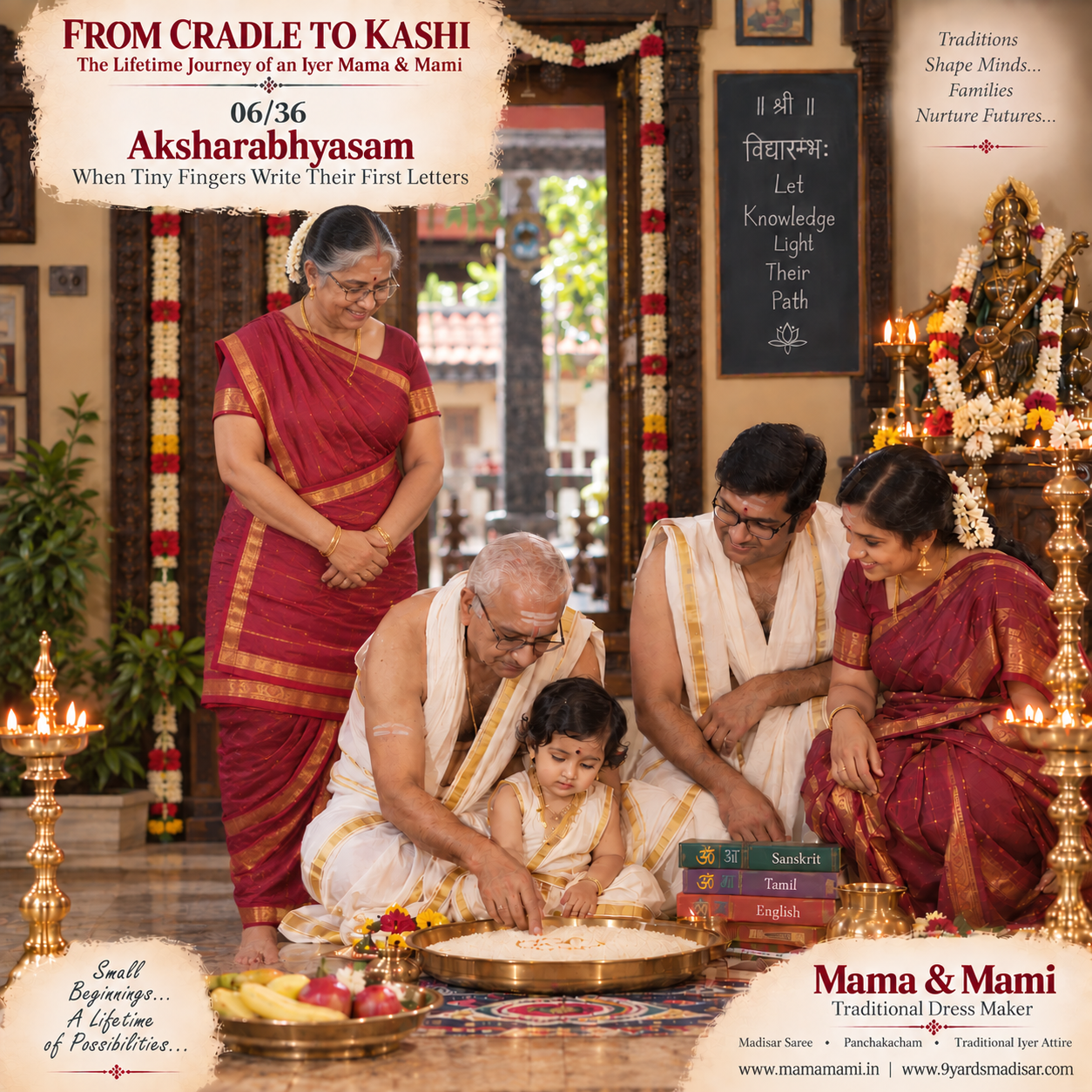
Look at Today's Photograph
There is the child sitting in front of the tray of rice.
One finger touching the first letter.
Beside the child is Thatha.
Behind them, Patti in her Madisar.
Amma watches.
Appa smiles.
Perhaps nobody thinks the photograph is extraordinary.
There will be thousands more.
But decades later, this image may be rediscovered.
The grown child might show it to their own son or daughter.
“That was my Aksharabhyasam.”
Then perhaps Patti's Madisar catches their attention.
“Who is that?”
A pause.
“That's your great-grandmother.”
And once again, one photograph opens the door to another family story.
The First Letters Are Written
The ceremony finishes.
The rice is disturbed.
The perfect little writing has disappeared.
The books are packed.
Prasadam is distributed.
Patti is satisfied.
Thatha is happy.
Amma has approximately 137 photographs.
Appa has a video he will probably watch several times that evening.
The child?
The child is already thinking about something else.
But something important happened today.
A door opened.
Behind that door are books, questions, teachers, music, mathematics, languages, history, science, philosophy and a lifetime of learning.
And alongside all of that will be another kind of education.
The education that happens simply by growing up inside a family.
That is where we go next.
Because before Upanayanam, before college, before marriage and before adulthood, there are years of watching Patti and Thatha and absorbing traditions without even realising it.
FROM CRADLE TO KASHI • 06/36
The Lifetime Journey of an Iyer Mama & Mami
Previous — 05/36:
First Kula Deivam Darisanam: Introducing the Child to the Deity Who Watches Over the Family
Next — 07/36:
Growing Up in an Iyer Home: Patti's Madisar, Thatha's Panchakacham and Childhood Memories
Mama & Mami – Traditional Dress Maker
Preserving traditions, one generation at a time.
Madisar Saree • Panchakacham • Traditional Iyer Attire