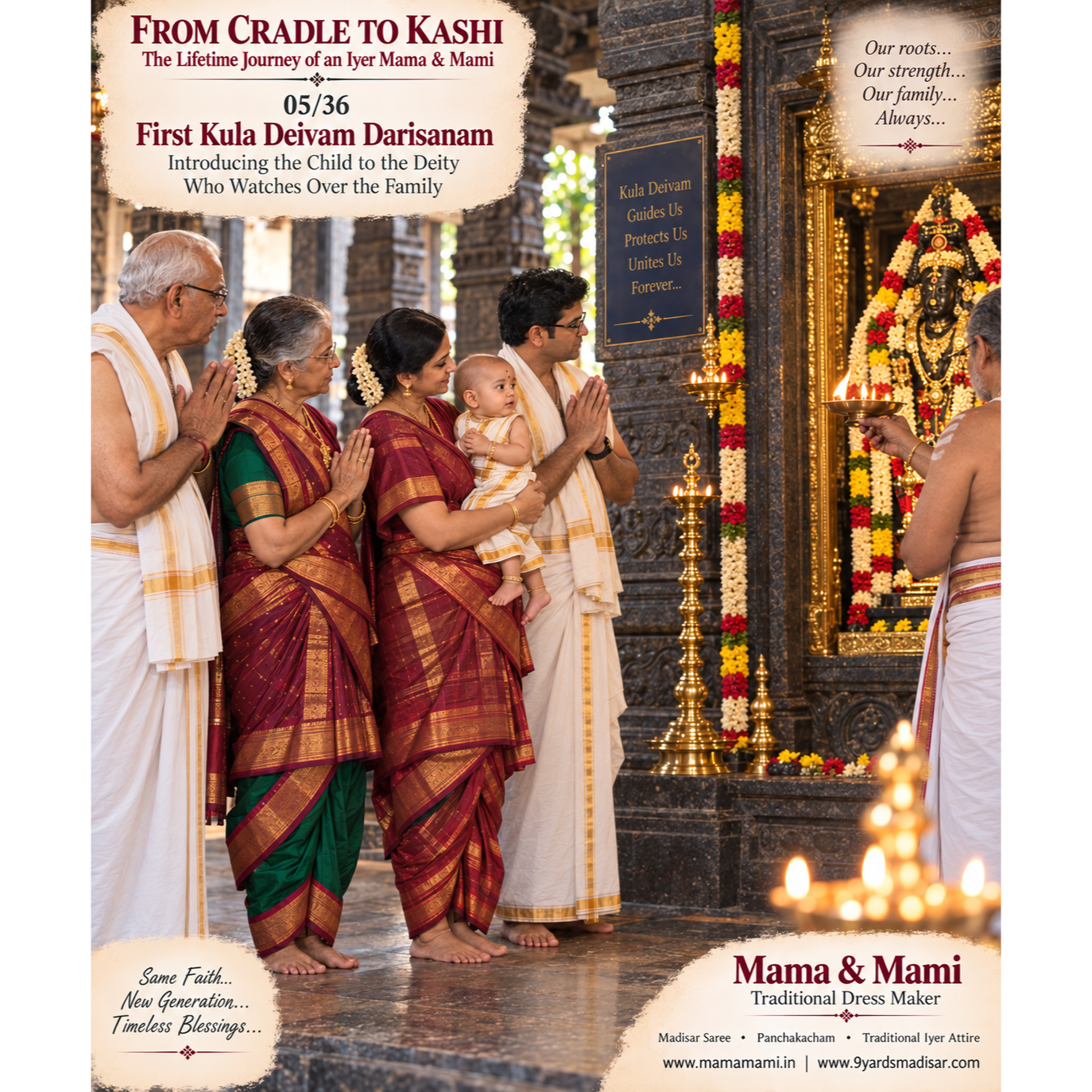
First Kula Deivam Darisanam
Introducing the Child to the Deity Who Watches Over the Family
FROM CRADLE TO KASHI • 05/36
The Lifetime Journey of an Iyer Mama & Mami
There is excitement in the house this morning.
But this time, nobody is decorating the cradle.
There is no birthday cake.
No photographer has been called.
The family is preparing for a journey.
Amma is packing everything the child might possibly need—and several things the child almost certainly will not need.
Appa is checking the route.
Patti has already asked whether the pooja items have been packed.
Thatha says they should leave early.
Then asks why nobody is ready yet.
The baby, freshly bathed and beautifully dressed, has no idea where everyone is going.
But for the elders, this isn't simply another temple visit.
Today, the newest member of the family is going to be taken before a deity whose relationship with this family began long before the child was born.
The Kula Deivam.
“First We Must Take the Child to Our Kula Deivam”
This is a sentence many of us have heard from an elder.
A baby is born.
A marriage takes place.
A new chapter begins.
And somewhere in the conversation, Patti or Thatha says:
“Kula Deivathukku poi sevichuttu varanum.”
We must go and have Darshan of our Kula Deivam.
To a child growing up in the family, the temple may initially appear to be simply another temple.
But to the older generation, it carries something deeper.
It is connected to family continuity.
What Is a Kula Deivam?
In broad terms, Kula Deivam refers to a deity traditionally worshipped by a particular family lineage or community group across generations.
The exact traditions surrounding Kula Deivam worship vary considerably between families.
The deity may be worshipped at a temple connected to an ancestral place.
Some families maintain a strong relationship with the same temple over many generations.
Others may know the name of their Kula Deivam but have gradually lost details about the ancestral connection.
For families that continue the practice, visiting the Kula Deivam can become an important part of major life events.
Birth.
Marriage.
A new home.
Children.
Important beginnings.
And annual family visits.
The underlying idea is powerful:
Before moving forward, remember where your family came from.
A Journey Their Ancestors May Have Made
The car leaves the city.
Buildings slowly become fewer.
The road changes.
Perhaps the family travels through towns the younger generation has never visited.
Patti recognises some names.
Thatha points toward a road and says:
“Our native place is somewhere near here.”
Suddenly the journey isn't only geographical.
It begins moving backwards through family history.
Perhaps Appa remembers travelling along the same route as a child.
He sat in the back seat then.
His father organised everything.
His mother carried the food.
Today, Appa is driving.
His own child is sitting behind him.
These are the quiet moments when generations exchange places.
The Temple Appears
After hours of travelling, someone finally says:
“Vandhachu.”
We have arrived.
The family steps out.
The atmosphere is immediately different.
Temple bells.
Flowers.
Camphor.
Oil lamps.
Stone floors warmed by the sun.
The sound of people calling out to one another.
Perhaps this isn't a famous temple appearing on every tourist itinerary.
That doesn't matter.
For this family, it is important.
Because their parents came here.
Their grandparents came here.
Perhaps their great-grandparents did too.
And today another generation has arrived.
Patti Changes the Way She Walks
Watch Patti as she approaches a temple deeply connected with the family.
There is familiarity in her movements.
She knows where to leave the footwear.
She knows which sannidhi they should visit.
She knows what the family normally offers.
She knows which relative made a particular vow years ago.
She knows stories nobody thought to write down.
This is another reminder of something we have already seen throughout our journey:
Much of a family's tradition lives inside people before it ever reaches paper.
Traditional Attire Becomes Part of the Memory
For an important Kula Deivam Darisanam, many families prefer traditional attire appropriate to their custom and the temple.
Patti may choose a beautiful Madisar saree.
Nine yards carefully arranged.
Traditional border.
Jasmine in her hair.
Kumkum on her forehead.
Thatha may wear veshti and angavastram, or Panchakacham where appropriate to the family's observance.
Amma and Appa dress traditionally too.
The baby may wear a tiny veshti-style outfit or pavadai according to age and family preference.
Nobody is dressing for a fashion photograph.
Yet this may become one of the family's most treasured photographs.
Because traditional clothing often gives a visual language to memory.
Years later, someone can look at the picture and immediately understand:
This was an important day.
The Baby Meets the Kula Deivam
Of course, the baby doesn't understand what is happening.
Appa carries the child.
Amma stands beside him.
Patti and Thatha are close.
The family moves toward the sannidhi.
The lamp flickers.
The priest performs the worship according to temple practice.
The bell sounds.
The child looks around.
Perhaps the baby is fascinated by the flame.
Perhaps frightened by the bell.
Perhaps completely asleep.
But the elders are watching carefully.
This is the moment they came for.
The newest generation has been brought before the family's Kula Deivam.
The Prayer Is Simple
The elders may have many prayers.
Health.
Long life.
Good character.
Education.
Protection.
A peaceful family life.
But beneath all of them is something very simple:
Look after this child.
Patti has probably prayed for her children here before.
Now she is praying for their child.
That is how a family prayer grows.
Appa Sees the Temple Differently Now
As a boy, Appa may have visited this temple because his parents told him to come.
Perhaps he complained about waking up early.
Perhaps the journey felt too long.
Perhaps he wanted to know when they were going to eat.
Now he stands holding his own child.
Suddenly his father's insistence on making the journey makes more sense.
Some traditions are understood only after our role changes.
The son becomes a father.
The daughter becomes a mother.
And an old instruction becomes a personal responsibility.
Amma Is Learning Another Family Story
Marriage often introduces a woman not only to another person, but to another family's history.
There may be a different Kula Deivam.
Different temple customs.
Different recipes.
Different ways of observing familiar festivals.
A young Mami gradually learns them.
But she does not stop carrying the traditions of the home where she was born.
This is one reason Indian family culture can become so layered.
A marriage doesn't simply join two individuals.
It brings two collections of memories into conversation.
Later in our series, when our child grows up and marries, we will return to this subject in much greater depth.
“Do You Know Why This Is Our Kula Deivam?”
Years from now, the baby will become a child capable of asking questions.
One day, standing at this same temple, the child may ask:
“Why is this our Kula Deivam?”
That question is important.
And families should answer it as accurately as they can.
If Thatha knows the ancestral story, record it.
If Patti remembers the native village, write it down.
If an elderly relative knows how the family's connection with the temple was maintained, ask now.
Don't wait.
Family history can disappear surprisingly quickly when the person carrying it is no longer there to answer questions.
Make the Annual Visit a Story, Not an Obligation
There is another way traditions survive.
Make memories around them.
The Kula Deivam trip doesn't have to be remembered by children only as:
“That temple Appa forced us to visit.”
Let them remember the journey.
Breakfast on the way.
Patti telling stories in the car.
The flowers bought outside the temple.
The prasadam.
The photograph near the temple entrance.
The lunch afterwards.
Visiting the ancestral village if possible.
Meeting relatives.
Tradition becomes easier to carry when it is attached to affection.
And This Visit Should Not End Today
One of the important ideas we want to preserve throughout this 36-part journey is that Kula Deivam Darisanam is not merely a one-time ceremony after the birth of a child.
For families that follow the tradition, the connection continues.
The family may return regularly or annually according to its practice.
The child grows.
The photographs change.
First, Appa carries the baby.
A few years later, the child walks into the temple holding Patti's hand.
Then comes school.
College.
Career.
Marriage.
And after the wedding?
Something beautiful happens.
The child returns.
But not alone.
One Day, This Child Will Return With a Life Partner
Many chapters from now, we will see this same temple again.
The baby we are following today will have become an adult.
There will have been Jathagam discussions.
Penn Paarthal.
Nichayathartham.
An Iyer wedding.
Madisar.
Panchakacham.
Mangalya Dharanam.
And then the newly married couple will come here.
Mama and Mami will stand before the Kula Deivam together.
Patti and Thatha may accompany them.
Or perhaps, by then, only one of them can make the journey.
The photograph will be different.
But the temple will remain.
And Then They Will Bring Their Own Child
Years later, Mama and Mami may arrive carrying a baby.
Exactly as Amma and Appa are doing today.
Someone will say:
“This is the baby's first Kula Deivam Darisanam.”
And suddenly today's young parents will understand how quickly a generation turns.
The child becomes the parent.
The parent becomes the grandparent.
The person who was once carried into the temple now carries someone else.
Perhaps That Is What Kula Deivam Really Teaches Us
A family is temporary.
A lineage is longer.
Individual lives begin and end.
Houses change.
Cities change.
People move overseas.
Languages change.
Clothing changes.
Careers change.
Even the way we celebrate festivals changes.
But families look for certain things that can act as anchors.
A name.
A photograph.
A Madisar preserved in a cupboard.
A Panchakacham worn for important rituals.
An ancestral village.
A recipe.
A Shraddham date.
And sometimes...
a temple.
A place where generations have stood before the same deity and asked, in their own words, for essentially the same thing:
Please look after our family.
Before Leaving, Take One Photograph
The Darshan is complete.
The baby has received prasadam.
Everyone begins walking toward the temple entrance.
Before leaving, Appa asks the family to stop.
One photograph.
Patti stands proudly in her Madisar.
Thatha beside her in traditional attire.
Amma holds the baby.
Appa stands close.
Behind them is the temple that brought their ancestors here before any of them were born.
Click.
Today, it is simply another photograph on a phone.
Decades later, the child may stand in exactly the same place holding another baby.
And someone may show them this picture.
“See? This was the first time we brought you here.”
That is when a temple visit becomes a family story.
The Journey Home
The baby falls asleep almost immediately.
Patti is tired but happy.
Thatha begins discussing when they should come again.
Amma looks through the photographs.
Appa drives.
The temple slowly disappears behind them.
But something has been established.
A connection between the newest member of the family...
and something much older than them.
Soon, however, another journey begins.
This one doesn't lead to a temple.
It leads toward books.
Letters.
Learning.
And the moment tiny fingers are guided to write for the very first time.
Aksharabhyasam.
FROM CRADLE TO KASHI • 05/36
The Lifetime Journey of an Iyer Mama & Mami
Previous — 04/36:
From First Food to First Birthday: Annaprasanam, Ayushya Homam, Mottai & Kaathu Kuthal
Next — 06/36:
Aksharabhyasam: When Tiny Fingers Write Their First Letters
Mama & Mami – Traditional Dress Maker
Preserving traditions, one generation at a time.
Madisar Saree • Panchakacham • Traditional Iyer Attire