A Child Is Born: Where the Journey of an Iyer Family Begins
FROM CRADLE TO KASHI • 01/36
The Lifetime Journey of an Iyer Mama & Mami
There are some moments in a family that divide time into two simple parts:
Before this happened. And after this happened.
The birth of a child is one of them.
A telephone rings.
A message reaches the family WhatsApp group.
“Baby has arrived.”
For a few seconds, nothing else seems important.
The new father is trying to understand how his entire world has changed in a matter of minutes.
The exhausted mother looks at the tiny face beside her and wonders how someone she has only just met can already feel so familiar.
And somewhere else, two people receive the news they have been waiting to hear.
They were Amma and Appa yesterday.
Today, they have another name.
Patti and Thatha.
And without anyone quite realising it, another chapter in an Iyer family's story has begun.
A Baby Is Born. But So Are Many New Relationships.
Whenever a child enters an Indian family, it isn't only the parents whose lives change.
A daughter becomes a mother.
A son becomes a father.
Parents become grandparents.
Brothers and sisters become Chithappa, Chithi, Mama, Mami, Athai or Periappa.
And the oldest members of the family suddenly find themselves looking at another generation carrying forward the family they once received from their own elders.
That is perhaps why the arrival of a baby feels so much bigger than one new life.
The entire family moves forward by one generation.
Patti Arrives
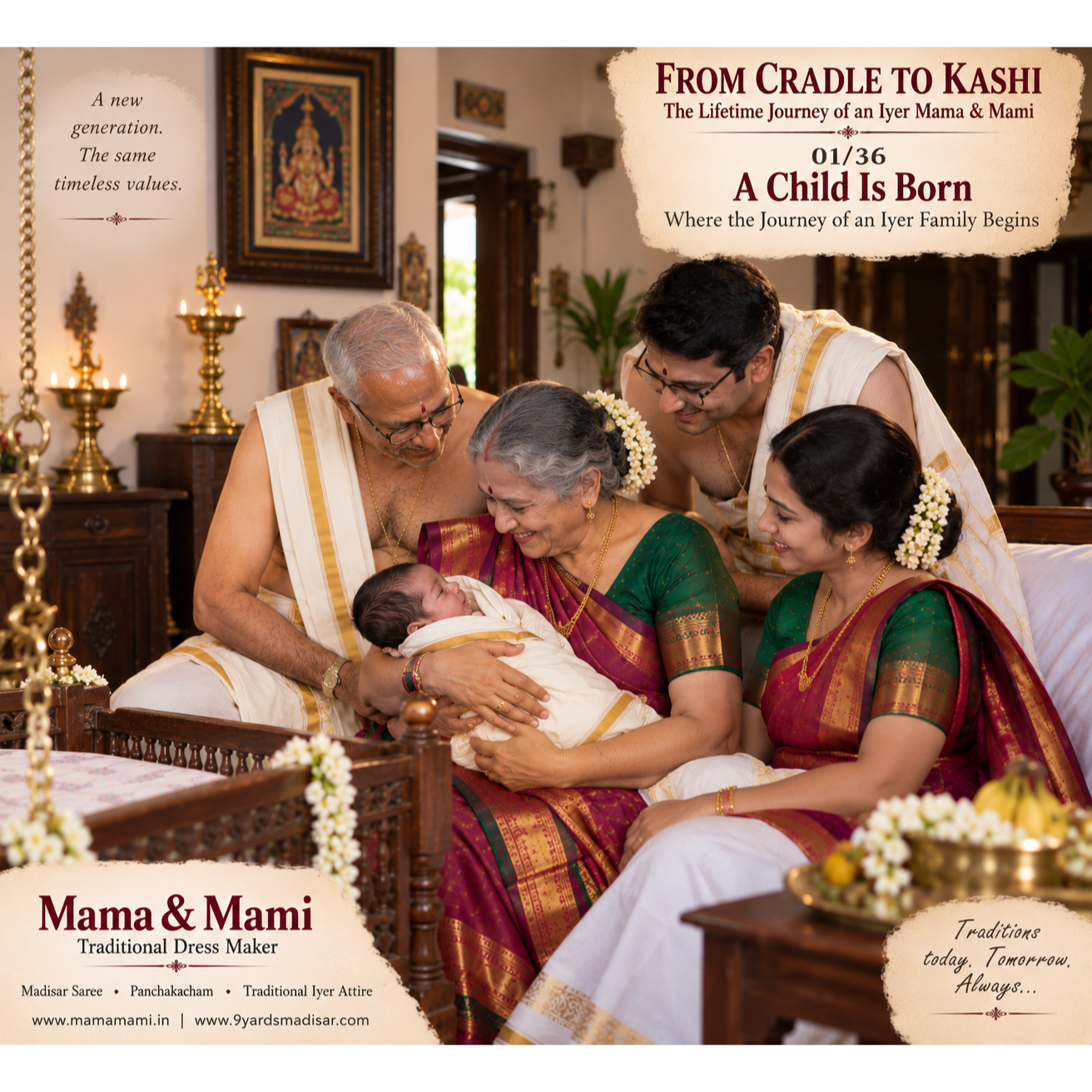
Imagine Patti arriving to see her grandchild.
Perhaps she has hurriedly packed after receiving the news. Perhaps she has travelled overnight. Perhaps she has been staying nearby for days because she refused to be anywhere else when the baby arrived.
She enters the room and sees her daughter—or daughter-in-law—holding the newborn.
For a moment, Patti doesn't say very much.
She simply looks.
Then comes the smile.
She takes the baby carefully into her arms.
And suddenly the woman who has spent years telling everyone what to do is whispering to a sleeping child who understands absolutely none of it.
There may be tears.
There will almost certainly be advice.
And before long, someone will probably say:
“Don't wake the baby!”
And Then Comes Thatha
Thatha may pretend to be calmer.
He may stand a little distance away and ask whether mother and child are doing well.
He may check practical things.
But put the newborn into his arms and watch what happens.
The voice changes.
The expression changes.
The man whom everyone has known as Appa suddenly becomes remarkably gentle.
Perhaps he remembers holding his own son or daughter decades earlier.
Perhaps he remembers his father.
For one brief moment, several generations seem to occupy the same room.
Patti's Madisar and Thatha's Traditional Veshti
Traditional clothing has a curious relationship with family memory.
Years later, the child may not remember anything about this day.
But photographs will remain.
There might be a photograph of Patti standing beside the cradle in her traditional Madisar saree, jasmine in her hair and kumkum on her forehead.
Beside her may be Thatha in his traditional veshti, and on appropriate religious occasions, Panchakacham.
At the time, nobody thinks much about the clothes.
They are simply what Patti and Thatha wear for important family moments.
But decades later, that photograph becomes precious.
The child who once lay in the cradle may look at it and say:
“That was Patti's favourite Madisar.”
Or:
“Thatha always wore his Panchakacham for our important family functions.”
Clothing becomes memory without asking permission.
Nine Yards Can Carry More Than Tradition
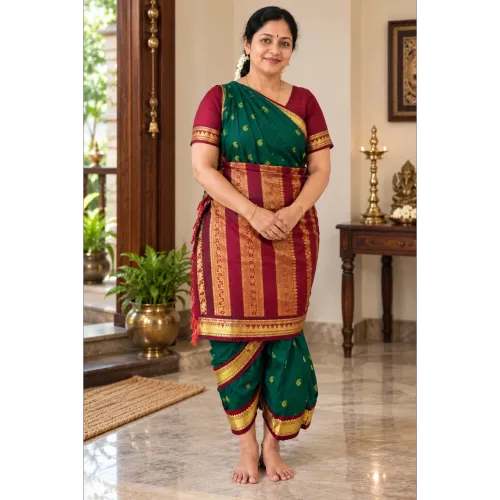
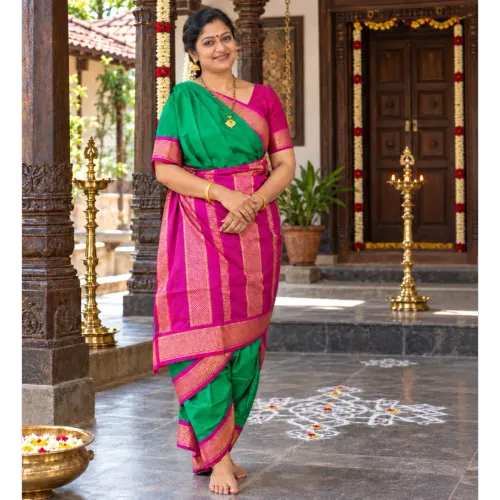
A Madisar is nine yards of fabric.
But inside a family, it can carry much more.
One Madisar may have been worn for a daughter's wedding.
Another for a Seemantham.
Another for Ayushya Homam.
Another for Navaratri.
Some are carefully folded and kept for decades.
Eventually, the saree becomes associated not merely with its colour or border, but with the people and occasions surrounding it.
The same is true of a Panchakacham.
A child may first see it as simply “what Thatha wears for poojai.”
Later, he may watch Appa wear it.
One day, after his Upanayanam and as he grows older, he may learn how traditional attire belongs within his own responsibilities.
These things rarely arrive as formal lessons.
Children learn by watching.
The First Days Are Full of Questions
What Nakshatram was the baby born under?
What will the child be named?
Whose eyes does the baby have?
Does the nose look like Amma's?
Or is it exactly like Thatha's?
Which name should be chosen?
When will Punyavachanam be performed?
When will Namakaranam take place?
When can relatives visit?
Everyone has a question.
And, naturally, everyone has an opinion.
That is family.
The Grandparents Suddenly Become Important in a New Way
Modern families may live in Chennai, Coimbatore, Bengaluru, Mumbai, Delhi, Singapore, Dubai, London, Sydney, California—or almost anywhere.
Children grow up and move away.
Careers scatter families across cities and countries.
Yet the birth of a baby has an extraordinary ability to bring generations together again.
Suddenly the younger couple begins asking questions they may never have asked before.
“Amma, what did you do when I was born?”
“Appa, when is this ceremony normally performed?”
“Which Vadhyar should we speak to?”
“What did Patti do?”
Traditions that seemed distant become immediately relevant.
And the people who carried that knowledge become invaluable.
Tradition Doesn't Always Look Exactly the Same
It is important to remember that not every Iyer family follows every custom identically.
Practices can differ according to family tradition, region, Veda shakha, circumstances and the guidance of elders and the family's Vadhyar.
Families living outside India may also adapt practical details while trying to preserve the meaning behind them.
That doesn't necessarily mean tradition has disappeared.
Sometimes tradition survives precisely because families learn how to carry it into a different time and place.
The Baby Knows None of This
And perhaps that is the most beautiful part.
While adults discuss Nakshatram, ceremonies, names, customs and which relative the baby resembles…
the baby sleeps.
Completely unaware that an entire family history has already begun gathering around the cradle.
The child doesn't yet know about Punyavachanam.
Or Namakaranam.
Or Ayushya Homam.
Or Aksharabhyasam.
The child doesn't know that one day there may be an Upanayanam or a wedding.
There may be a first Madisar.
A first Panchakacham.
A first Kula Deivam journey.
A first home.
A Grahapravesam.
Children.
Grandchildren.
Kashi.
Gaya.
Prayagraj.
And responsibilities toward ancestors whose photographs the child currently cannot even recognise.
All of that is still waiting.
For today, there is only a newborn sleeping peacefully in someone's arms.
Somewhere, Another Journey Has Started
This is where our story begins.
Not at the wedding.
Not when someone first wears Madisar.
Not at Grahapravesam.
Not at Kashi.
It begins here.
With a child.
Over the next 35 chapters, we will watch this generation grow.
We will follow childhood and family celebrations.
We will sit beside Patti and listen to her stories.
We will watch Thatha pass on what he knows.
We will experience Upanayanam, education and leaving home.
Then come Jathagam, Penn Paarthal, Nichayathartham and the excitement of an Iyer wedding.
We will watch a young bride wear her Madisar.
A young groom wear his Panchakacham.
They will become Mama & Mami.
They will visit their Kula Deivam.
Enter their own home.
Celebrate their first festivals.
Become parents.
And eventually become Patti and Thatha themselves.
We will travel with them to Kashi, Gaya and Prayagraj.
We will also face the quieter chapters of life—losing elders, Apara Karma, Shraddham and Tarpanam.
Until eventually we arrive where every family journey leads.
Another generation.
Another cradle.
Another beginning.
Because in a family, a tradition doesn't really belong to one person.
We receive it from someone.
We live it in our own way.
And one day, we hand it to someone else.
FROM CRADLE TO KASHI • 01/36
The Lifetime Journey of an Iyer Mama & Mami
Next — 02/36:
Punyavachanam & Namakaranam: A Baby's First Blessings and the Name That Bec