From First Food to First Birthday
Annaprasanam, Ayushya Homam, Mottai & Kaathu Kuthal
FROM CRADLE TO KASHI • 04/36
The Lifetime Journey of an Iyer Mama & Mami
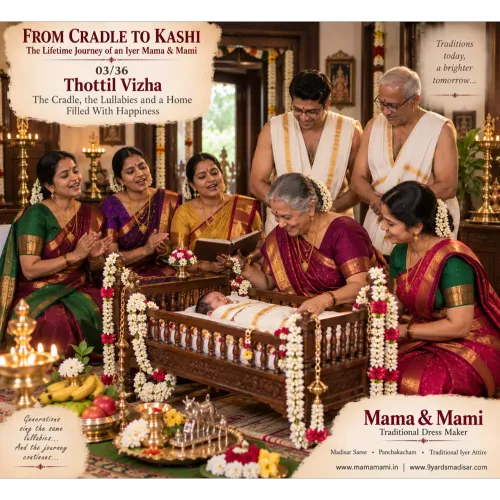
Only a few months ago, the entire family stood around a cradle.
The baby slept.
Patti sang.
Thatha watched quietly.
Amma and Appa were still learning what it meant to be parents.
And everyone seemed to have an opinion about when the baby should sleep.
Now look at the same house.
The cradle is slowly becoming unnecessary.
The baby recognises familiar faces.
There is laughter.
There are tiny hands reaching for everything they are not supposed to touch.
Patti insists the baby smiles more when she enters the room.
Thatha claims the child recognises his voice.
Amma knows exactly which sound means hunger.
Appa has developed the extraordinary ability to identify the baby's toys in complete darkness.
Time has started moving.
And with it come some of the most memorable milestones of early childhood.
Annaprasanam.
Ayushya Homam.
Mottai.
Kaathu Kuthal.
Four occasions.
Four sets of family photographs.
And four more stories that will eventually become part of this child's history.
Annaprasanam — The First Taste Beyond Milk
For months, the baby's world of food has been very simple.
Then comes a day when the family prepares to introduce solid food ceremonially, according to its tradition.
Annaprasanam marks the child's first ceremonial feeding of solid food in families that observe the custom.
As with many traditions in our journey, the exact timing and procedure may vary between families.
But one thing is almost guaranteed.
Everyone wants to watch.
One Tiny Spoon. Twenty People Watching.
Imagine the scene.
The child is dressed beautifully.
Amma has spent considerable time getting the baby ready.
Appa is trying to ensure the child remains in a good mood.
Patti is nearby with advice.
Thatha is watching.
Mamas and Mamis have gathered.
A small quantity of the ceremonial food is prepared according to family custom.
Someone takes the first tiny portion toward the baby's mouth.
Twenty adults lean forward simultaneously.
The baby looks suspicious.
A little taste reaches the mouth.
Silence.
Everyone waits for a reaction.
Perhaps the baby smiles.
Perhaps the baby immediately spits everything out.
Either way, the adults applaud.
For the child, it is a spoonful of food.
For the family, it is a milestone.
Food Is Never Merely Food in a Family
The Annaprasanam also begins another lifelong relationship.
Food.
Soon this child will learn the flavours of home.
Curd rice.
Rasam.
Sambar.
Paruppu.
Vegetables prepared in the family's particular way.
Patti's special recipes.
Deepavali bakshanam.
Navaratri sundal.
Pongal.
Payasam.
Prasadam from the temple.
One day the child may move thousands of kilometres away.
Yet a familiar smell from a kitchen can bring childhood back instantly.
That journey begins with surprisingly small tastes.
And Patti Is Already Planning What the Child Will Eat Next
Grandmothers possess a special confidence regarding feeding grandchildren.
Amma may say:
“Enough.”
Patti hears:
“Perhaps one more small spoon.”
Appa wisely stays out of the discussion.
Thatha smiles.
The baby has already discovered that grandparents operate under slightly different rules from parents.
This information will become extremely useful later.
Then Suddenly, the First Birthday Approaches
Parents often discover something strange about the first year.
The nights can feel very long.
But the year feels incredibly short.
One day you are learning how to hold a newborn.
Then somebody asks:
“What are you doing for the first birthday?”
Already?
Yes.
Already.
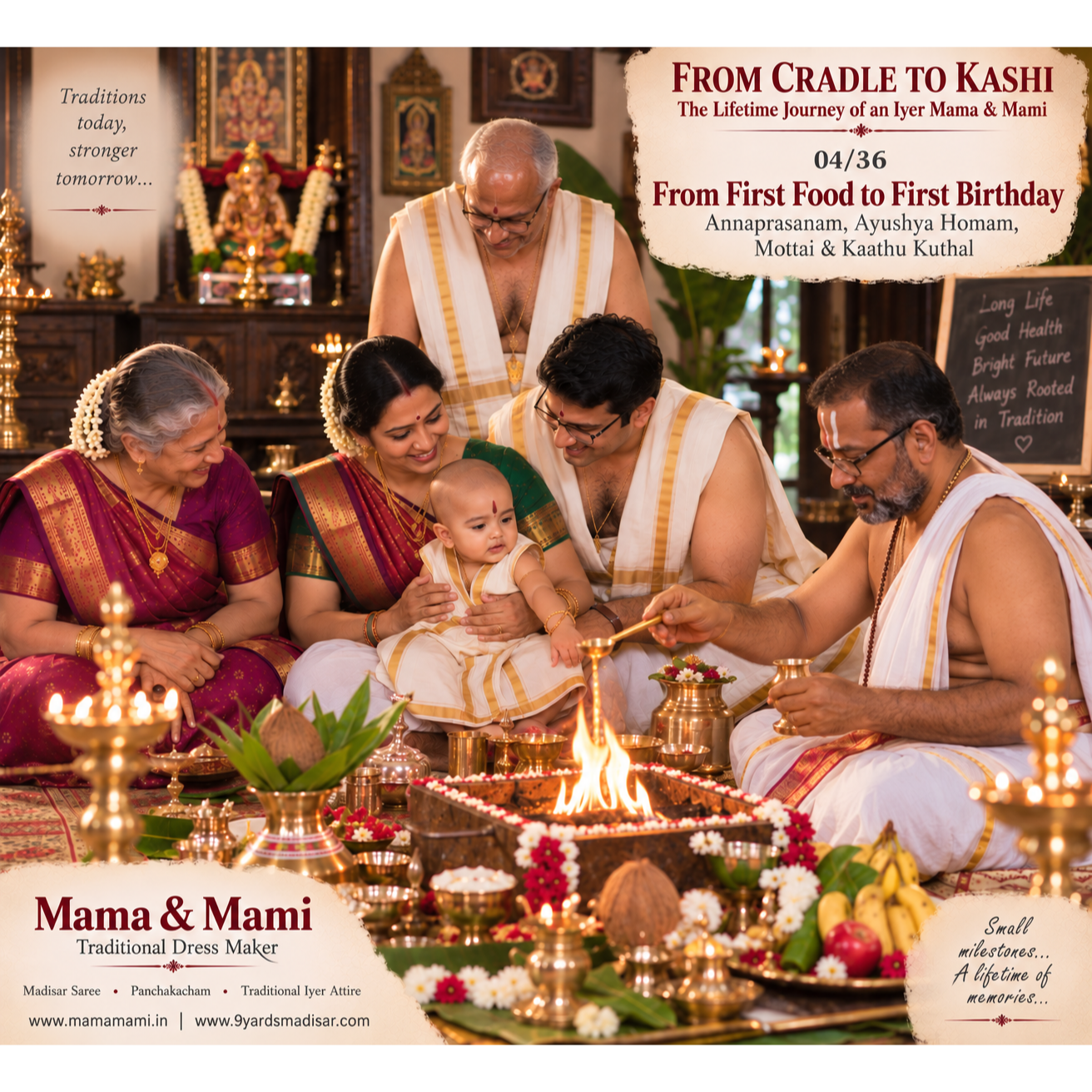
In many Iyer families, the child's first birthday may include an Ayushya Homam, depending on family tradition.
Ayushya Homam — A Prayer for a Long and Healthy Life
Ayushya Homam is performed with prayers for Ayush—or longevity, health and well-being.
Families may observe it on an appropriate day connected with the child's birth star and according to the guidance of their Vadhyar and family practice.
This distinction is interesting.
Modern life often celebrates birthdays according to the calendar date.
Traditional observances may also give importance to the child's Nakshatra.
For many families today, both worlds coexist.
There may be a Homam in the morning.
And a birthday cake later.
A Panchakacham at one part of the day.
Party clothes at another.
Vedic mantras in the morning.
“Happy Birthday” in the evening.
Tradition and modern life do not always have to compete.
Sometimes they simply occupy different hours of the same day.
The House Wakes Up Early
On the morning of the Ayushya Homam, the home feels different again.
Kolam at the entrance.
Flowers.
Kalasam.
Homam arrangements.
Banana leaves.
Fruits.
The fragrance of sambrani or incense.
The Vadhyar arrives.
Appa gets ready in the traditional manner required for the ceremony.
Where customary, Panchakacham becomes part of the visual language of the occasion.
Thatha is ready too.
The child, meanwhile, has decided this is an excellent morning to refuse to cooperate.
Mami and the Madisar
For significant religious family occasions where family custom calls for it, the women may choose the traditional Madisar saree.
The nine-yard drape brings a distinctive dignity to the gathering.
Perhaps Patti wears the same Madisar she wore for the Thottil Vizha.
Perhaps Amma is beginning to understand the garment differently now.
As a girl, she watched older women wear it.
As a young mother, she begins to see where traditional attire belongs within her own family's ceremonies.
One day, much later in our journey, she may teach another young woman how to wear those same nine yards.
But that chapter is still far away.
Fire, Mantras and a Restless One-Year-Old
The Homam begins.
The Vadhyar chants.
Offerings are made into the sacred fire according to the prescribed procedure.
Appa participates.
Amma sits with the child.
Patti watches carefully.
Thatha follows the mantras.
And the one-year-old?
The one-year-old is fascinated by absolutely everything except remaining still.
A flower is interesting.
A spoon is interesting.
Appa's angavastram is extremely interesting.
The Homam itself?
Perhaps for thirty seconds.
Family ceremonies with small children are rarely perfectly composed.
That is part of their charm.
Blessings From the Elders
After the ceremony comes a moment that will repeat throughout this child's life.
The child receives the blessings of elders.
Today, Patti and Thatha bless a one-year-old.
Years later they may bless the same child at Upanayanam.
At graduation.
At Nichayathartham.
At the wedding.
During Grahapravesam.
Before a journey overseas.
One day those grandparents may no longer be physically present.
But the habit remains.
Seek the blessings of those who came before you before beginning something important.
That lesson is often taught long before a child understands its meaning.
Then Comes Mottai
There is another photograph found in countless South Indian family albums.
A perfectly round little head.
A slightly confused child.
And several adults looking delighted.
Mottai—the child's tonsure.
The first tonsure may be performed according to family tradition, often associated with a temple or Kula Deivam visit.
Practices vary significantly, so the exact timing and procedure should always be understood through one's own family custom.
For the child, however, the philosophical meaning is probably less important than one immediate discovery:
“Where did all my hair go?”
The Temple Journey
For many families, Mottai is connected with a temple visit.
That itself becomes an adventure.
The family wakes early.
Bags are packed.
Someone has forgotten something.
They turn back.
Someone asks whether the coconut was brought.
Patti says she reminded everyone.
Eventually the family reaches the temple.
The child sees crowds, lamps, flowers, bells and unfamiliar faces.
Appa carries the baby.
Amma keeps checking whether everything is all right.
Patti and Thatha know exactly where they want to go.
The ritual is completed according to family and temple practice.
And soon everyone is looking at a newly tonsured child.
The First Photograph After Mottai
This photograph is compulsory.
The child may not be happy.
That does not matter.
Everyone else is.
Thatha says the baby looks wonderful.
Patti says the face looks even more beautiful now.
Amma is still getting used to it.
Appa is taking photographs from every possible angle.
Years later, this picture will be shown to the grown child.
Almost certainly against their wishes.
That, too, is family tradition.
Kaathu Kuthal — The First Earrings
Another early milestone in many South Indian families is Kaathu Kuthal, or ear piercing.
Again, timing and customs differ between families.
It may be associated with a temple visit or performed according to the family's established practice.
For a little girl, the first pair of traditional earrings can become a particularly cherished memory for parents and grandparents.
Sometimes the jewellery is given by grandparents.
Sometimes there is an older family connection.
Perhaps Patti has carefully selected the tiny earrings.
She has imagined them on her granddaughter for weeks.
The child has not been consulted.
One Moment of Tears, Years of Photographs
The actual piercing may produce exactly the reaction everyone expects.
Tears.
Amma comforts the child.
Appa tries to distract her.
Patti says it will be all right.
Thatha produces something that magically gets the child's attention.
Within a short time, the tears stop.
The tiny earrings remain.
And another milestone has passed.
Why Do Families Remember These Small Ceremonies?
From the outside, these occasions may seem unrelated.
First food.
First birthday.
First tonsure.
First earrings.
But together they do something important.
They mark time.
Before smartphones automatically organised our photographs by date, families organised memories around events.
That was your Annaprasanam.
That was your first Ayushya Homam.
That was when we took you for Mottai.
Those were your first earrings.
Ceremonies become markers in a person's life.
They help a family remember not only what happened, but who was there when it happened.
Look at the Photographs Again
There is Patti in her Madisar.
There is Thatha in traditional attire.
There is Appa wearing Panchakacham for the Homam.
There is Amma holding the child.
There are Mamas and Mamis who travelled to attend.
Perhaps someone in those photographs will not be present twenty years later.
That changes the photograph.
What once documented a ceremony becomes evidence of a relationship.
This is why family albums grow more valuable with time.
The Child Is Growing
The baby from our first chapter is disappearing.
Not literally.
But childhood is changing.
Soon there will be words.
Questions.
Running feet.
Temple visits.
School.
Friends.
Arguments about vegetables.
Requests for another story from Patti.
And the inevitable question:
“Why?”
Why do we light the lamp?
Why does Patti wear Madisar?
Why does Thatha wear Panchakacham?
Why do we go to this particular temple?
Why does Appa do this?
Why does Amma do that?
Those questions will lead us toward something fundamental.
Before a child can inherit family traditions, the child needs to know where the family comes from.
And that brings us to our next chapter.
The family is preparing for another journey.
This time, they are taking the child to meet someone the baby has never met.
Someone whose relationship with the family began generations before the child was born.
The Kula Deivam.
FROM CRADLE TO KASHI • 04/36
The Lifetime Journey of an Iyer Mama & Mami
Previous — 03/36:
Thottil Vizha: The Cradle, the Lullabies and a Home Filled With Happiness
Next — 05/36:
First Kula Deivam Darisanam: Introducing the Child to the Deity Who Watches Over the Family
Mama & Mami – Traditional Dress Maker
Preserving traditions, one generation at a time.
Madisar Saree • Panchakacham • Traditional Iyer Attire