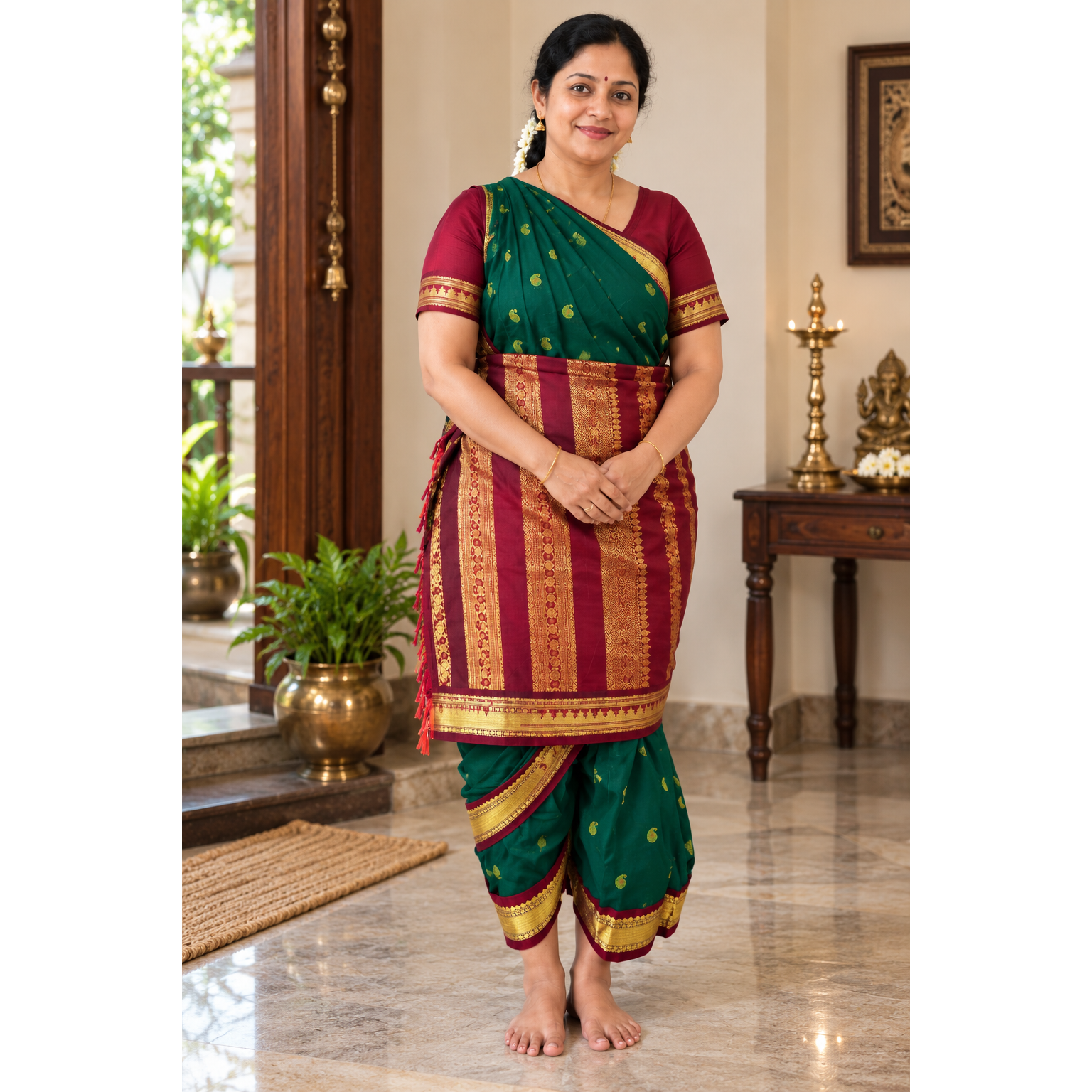
Why Is the Madisar Nine Yards? Understanding a Saree That Is More Than a Drape
Open an old family wedding album from a Tamil Brahmin household and you may notice something interesting.
Fashions change. Jewellery changes. Photography changes. Even wedding halls change.
Yet across generations, one garment continues to appear at some of the family's most significant moments: the Madisar.
Nine yards of fabric transformed through a distinctive drape into an attire immediately associated with tradition.
For someone encountering it for the first time, an obvious question arises:
Why nine yards?
A Saree With a Very Different Construction
Most sarees commonly worn today are approximately six yards long. The Madisar belongs to the family of traditional nine-yard saree drapes found in different parts of India.
Those additional yards aren't simply decorative.
The length allows fabric to be wrapped around the body and arranged between the legs, creating the characteristic lower portion of the Madisar while still leaving enough material for the upper drape.
This construction gives the Madisar its instantly recognisable silhouette.
More Than Festive Clothing
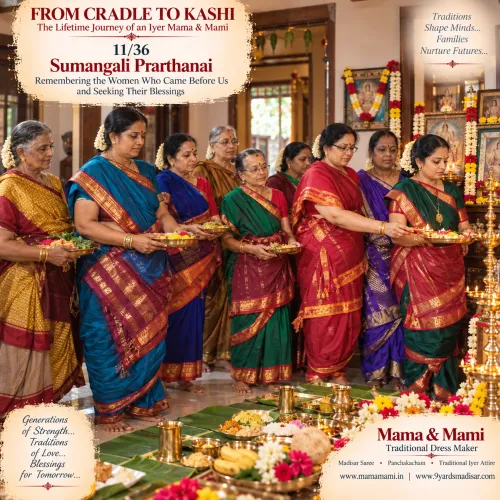
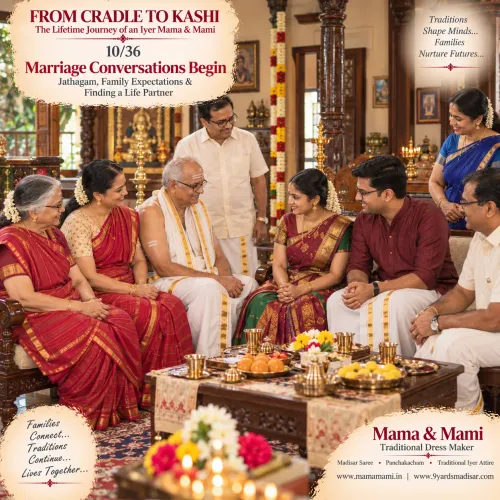
For many Tamil Brahmin families, Madisar isn't simply another saree reserved for photographs.
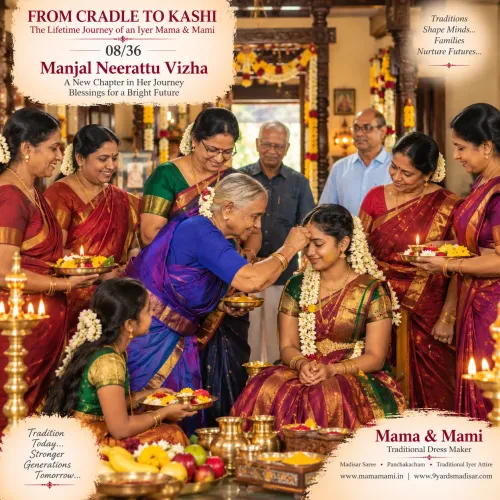
It is associated with religious and family traditions and is particularly visible during weddings and important ceremonies.
That context changes how the garment is understood.
A beautiful silk saree may be selected because of its colour, weaving or design. A Madisar may carry all those aesthetic qualities while also representing participation in a family custom.
That is why an older Madisar preserved carefully in a cupboard can mean considerably more to a family than its material value.
Iyer and Iyengar Traditions
It is tempting for someone unfamiliar with the garment to think of “Madisar” as one universal draping method.
The reality is more nuanced.
Iyer and Iyengar communities have their own traditional approaches to wearing the Madisar. Details of the drape distinguish one tradition from another, and families may also have practices passed down through generations.
These distinctions are precisely what make traditional clothing fascinating.
A Madisar isn't merely nine yards of fabric.
It is nine yards interpreted through community, family and occasion.
The Colours We Remember
Ask someone about the Madisar their grandmother wore and they may not remember every detail of the ceremony.
But surprisingly often, they remember the saree.
“Dark green with a maroon border.”
“Yellow with a deep red pallu.”
“A beautiful arakku shade.”
“Purple with a contrasting green border.”
Colour becomes part of memory.
Traditional combinations continue to remain popular because contrast works particularly beautifully in a nine-yard drape. Different portions of the saree become visible at different points on the body, allowing the body colour, border and pallu to interact rather than appearing as one uninterrupted colour.
From One Generation to Another
Perhaps the most interesting chapter in the story of Madisar is happening now.
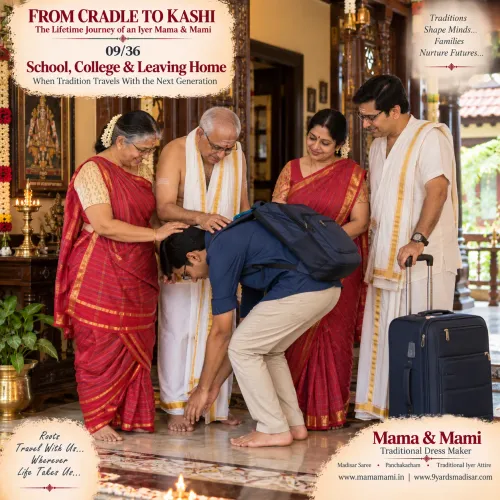
Many younger Tamil women live far from the homes where their mothers and grandmothers learned these traditions. Families are spread across Chennai, Coimbatore, Bengaluru, Mumbai, Delhi, Singapore, London, Sydney, the United States and elsewhere.
The physical distance between generations has increased.
Yet interest in traditional clothing hasn't disappeared.
A young woman may search online for how an Iyer Madisar is worn. Someone preparing for her wedding may video-call her mother to discuss the correct saree. A granddaughter may pull an old Madisar from her grandmother's cupboard and ask about its colour and border.
The method of learning has changed.
The curiosity remains.
Why Preserving the Knowledge Matters
Traditional clothing survives when the knowledge surrounding it survives.
Knowing what Madisar is, recognising different draping traditions, understanding when families wear it and learning how the nine yards are arranged are all part of preserving that knowledge.
Photographs help.
Videos help.
Mothers teaching daughters help.
Grandmothers explaining why something is done a particular way helps.
Even asking questions helps.
Because traditions rarely disappear overnight. They disappear gradually when a generation stops knowing what the previous generation knew.
Nine Yards, Countless Memories
Perhaps this is why Madisar continues to have such a strong presence in Tamil Brahmin family life.
From the outside, it is nine yards of fabric.
Within a family, those nine yards can contain something much larger: the memory of a grandmother getting ready for a pooja, a mother standing beside her daughter on her wedding day, the familiar colours of a family celebration, and the feeling of participating in something that existed long before us.
Fashion tells us what people are wearing today.
Tradition tells us why some things are still being worn generations later.
And the Madisar has quite a story left to tell.
Discover Madisar traditions, sarees and nine-yard collections:
9 Yards Madisar — www.9yardsmadisar.com
Mama Mami — www.mamamami.in